


Splitting utilities in a student flat: How to settle water and electricity bills
Utility billing in a student apartment in Gdańsk is most effectively carried out through a metering system based on actual consumption, supported by the installation of sub-meters in individual rooms and the use of payment management applications. In 2026 and 2027, in the era of dynamic electricity tariffs and rising water supply costs by GIWK, the fairest model is to divide fixed costs (subscriptions) equally among all tenants, while variable costs – in proportion to the consumption indicated by the meters. In the absence of sub-meters, variable costs are usually divided by the number of people, although this requires clear regulations for the use of energy-consuming devices to avoid conflicts over the “marathon runners in the shower” or owners of powerful gaming computers.
The new reality of the rental market in Gdańsk (2026–2027)
Gdańsk has been one of the most expensive rental markets in Poland for years, which results from the strong position of academic centers such as the Gdańsk University of Technology (Gdańsk University of Technology), the University of Gdańsk (UG) and the Medical University of Gdańsk (MUG). In the years 2026–2027, the structure of housing maintenance costs has changed. The energy transition, the introduction of smart meters by Energa-Operator and the new tariffs for water and sewage imposed by the Gdańsk Water and Sewerage Infrastructure have made the old “lump-sum” methods a thing of the past.
Students renting rooms in districts such as Wrzeszcz, Oliwa or Przymorze have to deal not only with rent, but also with precise utility billing. Transparency in this area has become a standard expected by both tenants and owners who care about the profitability of investments.
Key media in a Gdańsk apartment: What is included in the bills?
September 20, 2026
Before we move on to the distribution methods, it is necessary to define what exactly students in Gdansk pay for. The fee system is usually divided into three main pillars.
Electricity (Energa)
In Gdańsk, the dominant supplier is Energa. In 2026/2027, dynamic tariffs became common. This means that the price of a kilowatt-hour (kWh) changes throughout the day. For students living in older tenement houses in Wrzeszcz, where heating is sometimes electric, or in new buildings (e.g. housing estates near Grunwaldzka Avenue), precise electricity billing is crucial.
Water & Wastewater (GIWK / Saur Neptune)
Gdańsk has a specific water supply network management system. Water costs are relatively high here compared to other voivodeship cities. The settlement includes cold water, sewage disposal and – if the building is connected to the municipal network (GPEC) – water heating.
Heating and hot water (GPEC)
Gdańskie Przedsiębiorstwo Energetyki Cieplnej (GPEC) supplies heat to most of the units in Przymorze, Żabianka and Zaspa. Seasonal settlements are key here. By 2026, most buildings already have digital heat dividers on radiators, which allows for a shift away from billing “per square meter” in favor of real consumption in a given room.
Media Division Methods: Which One Is The Fairest?
The choice of method depends on the technical equipment of the apartment and the relationship between the roommates. Below we present an analysis of the most popular solutions used in Gdańsk.
Sub-Counter Method (Most Precise)
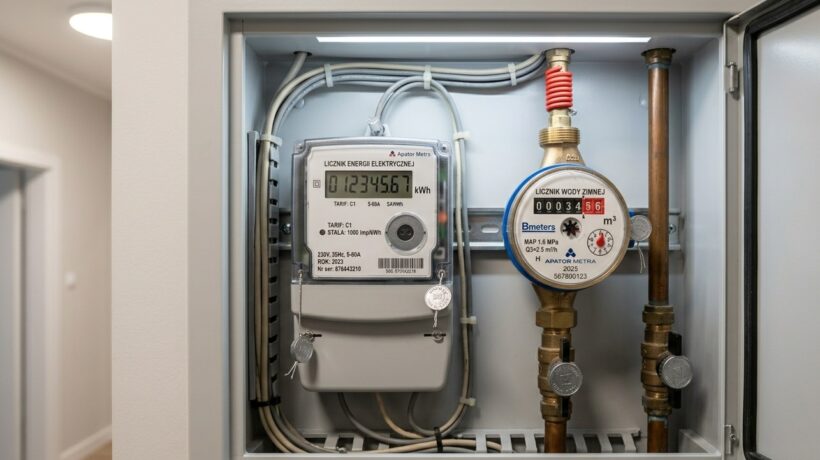
It consists in installing electricity submeters in each room and (more rarely) water meters on the branches of the installation leading to specific rooms.
- Advantages: Everyone pays exactly for what they consume. Ideal for apartments where one student has an air conditioner or cryptocurrency miner, and the other only charges his phone and laptop.
- Cons: The cost of installing sub-meters (although in 2026 they are cheap and often wireless, based on the Zigbee or Wi-Fi protocol).
- Application: High-standard apartments, e.g. in Garnizon or Gdański Brewery.
The “per capita” method (the most popular)
The total cost of the invoice is divided by the number of people living in the premises.
- Advantages: Simple calculations. No investment in equipment required.
- Cons: Generates conflicts. Frugal students feel harmed by people who abuse water or leave the lights on.
- Application: Older blocks in Żabianka or Stogi, where the modernization of the installation is difficult.
Hybrid Method (Recommended)
Fixed costs (meter subscription, fixed transmission fees, garbage fee) are divided equally by the number of people. Variable costs (kWh consumption, m3 of water) are divided according to the meter readings or – in the absence of them – according to a fixed key (e.g. 50% equally, 50% according to the area of the rooms, if the heating does not have dividers).
| Account Element | Division method | Justification |
|---|---|---|
| 🔌 Electricity/gas subscription | Equally per person | Everyone has equal access to the service. |
| ⚡ Energy consumption (kWh) | Sub-counter or equal | In proportion to the use of devices. |
| 🚰 Cold water and wastewater | Equally per person | Difficult to separate without expensive installations. |
| 🌡️ Heating (GPEC) | Heat dividers | It promotes energy savings in individual rooms. |
| 🗑️ Garbage (City fee) | According to the declaration (per person) | The Gdańsk system is based on the number of inhabitants or water consumption. |
| 🌐 Internet (Fibre) | Equally | Fixed cost independent of transfer. |
Electricity billing in Gdańsk – tariff challenges 2026/2027
In the years 2026–2027, students in Gdańsk need to understand the mechanism of dynamic tariffs. Energa-Operator has introduced systems in which electricity during peak hours (e.g. 5:00 p.m. – 9:00 p.m.) is much more expensive than at night or at noon (when photovoltaics are in operation).
How to settle it in a student apartment?
- Educating roommates: It is worth determining that the washing machine or dishwasher is switched on during “cheap” hours.
- Smart Sockets: Apartment owners are increasingly installing smart plugs next to household appliances, which allows for automatic consumption reporting to applications (e.g. Tuya, Home Assistant).
- Weighted Average: If there are no sub-meters, it is safest to take the average from the invoice, but it is worth monitoring whether any of the tenants heat the room with an electric heater outside the heating season.
Water and sewage in Gdańsk – local specificity
Gdańsk, due to the terrain and the need to maintain an extensive infrastructure (including drainage pumping stations), has a specific system of water fees. In 2026, the price per 1 m3 of water and sewage exceeds the amounts known from previous years.
In student apartments, the most common hotspot is the consumption of water by third parties (e.g. partners, roommates who “sleep 5 times a week”). In Gdańsk, a provision on an additional fee for utilities in the case of staying of persons not registered for more than a certain number of days in a month is becoming a standard in lease agreements.
Tools to facilitate billing
In 2027, no one should count the media “on a napkin” in the kitchen anymore. Students and owners have at their disposal:
- Mobile applications (e.g. Splitwise, LiveRent): They allow you to enter amounts from invoices on an ongoing basis and automatically divide them among residents.
- Google Sheets: Simple, free and transparent way. The owner makes the file available to tenants, where meter readings are entered every month.
- Tenant panels with managers: Rental management companies in Gdańsk (serving, for example, buildings at Do Studzienki Street or in the vicinity of the UG campus) offer their own panels, where invoices are automatically processed.
Legal and tax aspects of media accounting: What does the law say?
Understanding the legal foundations is essential to avoid charges of illegal enrichment or violation of tenant rights. In the Polish legal system, the key act is the Act on the Protection of Tenants’ Rights, the Housing Stock of the Commune and on the Amendment of the Civil Code.
Article 6a(1) – Owner-independent fees
According to the regulations, the owner is entitled to charge fees independent of him (i.e. utilities: electricity, gas, water, garbage collection), but only in the amount of the costs actually incurred by the owner. This means that in Gdańsk 2027, the owner cannot add a “margin” to a kilowatt hour of electricity from Energa or a cubic meter of water from GIWK. Any such attempt is unlawful and may result in the obligation to return the overpaid funds with interest.
Documenting expenses (Transparency 2.0)
The landlord is obliged to present a statement of fees with copies of invoices at the tenant’s request. In the era of e-invoices and accounts in customer portals (e.g. My GPEC or e-BOK Energa), it is becoming standard to provide tenants with screenshots or PDF files immediately after they are issued by the operator. If the owner refuses to document the costs, the student has the right to withhold payment of the utility part (after prior written request), although this requires great procedural caution.
Technical metering systems: From analogue to IoT
In 2026, the technology allows for almost laboratory precision in cost distribution, which is especially important in large student apartments (e.g. 5-7 rooms) in Gdańsk tenement houses.
MID certified meters
If you decide to install sub-meters, they must be MID (Measuring Instruments Directive) certified. Only such devices can be the basis for a legal financial settlement between people. Meters without this certificate can only serve as indicative indicators.
Radio and LoRaWAN systems in Gdańsk blocks of flats
Many cooperatives in Zaspa or Przymorze use remote reading systems. For students, this means that they do not have to wait for a collector. Data on water or heat consumption are transmitted by radio.
- Advantage: Possibility to check consumption week by week.
- Application: If you rent an apartment, ask the landlord for access to the login in the property manager’s system. This often allows you to catch, for example, a leaking cistern, which in Gdańsk can generate PLN 500 in additional cost per month.
Smart Plugs – when is it worth it?
In apartments where it is not possible to interfere with the electrical installation (e.g. a rented room in a block of flats from the 70s), students can install their own smart sockets (e.g. Shelly, TP-Link Tapo).
- Refrigerators and freezers: Often, old appliances in rented apartments consume 3-4 times more electricity than modern ones. Monitoring will allow you to prove to the owner that the equipment needs to be replaced.
- Gaming PCs: Modern workstations under load can draw 500-800W. A student using such equipment for 10 hours a day generates a cost of PLN 150-200 per month more than a person with a laptop. Smart plug is the only way to calculate this difference fairly.
The specificity of Gdańsk’s districts and the costs of utilities
The cost of maintaining a room varies depending on which part of Gdansk the property is located in, which is due to the variety of heating systems.
Wrzeszcz and the Old Town: The “electrician’s” trap
Many tenement houses (e.g. at Wajdeloty Street or in the vicinity of Długa Street) are not connected to GPEC. Heating is based on accumulation furnaces or electric heaters.
- Challenge: Electricity bills in winter can jump from PLN 200 to PLN 1200 for the entire apartment.
- Settlement: In such apartments, the division “per capita” is risky. It is necessary to establish strict rules regarding the temperature in the rooms (e.g. 20°C) and to monitor the consumption in each room separately.
Przymorze, Żabianka, Zaspa: Heat from the grid (GPEC)
These are districts dominated by blocks of flats. Here, heating costs are relatively stable, but evaporative or electronic dividers are a problem.
- Mechanism: The divider does not measure the heat consumed in physical units, but only the proportion of consumption of a given radiator in relation to the entire building.
- Problem: The settlement comes once a year. A student who moves out in June may not know that he will have to pay an additional PLN 1000 for the winter period in October.
- Problem: The settlement comes once a year. A student who moves out in June may not know that he will have to pay an additional PLN 1000 for the winter period in October.
New construction (Jasień, Letnica, Morena)
New housing estates (e.g. Robyg or Invest Komfort blocks) are very energy-efficient. Here, utilities are usually the lowest, and meters (heat meters) measure real consumption in gigajoules (GJ). It is the most transparent system for students – you pay exactly for the energy that flows into your room.
Calculation methodology: Case Study
Let’s imagine a 3-room apartment at Do Studzienki Street (near the Gdańsk University of Technology). It is inhabited by: Ania (thrifty), Bartek (computer gamer) and Czarek (he often goes home).
Invoice data for March 2026
- Electricity (Energa): PLN 450 (including PLN 50 fixed fees).
- Water (GIWK): 300 PLN.
- Internet: 90 PLN.
Hybrid billing method:
- Fixed fees: (50 PLN electricity + 90 PLN internet) / 3 people = 46.60 PLN per person.
- Alternating current (400 PLN):
a) Bartek has a sub-meter in the room, which indicated the consumption of 60% of alternating current = 240 PLN.
b) The remaining PLN 160 (refrigerator, bathroom, hallway, rooms of Ania and Czarek) is divided into 3 = PLN 53.30 per person. - Water (300 PLN): There are no sub-counters, so the division is equal = PLN 100 per person.
Summary:
- Bartek: 46.60 + 240 + 53.30 + 100 = 439.90 PLN
- Ania: 46.60 + 53.30 + 100 = 199.90 PLN
- Czarek: 46.60 + 53.30 + 100 = 199.90 PLN
This example shows how a sub-meter protects thrifty people from excessive costs generated by a single roommate. Without the sub-meter, everyone would pay 280 zlotys, which would be extremely unfair for Ania and Czarek.
Media Conflict Management
In 2026, disputes over the media are the most common cause of premature termination of lease agreements in Gdańsk. How to avoid them?
It is worth creating a simple document (annex to the agreement) in which students determine:
- The maximum temperature in the rooms in winter (e.g. 21 degrees).
- Rules for staying overnight (e.g. more than 3 nights a month a person pays 1/4 of the cost of water).
- A ban on the use of farels (electric heaters) in apartments with city heating without the consent of roommates.
Shared responsibility for failures
Micro-leaks often occur in Gdańsk installations (e.g. a valve in a flush-mounted cistern). The agreement should specify that tenants are obliged to report such defects immediately. If a student sees that water has been leaking for a week and does not report it, he may be charged with the entire excess bill.
The role of the owner in the billing process
In 2026, the owner of a student apartment in Gdańsk is no longer just a “rent collector”, but an administrator of resources. Its role is:
- Tool delivery: Share a spreadsheet in the cloud or application.
- Regularity: Entering invoice data without undue delay (up to the 5th day after receipt of the invoice).
- Modernization: Investing in thermostatic faucets and LED lighting, which in the long term increases the attractiveness of the apartment on the competitive Gdańsk market.
When can the owner change the amount of advance payments?
According to the Civil Code, the owner may increase the advance payment for utilities if he has received information about a change in the tariff (e.g. the announcement of new rates by GIWK). However, it must notify tenants in advance and justify the change. A unilateral increase in the “utility fee” without coverage in invoices is treated as an attempt to increase the rent in a hidden way.
Ecology and savings – perspective
In 2026, ESG (Environmental, Social, and Governance) is increasingly important in Gdańsk. Students, as an environmentally conscious group, can use the media to reduce the cost of living.
- Rainwater harvesting (in detached houses): More and more student accommodation in Oliwa or Aniołki uses water recovery systems to water their gardens, which reduces bills.
- Heat Recycling: Simple habits, such as not airing the apartment with the radiators turned on (a common mistake in Gdańsk dormitories), can reduce the heating bill by 15-20%.
- Night fare (G12): If the apartment in Gdańsk has a two-zone tariff, students can program the washing machine and dishwasher for night hours (10:00 p.m. – 6:00 a.m.) or midday (1:00 p.m. – 3:00 p.m.), which at current energy prices gives savings of PLN 30-50 per month per person.
Checklist for the student before signing the contract
Before you rent a room in Wrzeszcz or Przymorze, check:
- Are electricity and water meters individual for the apartment or shared with neighbors?
- Is there a submeter in the room? (If not, ask about the rules of distribution.)
- What is the source of hot water? (Gas stove, GPEC municipal network, or electric boiler?). A boiler is usually the highest cost.
- Does the owner settle utilities on the basis of real invoices, or does he want a fixed amount “in hand”?
- Is there fiber optic in the building and is the fee for it fixed?
- What was the average amount of utility bills in this apartment last winter season? (Ask to see old invoices.)
Frequently asked questions about the media in Gdansk (2026/2027)
What is the fairest way to settle water in a 4-person apartment if one person bathes twice a day?
Billing water without individual water meters in each room (which is rare in blocks of flats in Przymorze or Zaspa) is always based on a certain simplification. The fairest, although technically demanding solution, is to install sub-meters on the inlets to individual batteries, which is practically impossible in a rented apartment.
In 2026, the so-called “gentleman’s agreement” supported by lease regulations will become the standard. If the differences in consumption are glaring, roommates can agree on a different percentage division (e.g. the person who consumes more pays 30% of the bill, the others 23% each). However, in most cases, an equal division is used, accepting the fact that living together involves a certain cost averaging. To avoid conflicts, it is worth installing water aeration aerators, which reduces consumption by about 30-40% without reducing comfort, which in Gdańsk GIWK price conditions translates into real savings of several hundred zlotys per year for the entire apartment.
Can the owner of an apartment in Gdańsk charge a lump sum for utilities and not pay the overpayment?
It depends on the wording of the lease agreement. In Polish law (the Tenants’ Rights Protection Act), the landlord can settle accounts with the tenant in two ways: through service charges (utilities) transferred directly to suppliers or through the landlord, who must settle them on the basis of invoices. If the contract provides for a “lump sum for utilities” without a provision for subsequent settlement, it is a form of remuneration that carries a risk for both parties.
However, in 2026/2027, due to the high volatility of energy prices, most lawyers and real estate market experts in Gdańsk advise against a lump sum. The safest form for a student is the advance system. You pay e.g. PLN 300 for utilities every month, and once a quarter the owner shows invoices from Energia, GPEC and GIWK. If the consumption was lower – you have an overpayment for the next month. If larger – you have to pay extra. Each student has the right to inspect the source invoices. The refusal of the owner to show the bills is an alarm signal and may be the basis for claims.
What to do if your roommate doesn’t pay their share for electricity and water?
This is one of the most difficult scenarios in student life in Gdańsk. From the point of view of the supplier (e.g. Energa), the debtor is the person for whom the contract is issued – usually the owner or one of the tenants who signed the contract for the supply of utilities. In the case of “room rentals”, where everyone has a separate agreement with the landlord, the responsibility for the non-paying tenant usually does not fall on the other students, unless their contracts provide otherwise (joint and several liability).
However, if you rent an apartment as a group (one contract for all), you are jointly and severally liable. In 2027, it is recommended to use the provisions on the deposit, which secures not only damage, but also arrears in the utilities. The most effective prevention method is to raise money for utilities in advance (advance payment system) and to use Splitwise applications, where the debt is publicly visible to the entire group, which puts social pressure. As a last resort, there is the court route (e-court), which is relatively fast in the case of undisputed debts.
How to settle heating with GPEC if I have old, leaky windows in my room?
In districts such as Wrzeszcz or Dolne Miasto, many tenement houses have problems with thermal modernization. If your room is objectively more difficult to heat due to the technical condition of the building, settling according to heat dividers may be very disadvantageous for you. In such a situation, it is worth negotiating with the owner before signing the contract.
An argument may be the fact that it is the owner who is responsible for the technical condition of the premises (Article 662 of the Civil Code). It can be proposed to divide the heating costs according to the size of the room instead of the indications of the dividers, which will distribute the cost of “heat losses” to all residents. Another solution is to ask for windows to be sealed or the rent (base amount) reduced by the estimated difference in heating costs. In 2026, with high energy efficiency standards, apartments with “drafts” should be cheaper, and students are increasingly checking the energy performance certificates of a building before renting.
Who pays for the so-called “common areas” – staircase lighting and elevator?
In Gdańsk, these fees are usually included in the administrative rent to the community or cooperative (e.g. SM Młyniec, SM Przymorze). This rent is paid by the landlord, but most often the tenant passes on its cost to the tenants in the form of a fixed fee.
The division of these costs among students should always be done equally, regardless of whether someone lives in the largest room or in a small “one”. Everyone uses the elevator, intercom or light in the corridor to the same extent. It is important to clearly separate the rental rent (owner’s profit), administrative rent (fees to the cooperative) and utilities according to consumption (metering) in the agreement. Such transparency allows to avoid misunderstandings in the annual settlements of the renovation fund or management costs.
How do dynamic energy tariffs work in 2026 and how to save on them in a student apartment?
Dynamic tariffs are based on the fact that the price of electricity from Energi changes every hour depending on the prices on the Polish Power Exchange. For students in Gdańsk, this means a huge opportunity for savings, but also risk. The most expensive electricity is in the morning (7:00-9:00) and in the evening (17:00-21:00). The cheapest – at night and in the midday hours (especially on sunny weekends).
To account for this, it is best to install a simple energy monitoring system (e.g. Shelly or other smart home solutions). Roommates can arrange to perform energy-intensive activities (baking pizza, washing, drying clothes in a tumble dryer) in “cheap” time windows. If the apartment does not have a smart system, the average price is settled from the invoice, but tenants who consciously generate a load during the most expensive hours should be aware that they are increasing the average cost of kWh for everyone.
How to settle gas in an old tenement house in Wrzeszcz if it is used both for cooking and for heating water?
Gas in Gdańsk (PSG/PGNiG supplier) is often used in older buildings at Wajdeloty Street, Partyzantów Street or in the vicinity of the University of Technology. Settlement is difficult, because there is usually one gas meter.
If the gas is only used for cooking, the cost is low and divided equally. However, if the gas heats the water (a “Junkers” stove), the consumption depends directly on the time spent in the shower. In 2026, the fairest method without installing gas submeters (which is expensive and requires permissions) is to link gas consumption to water consumption. Whoever consumes more water automatically uses more gas to heat it. Proportional division of the gas bill according to water consumption (if there are water meters in the rooms) or simply equally (with a similar lifestyle) are the most common practices.
Is it possible to disconnect the media for a student who does not pay?
The landlord cannot arbitrarily disconnect the tenant’s electricity, water or gas, even if the tenant is in arrears with the fees. Such an action in Polish law (Article 191(1a) of the Criminal Code) may be considered as obstructing the use of the premises and is punishable by imprisonment.
In Gdańsk, as in the whole of Poland, the only legal way is to terminate the lease agreement in accordance with the statutory deadlines (first a call for payment, an additional month, then termination) and an eviction and payment process. Roommates also cannot “cut off” a colleague from the bathroom or kitchen. The solution is quick intervention by the owner and mediation. That is why it is so important to check with whom you sign the contract and whether each tenant has a steady source of income (or a guarantee from your parents).
How to settle utilities when changing tenants during the month?
In Gdańsk’s academic reality, turnover is high, especially around February (the end of the winter semester). The best practice is the so-called “zero reading”. On the day the old tenant moves out and a new one is introduced, the readings of all meters (electricity, water, gas, heat dividers) are written down.
The cost of utilities for a given month is divided proportionally to the number of days: the old tenant pays for the days from the beginning of the settlement period to the day the keys are handed over, the new tenant pays for the others. Landlords of apartments in Gdańsk often use handover protocols in digital form (photos of meters sent to e-mail/WhatsApp), which is irrefutable evidence in the event of a dispute.