


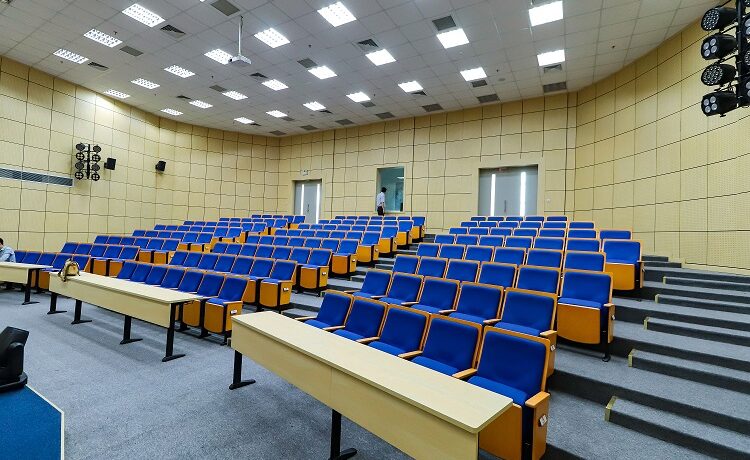
What Are College Classes Like? Lectures vs. Seminars Explained
Studies differ from secondary school in the lack of a fixed lesson plan, the division of classes into theoretical (lectures) and practical forms (exercises, laboratories) and independence in learning. The lecture is an auditorium class for the whole year, where the professor presents the theory, while the exercises take place in small groups, require active participation, mandatory attendance and preparation from classes to classes.
The most important information at a glance:
Lecture: Mass (100–300 people), theory, attendance often optional (although check the syllabus!), ends with an exam in the session.
Exercises / Laboratories: Small groups (15–30 people), practice, attendance is mandatory (max 1–2 unexcused per semester), passed on the basis of colloquia and entrance exams.
Grading system: No current grades from whiteboard answers. The semester result depends on 1-2 colloquia and the exam in the session (January/February and June).
University systems: Instead of an e-diary (Librus/Vulcan), you use the USOSweb system (or e-SGH / MojaPG), where you check the plan, grades and register for courses.
Culture Shock: 7 Major Differences Between High School and College
Moving from high school or technical school to university is not just about changing a building. This is a complete change in the philosophy of education. In high school, the teacher led you by the hand, kept an eye on your attendance and reminded you of your tests. At university, no one will ask why you were not in class – you will feel the consequences only during the session.
September 20, 2026
1. Anonymity vs. working in microgroups
At the lectures in the Main Hall, you are one of 150 students. The lecturer usually does not know your name. However, during exercises or laboratories, you end up in a group of 15-20 people, where the instructor quickly remembers unprepared people.
2. No daily evaluations
There are no current ratings on a scale of 1-6 entered every week. The grade in the subject results from the resultant: the final colloquium, the project and the final exam.
3. Windows and a jerky schedule
The study plan is not continuous. You can have the first classes at 8:00 a.m. at the University of Technology Square, then 4 hours of “windows” (time for studying in the library or coffee), and the next classes at 2:00 p.m. at the South Campus in Mokotów.
4. A session instead of grades
Studies at the university are cumulative in two periods of the year: the winter session (late January and early February) and the summer session (June). During the semester you have relative peace, but during the 2 weeks of the session you have to pass 4-6 difficult exams.
Exercises, laboratories, seminar – how do they differ?
The basic trap for first-year students is the lack of differentiation between the forms of classes. The fact that you pass the exercises in a given subject does not mean that you have passed the whole subject – you usually still have to pass the lecture exam.
Comparative table of forms of classes at studies:
| Feature | Lecture (ex) | Exercises (Thu) | Laboratories (Lab) | Seminar (SEM) |
| Number of people | 100 – 300 people (whole year) | 15 – 30 people (group) | 10 – 15 people | 5 – 15 people |
| Presence | Often optional | Absolutely mandatory | Absolutely mandatory | Mandatory |
| Form of work | Listening, taking notes | Solving problems, discussion | Work on equipment / coding | Presentation of your own work |
| Who is driving? | Professor, habilitated doctor | Doctor, Assistant, MSc | MSc, Engineer, PhD student | Supervisor (Professor / Dr hab.) |
| Method of passing | Session Exam (Written/Oral) | Colloquium, entrance tickets, papers | Reports (so-called laboratories) | Writing a chapter of the paper |
1. Lecture (W)
The lecture has the character of a monologue. The lecturer (often a professor with many years of achievements) presents the theoretical foundations of the field.
Is it worth walking? Definitely yes. Although the attendance list at lectures is rare, professors often give “exam questions” in lectures that are not in scripts or presentations.
Tip: Lecture notes are worth their weight in gold during a session.
2. Exercises (auditorium / blackboard)
The exercises are a practical test of the theory from the lecture. You recalculate formulas, analyze legal cases (case studies), translate text or discuss.
Attendance rule: By default, 1 unexcused absence per semester is allowed. Exceeding this limit means that you will not be admitted to the final colloquium and will have to repeat the course.
Entry cards: Short, 5-minute quizzes at the beginning of the previous week’s knowledge of the material.
3. Laboratories and Projects (Lab/Proj)
They are found mainly at technical universities (e.g. Warsaw University of Technology), natural sciences (SGGW) and medical universities (MUW). You work at measuring equipment, in a chemical laboratory or write code at a computer workstation.
You are given a specific measurement exercise to perform, from which you must prepare and defend the so-called report (report).
4. Seminars (SEM)
The form of classes in the last years of studies (bachelor’s, engineer’s, master’s). You meet in an intimate group with your supervisor, and the aim of the class is to gradually write and correct your thesis.
Logistics and movement around campuses in Warsaw
Warsaw universities rarely fit in one building. Studying in the capital requires efficient mastery of public transport (WTP Warsaw) and planning commuting between faculties.
Logistical challenges of major universities:
University of Warsaw (UW): Humanities classes take place on the historic Main Campus (Krakowskie Przedmieście / Nowy Świat – access by metro M2 to the Nowy Świat-Uniwersytet station). However, the faculties of science (MIMUW, Biology, Chemistry, Physics) are located on the Ochota Campus (Pasteura / Banacha Street). The journey by bus 128 or 175 from Krakowskie Przedmieście to Ochota takes about 25-35 minutes during rush hours.
Warsaw University of Technology (WUT): The heart of the university is the Central Campus (Plac Politechniki – M1 Politechnika metro station). Some of the faculties (e.g. Production Engineering, Faculty of Automobiles and Working Machines) are located on the South Campus in Mokotów (Narbutta Street). The fastest connection between campuses is provided by tram line 17 or 33.
Warsaw School of Economics (SGH): Located compactly at Niepodległości Avenue (Mokotów). Buildings A, B, C and the Main Building are located right next to the M1 Pole Mokotowskie metro station.
Warsaw University of Life Sciences (Ursynów): A huge, green campus in Ursynów (Nowoursynowska Street). Access by metro M1 to the Służew or Ursynów station, and then by bus 193 or 401.
Commuting between departments, casual work, settling bills with roommates at the dormitory and keeping an eye on deadlines for submitting reports can be overwhelming in the first year. To avoid chaos, check out how the comprehensive application for students Student360 works – it allows you to control the class calendar and schedule at work, convert ECTS credits, store lecture notes on a 5 GB disk and efficiently settle fees and meter readings in a rented apartment in one place.
Academic title – how to address teachers?
A mistake in a scientific title at a university is the easiest way to make a mistake. In high school, every teacher was called “Professor”. Only a few are entitled to the title of professor at the university.
Rules for writing e-mails to lecturers (E-mail savoir-vivre):
- Never start an email with the word “Hello!”. In English, the word “hello” means that the host welcomes a guest to his home. In an academic relationship, this is treated as tactlessness.
- Start with: Dear Doctor, / Dear Professor,.
- In the body of the email, briefly present your problem, provide your name, surname, album (index) number, field of study, year and exercise group.
- End with the phrase: Yours sincerely, or Yours sincerely.
How to survive the first session and avoid rework?
An exam session is a test of your work organization. The first winter session (January/February) takes the biggest toll on first-year students, mainly due to last-minute postponement.
Tips for surviving the first session:
- Get a “Zero” Exam: Lecturers often offer a so-called zero-date exam (before the official session) for people who have been active in the exercises. Take this chance – if you don’t pass, you usually don’t miss the first official deadline.
- Collect notes from the first week: Solving exam tasks from previous years (the so-called “question databases” circulating in student groups of the year) is the most effective method of preparing for colloquia.
- Keep an eye on the deadlines in USOS: Missing the registration for the exam in the electronic system may result in a lack of grade in the protocol and an unsatisfactory grade.
Organizing your time, storing class scripts, and keeping an eye on your earnings from work on weekends becomes a lot easier when you have all your tools in one place. To avoid getting lost in the crowd of responsibilities, try the Student360 study and daily life management app, which helps you build effective learning habits, keep an eye on the dates of colloquia and take care of your student budget.
Frequently Asked Questions of First-Year Students
1. What happens if I miss a lecture or exercise?
In lectures, entering after time is usually not a problem – you enter quietly and take a seat at the back of the auditorium. Being late for exercises or laboratories may result in not being allowed to attend classes (especially in OHS laboratories at WUT or MUW) or not being able to write an entry form.
2. Is mLegitymacja studentcka in the mObywatel application enough?
Yes. In the academic year 2026/2027, mStudent ID on your phone is fully equivalent to the traditional plastic Electronic Student ID (ELS). It entitles you to 51% discounts on PKP fares and discounts in public transport (e.g. ZTM Warszawa student tickets).
3. What should I do if I get sick and miss mandatory exercise?
You must see a doctor as soon as possible and obtain a sick leave (L4). When you return to the university, you present the dismissal to the lecturer (you usually have 7 days to do so). The lecturer will set a date and form of working on the outstanding material (e.g. writing an additional paper or responding on duty).
4. What are “windows” in the timetable and how to use them?
A “window” is a break between one class and another during the same day (lasting from 1.5 to even 4 hours). In Warsaw, students spend their windows in university libraries (e.g. BUW in Powiśle, BG WUT on Plac Politechniki), student zones or nearby cafes, using this time to study or write reports.
5. Are there interviews for parents at university?
No. Upon reaching the age of 18 and joining the legal group of students, the university protects your personal data (GDPR). Information about your grades, attendances or possible deletion from the list of students is made available only to you. The Dean’s Office has no right to provide such information to your parents without your written authorization.
6. What is the difference between a colloquium and an exam?
A colloquium (equivalent to a test) includes material from exercises or laboratories during the semester. The exam is the final, summarizing test of knowledge from the entire lecture, taking place only during the official exam session.
Studies are a time of great freedom, but also full responsibility for one’s own results. To make your first semester in Warsaw stress-free:
- Log in to USOSweb and carefully analyze your timetable and the rules for passing the course syllabus.
- Install the Jakdojade / Mobilet app and buy the Warsaw Student Ticket (encoded on ELS or in the WTP app).
- Join your year’s group on Facebook/Discord to stay up to date with question databases and information from the Dean’s Office.
What to do now?
Download the syllabi of your first subjects, check the room and building numbers on the campus map and prepare a small notebook or application to organize the plan – your first lecture is coming soon!