


How to meet people at university in Warsaw?
Warsaw is a city of enormous opportunities, but for a new student it may seem like an overwhelming, anonymous labyrinth. The scale of the local universities – from the mighty University of Warsaw (UW), through the Warsaw University of Technology (WUT), to the Warsaw School of Economics (SGH) – makes it easy to disappear into the crowd at lectures without an active approach. Building a network of contacts in the capital is not only a matter of social comfort, but also the foundation of a future professional career.
In this article, you will learn how to effectively break the ice, where to look for valuable relationships and how to use the specifics of Warsaw universities to make your student life full of inspiring people.
Integration trips, i.e. “Kindergartens” and AdaptiCamps
The most effective process of getting to know people begins even before the official matriculation. Warsaw-centric universities have been betting on the so-called zero trips for years.
September 20, 2026
Why is it worth going to AdaptiCamp?
AdaptiCamp (organized, m.in, by the Student Government of the University of Warsaw or WUT) is a several-day trip to one of the holiday resorts (often in Masuria or in the mountains), dedicated exclusively to newly admitted students.
- Common denominator: Everyone is in the same situation – they don’t know anyone and feel similar insecurity. This is the perfect moment to start a conversation naturally.
- Relationship intensity: A few days spent playing field games, workshops and evening integrations builds bonds that often last throughout the five years of study.
- Contact with older years: The animators on such trips are senior students. This is your first source of knowledge about how to survive a session with a particular professor or where to eat cheaply and well in Warsaw.
Faculty “kindergartens”
Some faculties, e.g. at the Warsaw School of Economics or Medicine (WUM), organize smaller, more profiled trips. It is here that you will meet the people with whom you will sit on the same bench for the coming years. Integration in a smaller group is conducive to the creation of durable “packages”.
Life in a dormitory – the sociology of the “shared kitchen”
If you have the option to live in a student dormitory, you get automatic access to a powerful community. In Warsaw, dormitories such as Riviera (WUT), Jelonek (UW) or Sabinki (SGH) are legends of integration.
The kitchen as a command center
In Warsaw dormitories, social life rarely takes place behind closed room doors. These communal kitchens are where you will meet people from different faculties, countries, and cultures.
- Strategy: Instead of cooking with the headphones closed, ask the person next to you for a recipe or opinion about a nearby supermarket. In the dormitory, every “hello” can turn into a discussion lasting hours.
- Teaching Together: Before the session, the dormitories turn into large tutoring centers. Helping someone understand statistics or logic is one of the fastest ways to gain loyal friends.
Residents’ Councils and Internal Events
The dormitories organize their own e-sports tournaments, watching matches together or having a barbecue in front of the building (e.g. in the green areas next to the dormitories in Ochota). By getting involved in organizing them, you become a recognizable figure in the community.
Scientific clubs and student organizations – targeted networking
Warsaw is a city of ambitious people. If you want to meet people with similar interests, science clubs are unbeatable.
SGH and business networking
At SGH, organizations such as SKN (Student Scientific Clubs) or CEMS Club operate like small corporations. Here you will meet people focused on success, with whom you will implement projects for the largest companies in Warsaw. Working together on a Case Study builds deeper relationships than a chance meeting at a club.
Technical clubs at WUT
At the Warsaw University of Technology, integration often takes place in workshops. Building a Formula Student car or working on rockets in the Astronaut Circle requires hundreds of hours of cooperation. It is an extremely strong social bond.
University-wide organizations (NZS, AIESEC, ESN)
- ESN (Erasmus Student Network): A perfect place if you want to meet students from all over the world studying in Warsaw. As a “Buddha”, you take care of a foreigner, helping him find his way in the capital, and at the same time you enter an international environment.
- NZS (Independent Students’ Association): Organizes numerous social and cultural actions (e.g. Wampiriada). Working on projects is a natural opportunity to integrate with people from different universities.
The specificity of Warsaw locations – where do you “go”?
Warsaw has its own geographical centers of integration, which change with the seasons.
Vistula Boulevards and “Stairs”
From April to September, it is the most important place on the student map of Warsaw. Thousands of students from different universities spend their evenings here.
- How to integrate? The atmosphere on the Boulevards is extremely relaxed. Playing frisbee together or asking to borrow an opener are standard “ice-breakers”. This place is conducive to meeting people outside your major.
Mokotowskie Field
An ideal place for students of the Warsaw School of Economics and WUT (due to the proximity of campuses). Spring picnics and sports together (running, rollerblading, volleyball) are a great opportunity to join a group. “Can I play with you?” on the volleyball court is the easiest way to make a new acquaintance.
Iconic Student Clubs
Warsaw has a network of clubs directly related to universities:
- Renovation and Riviera (PW): This is where classic Thursday integrations take place.
- Barn: Although it is mainly a concert hall, the student events held there attract people from all over Warsaw.
- Proxima (UW): A meeting place for students from the main campus at Krakowskie Przedmieście.
Facebook and Discord groups – digital launch
Before you meet people face-to-face, you need to make a name for yourself in the digital space. Each year, field of study and dean’s group in Warsaw has its own Facebook group or Discord server.
- Be active but factual: Answer questions about the timetable, share notes, take part in surveys about the exits after lectures.
- Initiate meetings: If you see that no one suggests going out for a beer or coffee after a difficult colloquium – do it. Many people are waiting for this first signal.
- “Warsaw Students” groups: There are group-wide groups for the whole city, where people are looking for partners for squash, going to the cinema or studying together at the University Library (BUW).
Sport and AD – joint physical effort
The Academic Sports Association (AZS) is one of the largest organizations in Poland. Sports sections at Warsaw universities are extremely extensive.
- Sections at each level: You don’t have to be a pro. You can join the skiing, swimming or climbing section at the amateur level.
- Joint trips to AMPs: The Polish Academic Championships are several-day trips that integrate the sports community from all over Warsaw. Nothing unites us as much as competing together and representing the colors of their university.
Student Government – meet the leaders
Involvement in the Student Government is an entry into the social elite of the university. As a member of a cultural or social commission, you are in contact with hundreds of people.
- Organization of the Juwenalia: This is the biggest logistical and social challenge. By cooperating in the organization of concerts at Pole Mokotowskie or Sowiński Park, you will meet people from the event industry, artists and student leaders from all over the capital.
How to make friends quickly in Warsaw?
- Don’t run home for the weekend: If you come from outside Warsaw, stay in the capital for at least the first two weekends of October. This is when most integration events take place.
- Sign up for BUW: The University Library in Warsaw (BUW) is a cult place. Learning together in the local gardens or in the work zone is a great opportunity to meet someone “over a book”.
- Become a Group Governor: It’s a feature that requires accountability, but it automatically makes everyone in the group know you and need to keep in touch with you.
- Go to dinners at “Milkmen” or cheap canteens: In the vicinity of the UW and WUT campuses there are iconic milk bars. You often sit there with someone at a table – it’s a natural opportunity to talk.
- Ask for directions (even if you know Google Maps): It is easy to get lost on the campuses of Warsaw universities. Asking about a specific room is a classic conversation starter.
- Use language courses and PE: These are classes where you meet people from other faculties. Use pairs exercises to get to know someone outside your “bubble”.
- Take care of your LinkedIn profile: In Warsaw, student life is intertwined with professional life. Inviting someone to your network after an interesting meeting of a scientific circle is a professional way to maintain relationships.
- Participate in cultural events: Warsaw offers free admission to museums (e.g. Thursdays at the National Museum) or an open-air cinema. Offer the group to go out together.
- Don’t turn down the first invitations: Even if you’re tired, go for your first coffee after class. The first two weeks build a social structure for the rest of the semester.
- Be “face to face”: Don’t hide in your phone during breaks. Look around – someone next to you probably feels a little uncomfortable and will be happy to talk.
International and intercollegiate integration – go beyond your faculty
Warsaw, as the largest academic center in Poland, attracts thousands of students from abroad. This creates a unique opportunity to build an international network of contacts without leaving the country. Integration with foreigners is not only about polishing the language, but above all about meeting people with a completely different view of the world.
Tandem Language Exchange programs
Many Warsaw universities, as well as cafes in the vicinity of the City Center and the Old Town, organize the so-called Tandem.
- What is it about? You meet a person who wants to learn your language, and in return, teaches you theirs. In Warsaw, such meetings often turn into regular outings to pubs or joint sightseeing of the city.
- Where to look? Check out the Facebook groups: “Tandem Warszawa” or “Language Exchange Warsaw”. They often take place in places such as the Południk Zero café or public libraries.
Intercollegiate Events
Don’t close yourself off only to your university’s events. Inter-university integrations are a standard in Warsaw.
- The Great Integration of Warsaw: These are cyclical club events dedicated to students of all the capital’s universities. It is here that a medical student from the Medical University of Warsaw can meet a future lawyer from Kozminski or an engineer from the Warsaw University of Technology.
- Joint research projects: If you are interested in science, look for intercollegiate science clubs. Examples include projects related to biotechnology or renewable energy, where students from different universities join forces to create innovative solutions.
Casual work in Warsaw
Many students in Warsaw work to finance the cost of living in the capital. However, work can be more than just a source of income – it’s one of the most effective places to meet people.
Where to work to meet other students?
- Gastronomy in student areas: Working as a waiter or barista in the vicinity of Nowy Świat, Krakowskie Przedmieście or Plac Zbawiciela guarantees that your team will consist mainly of peers studying in Warsaw. Working together under time pressure brings people incredibly closer.
- Hostess / Promoter: Frequent events in centers such as EXPO XXI or PGE Narodowy require a large number of temporary workers. These are short but intense assignments during which you will meet dozens of people from different parts of the city.
- Cinemas and cultural institutions: Work in studio cinemas (e.g. Muranów Cinema, Luna) attracts a specific group of students with humanistic and artistic interests.
Traditional Academic Corporations
Warsaw has a rich tradition of academic corporations (e.g. Sarmatia, Arkonia, Respublica). This is a specific, traditional model of integration, which differs from loose scientific circles.
What does membership in a corporation give?
- Strong hierarchy and brotherhood: Corporations are based on lifelong ties. If you are looking for acquaintances that will last for decades and are based on shared values and a code of honor, this is the path for you.
- Intergenerational networking: In corporations, you meet not only students, but also “philistines” – older members who are often influential people in the Warsaw world of business, law or politics. This is a powerful support at the start of your career.
Hobbies and subcultures – thematic meetings
If you have specific interests, Warsaw offers dozens of places where you can meet people with the same passion.
Board games and esports
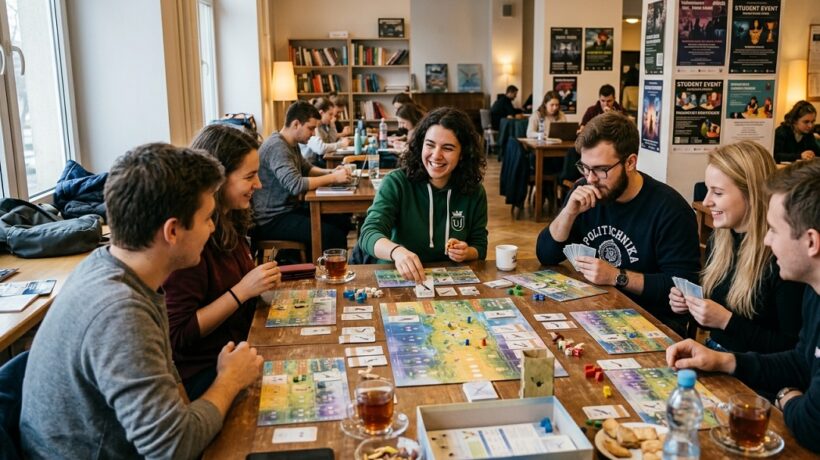
- Paradox Cafe or Cybermachina: These are places where a student-fan of board games or video games will feel at home. Many people come there solo and join the tables – this is a socially acceptable norm. Regular tournaments and “game nights” are organized there, which are a natural opportunity for integration.
- Fantasy Clubs: They operate dynamically at universities (e.g. the Fantasy Club at the Warsaw University of Technology). Joint RPG sessions are hours of conversation and cooperation, which builds very strong friendships.
Niche and urban sports
- Climbing walls (e.g. Macaque, Murall) Climbing in Warsaw has become extremely popular among students. It’s a very social sport – by belaying the other person or coming up with a “patent” for passing the route, you naturally start a conversation.
- Urban Dance and Dance Schools: Dance schools in the vicinity of Śródmieście offer courses dedicated to students. Dancing in pairs (salsa, bachata) is one of the fastest ways to break physical barriers and shyness.
Urban volunteering – integration by helping
Warsaw, as the capital, hosts the largest social events in the country. Volunteering is a place for people with a high level of empathy and energy.
- Sporting events: The Warsaw Marathon or national team matches at PGE Narodowy need hundreds of volunteers. It is an opportunity to meet people with a sporting flair.
- Cultural institutions: Volunteering at the Warsaw Uprising Museum or the Copernicus Science Centre attracts ambitious people, often enthusiasts of history or science. Joint management of exhibitions or taking care of guests is an excellent school of interpersonal relationships.
Co-learning and co-learning – where to learn and meet people?
In 2026, learning in isolation is a thing of the past. Warsaw students focus on co-learning.
Co-working spaces
- Public and university libraries: BUW is a classic, but it is also worth checking out the modern National Library in Pole Mokotowskie or the library in the Copernicus Science Centre. The sight of a person with the same textbook that you are facing is the perfect starting point for a conversation: “Do you have a problem with this chapter too?”
- Catering halls (Norblin, Koszyki): Although they are associated with food, many people work and study there during the day. The atmosphere of “hype” is conducive to less formal acquaintances.
Frequently Asked Questions
Is it difficult to meet people in such a big city as Warsaw?
Warsaw may seem cold, but the student environment is very open. The key is to go beyond the “home-university” scheme. The use of scientific circles and student organizations shortens the distance.
Do I have a chance for good integration if I am not in a dormitory?
Of course. Most students in Warsaw rent rooms or live with their parents. Additional activities are crucial: local government, sports (AZS) and spending time together after lectures in places such as the Vistula Boulevards or cafes at Zbawiciela Square.
Which student organizations in Warsaw are the most active?
The most active are the Student Self-Governments (UW, WUT, SGH), NZS, AIESEC (leadership development) and ESN (international integration). It is also worth checking out smaller hobby organizations, such as discussion or film clubs.
Is it worth going to AdaptiCamp if I’m an introvert?
Yes. The programs of these trips are structured in such a way as to facilitate integration for everyone. You don’t have to be the soul of the company – joint group tasks force interaction in controlled, friendly conditions.
How to find friends with specific, niche interests?
Look for science clubs. Warsaw has circles dedicated to everything – from ant breeding, through space law, to historical reconstructions. You can find them in the lists on the university’s websites.
Where do students in Warsaw most often go out in the evenings?
In summer, the Vistula Boulevards and club-cafés on the Vistula River reign supreme. Throughout the year, the surroundings of Mazowiecka Street (clubs), Parkingowa Street, Zbawiciela Square and the iconic bars on Nowy Świat Street (the so-called Pavilions) are popular.
Does networking at university in Warsaw really help at work?
In the capital, the labor market is based on recommendations. Friends from the scientific circle or local government are often people who will work in top companies in 2-3 years and can recommend you for a given position.
Your future starts with relationships
Meeting people at university in Warsaw is a process that requires courage and initiative, but it pays off more than once. The capital offers an infinite number of points of contact – from modern scientific centers to informal meetings on the Vistula. Remember that everyone you meet at the first lecture is probably just as curious about you as you are about him.
Take the first step, check the dates of the next team-building trip or sign up for the study club you are interested in. Student life in Warsaw is too short to spend in isolation.