Nursing studies in Warsaw: Which university is the best choice?
The decision to choose nursing studies in Warsaw is a step towards one of the most stable and at the same time the most demanding professional paths in the capital. Warsaw, as the largest medical center in Poland, offers unique conditions for learning – access to highly specialized teaching hospitals, modern medical simulation centers and a wide labor market, from the public sector to prestigious private clinics.
When choosing a nursing degree in Warsaw, you must prepare for an intensive curriculum that combines rigorous theoretical knowledge with thousands of hours of practice. The capital places high demands on you, but in return it gives you the chance to learn from the country’s leading experts and work on the latest generation of medical equipment.
Ranking and characteristics of the university
The choice of university determines not only the prestige of the diploma, but above all the clinical base where you will take practical classes. Warsaw is dominated by several centers that have been educating medical staff for years.
Medical University of Warsaw (WUM) – a leader in medical education
- The Medical University of Warsaw is the most prestigious medical facility in the region. The Faculty of Health Sciences of the Medical University of Warsaw offers studies in the field of nursing, which have been at the top of the rankings for years.
- Advantages: Access to our own teaching hospitals (e.g. Central Clinical Hospital at Banacha Street, Clinical Hospital of the Infant Jesus), which minimizes the time of commuting between theory and practice.
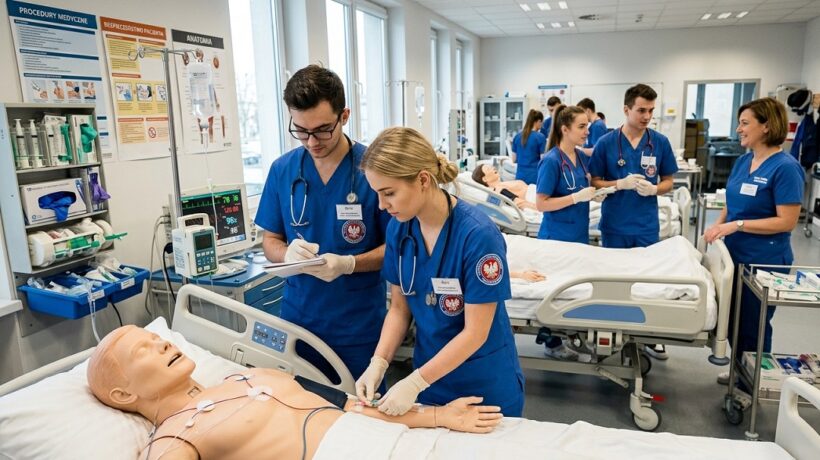
- Infrastructure: A modern Medical Simulation Center, where you can practice life-saving procedures on advanced phantoms before entering the ward.
September 20, 2026
Mazovia University of Applied Sciences (formerly Collegium Mazovia)
This is a proposal for people looking for an alternative to public universities, often offering a more flexible approach to the student while maintaining ministerial standards.
- Program: Focused on practical preparation for the profession, with a strong focus on patient care in the home environment and geriatrics.
Lazarski University and other non-public universities
In recent years, the educational market in Warsaw has been enriched by the offer of private universities that invest in medical faculties.
- Why is it worth it? Often smaller exercise groups and a modern approach to teaching soft skills, such as communication with the patient and coping with stress, which is crucial in Warsaw – a city with a high pace of life – is crucial.
Curriculum: What does a step-by-step nursing degree look like?
Studies in the field of nursing are two-cycle: bachelor’s (first-cycle) and master’s (second-cycle) studies. The program is strictly regulated by educational standards, which guarantees the recognition of the diploma throughout the European Union.
Undergraduate Degree (6 semesters)
Your goal at this stage is to obtain the right to practice the profession. The program includes a minimum of 4720 hours of classes, half of which are practical classes and internships.
- Basic Sciences: Anatomy, physiology, pathology, genetics – the foundations necessary to understand the functioning of the body.
- Field studies: Basics of nursing, ethics of the profession, health promotion.
- Clinical Sciences: Nursing in internal medicine, surgery, pediatrics, psychiatry, and obstetrics. This is where you will spend most of your time in Warsaw hospitals, learning how to work directly with the patient.
Master’s degree (4 semesters)
They focus on management in nursing, scientific research, and advanced clinical practice. Choosing Warsaw at this stage allows you to combine studies with professional work, which is a common practice among the capital’s students.
Clinical internships in Warsaw – the heart of education
What distinguishes nursing studies in Warsaw is the database of medical facilities. Professional internships are carried out in the most important medical units in Poland.
- Clinical Hospitals of the Medical University of Warsaw: This is where the most difficult cases from all over the country go. As a student, you have the opportunity to observe pioneering surgeries and learn how to care for patients in critical conditions.
- Children’s Memorial Health Institute: The most important paediatric centre, where you will gain unique competences in caring for the youngest patients.
- Municipal hospitals (e.g. Bródnowski Hospital, Bielański Hospital): They offer contact with the patient in the conditions of everyday work of emergency and internal medicine departments, which perfectly prepares them for the realities of the profession.
Professional development prospects in the capital
Graduating from nursing studies in Warsaw opens doors that may be more difficult to access in other cities. The Warsaw market is insatiable, and the demand for qualified personnel is growing every year.
Working in the public vs private sector
- Public hospitals: They offer stability, internship allowances and the opportunity to quickly gain experience in specialized departments.
- Private sector (Medicover, Lux Med, aesthetic medicine clinics): Warsaw is a center of private medical care. Nurses find employment here in modern medical centers, where the emphasis is on the comfort of work and premium patient service.
Specialization Paths
As a nurse practitioner in Warsaw, you can choose from numerous specialist and qualification courses that are delivered on-site. The most sought-after specializations in the capital are:
- Anesthesia and Intensive Care Nursing,
- Operational Nursing,
- Oncology Nursing,
- Cardiac Nursing.
Cost of Study and Admission
Admission to public studies (WUM) is based on the results of the matura exam. Key subjects are usually biology, chemistry or mathematics. In Warsaw, the point thresholds for full-time studies are one of the highest in the country, so it is worth taking care of a high score in extended subjects.
Part-time and private studies:
- The tuition fee for a semester at non-public universities in Warsaw ranges from PLN 4,000 to PLN 6,500.
- Many universities offer scholarship schemes and partnerships with hospitals that fund tuition fees in exchange for a commitment to work after graduation.
Practical tips for nursing candidates
- Location matters: When choosing a university, check where the internship takes place. Warsaw is vast, and clinical classes often start at 7:00 a.m. Choosing a university with a clinical base in one area (e.g. the Ochota campus) will save you hours spent in traffic jams.
- Invest in shoes and health: The internship is a 12-hour standing shift. Professional medical footwear is the first expense you should not save on.
- Get involved in science circles: Warsaw universities give access to international conferences. Participation in a scientific club (e.g. operational nursing) is a chance to get to know the environment of future employers in advance.
- Language Learning: Warsaw is an international city. Knowledge of English at a medical level will allow you to work with a foreign patient and opens the way to participate in exchange programs such as Erasmus+.
Modern Medical Simulation Centers (CSMs)
In 2026, nursing education in the capital is no longer based solely on bedside classes. A key element of nursing studies in Warsaw are advanced Medical Simulation Centers. It is here, in controlled conditions, that you will learn to react in situations of extreme threat to life.
- High Fidelity: The Medical University of Warsaw and universities such as the Mazovia University have phantoms that breathe, bleed, react to medications, and even blink and speak. Medical simulation allows you to make mistakes where you do not risk the patient’s health.
- Emergency and ICU scenarios: During classes at CSM, you will practice working in a therapeutic team in a virtual Hospital Emergency Department. You will learn how to use a defibrillator, a ventilator and cardiac monitors, which are standard in Warsaw clinical facilities.
- Debriefing: Each session ends with an analysis of the video recording. This is the most important moment of learning, in which you and your instructor evaluate your communication with the team and the precision of the procedures performed.
Student Scientific Clubs (SKN)
Warsaw is a city where competition on the labor market begins at the university level. If you want to work in the most prestigious departments, such as cardiac surgery in Anin or transplantology in Banach, you must be active beyond the study program.
- SKN at the Clinics of the Medical University of Warsaw: Joining the scientific circle of operational or anesthesiological nursing allows you to participate in scientific research and write articles for scoring medical journals.
- Medical Conferences: When studying in Warsaw, you are closest to conference centers (e.g. EXPO XXI), where nationwide nursing conventions are held. Participating in them as a volunteer or speaker builds your professional networking.
- Medical Volunteering: Warsaw hospices and foundations (e.g. the Warsaw Children’s Hospice Foundation) are often looking for nursing students to help. This is an invaluable experience in palliative care that is highly respected by future employers.
Bridging Nursing in Warsaw
The capital is also an education center for people who already have a nursing degree (e.g. after medical high school or university), but want to complete their education to the bachelor’s level. Bridging nursing studies in Warsaw are very popular due to the adaptation of schedules to shift work in hospitals.
- Flexibility: Non-public universities in Warsaw offer weekend conventions or in a hybrid system, allowing you to continue working full-time.
- Fast Track: Depending on your basic education, these studies can last from 2 to 3 semesters.
- Financial benefits: Improving qualifications in Warsaw’s healthcare entities is associated with an obligatory increase in remuneration in accordance with the Act on Minimum Wages in Health Care.
Warsaw District Chamber of Nurses and Midwives (WOIPiP)
Graduating is only half the way. To work legally, you must obtain a Right to Practice the Profession (PWZ). In Warsaw, this process is carried out by the Warsaw Regional Chamber of Nurses and Midwives at Żelazna Street.
- Registration: As a graduate of a Warsaw university, you submit an application for entry in the register. WOIPiP is also a place where you will return for referrals to specialist courses.
- Postgraduate training: Warsaw offers the widest range of qualification courses (e.g. in the field of dialysis or nephrological nursing) and specialist courses (e.g. ECG recording and interpretation).
- Legal and ethical support: The Chamber acts as your professional self-government, offering legal assistance in the event of disputes with your employer or patient.
Scholarship Programs and Financial Support for Nursing Students
Studying in Warsaw is associated with a higher cost of living, so it is worth knowing the available sources of financing dedicated to future medical staff.
- Scholarship of the President of m.st Warsaw: Dedicated to students achieving high academic results and engaging in social projects for the benefit of the city.
- Scholarships funded by hospitals: Many Warsaw institutions (e.g. Wolski Hospital or Prague Hospital) offer their own scholarship programs. In exchange for monthly financial support (up to PLN 2000), the student undertakes to take up a job in a given institution after obtaining PWZ.
- Medical Degree Loans: Although mainly associated with medical studies, some banks cooperating with Warsaw universities offer preferential credit lines for nursing students, which can be partially redeemed if you work in the public sector in Warsaw.
Working as a nurse in Warsaw medical corporations
Warsaw dominates in terms of the presence of headquarters of large medical groups. Working after nursing in Warsaw does not have to be limited to working at the patient’s bedside in a hospital.
- Coordinating Nurse / Case Manager: In private networks (Medicover, Enel-Med), nurses manage the patient path, coordinate preventive examinations and conduct health education as part of subscription care.
- Clinical Trials (CRA/CRC): Many CRO (Contract Research Organization) companies have their offices in Mokotów and Ochota. Nurses with knowledge of English are sought after there as coordinators of clinical trials on new drugs.
- Occupational Medicine Nursing: Warsaw is a huge concentration of corporations. Nurses working in office buildings (e.g. in Mordor or the vicinity of Rondo Daszyńskiego) deal with health prevention of office workers, vaccinations and first aid in the work environment.
Frequently Asked Questions
Are nursing studies in Warsaw more difficult than in other cities?
The curriculum is uniform for the whole country, but Warsaw’s universities, especially the Medical University of Warsaw, are famous for their high requirements during theoretical exams and the high pace of work during internships in busy teaching hospitals.
Is it possible to study nursing part-time?
Yes, there are part-time studies, but due to the required number of practical hours, classes often take place in blocks (e.g. Friday-Sunday plus intensive internship sessions during the week). In Warsaw, such an offer is mainly made by non-public universities.
Which hospitals in Warsaw are the best for internships?
From the point of view of science, the most valuable are the clinical hospitals in Ochota and Mokotów and the Bródnowski Hospital. They offer the widest spectrum of medical cases.
How much does a nurse earn in Warsaw after graduation?
Salaries in Warsaw are typically higher than the national average due to city allowances and huge opportunities to work extra hours in the private sector. A nurse with a master’s degree and specialization can count on very competitive financial conditions.
Is there a lot of physics at nursing studies in Warsaw?
Physics occurs mainly in the context of biophysics in the first year. It is not a dominant subject, but it is crucial to understand the operation of the medical equipment you will be working with (e.g. cardiac monitors, ventilators).
What are the health requirements for nursing studies?
It is necessary to have a certificate from an occupational medicine doctor confirming the absence of contraindications to the profession and an up-to-date sanitary booklet. In Warsaw, you can perform these tests in numerous institutions cooperating with universities.
Will I find a job immediately after my bachelor’s degree in Warsaw?
Yes. The labor market in Warsaw absorbs any number of nursing graduates. Often, hospitals offer employment to students as early as their last year of study.
Your path to medical professionalism
Choosing nursing studies in Warsaw is an investment in a profession of great social importance and high professional prestige. The capital offers unprecedented conditions for learning in the most technologically advanced medical units in Poland. Although the path to obtaining a diploma requires determination and resistance to stress, the prospects of working in public teaching hospitals or modern Warsaw medical centers compensate for this effort.
If you feel called to work with people and want to educate yourself where medicine beats the hardest – Warsaw is the best place to start your career in nursing.
All in one place.