Computer Science at Gdańsk University of Technology (2026/27): What they won’t tell you
The decision to study computer science at the Gdańsk University of Technology is not only a choice of a prestigious career path, but above all an entry into a specific ecosystem that is drastically different from colorful promotional brochures. Gdańsk’s “Eti” (Faculty of Electronics, Telecommunications and Computer Science) and “FtiMS” (Faculty of Technical Physics and Applied Mathematics) are two different IT worlds, and understanding the differences between them is crucial in order not to fall out in the first semester. If you think that studying here is just slapping code in Python over coffee, you need to be prepared for a brutal collision with computer architecture, low-level assembly and mathematics that will test your mental resilience.
Requirements and recruitment: How to get into Gdańsk Tech realistically?
The point thresholds for computer science at the Gdańsk University of Technology are among the highest in Northern Poland and are fully comparable to those at the Warsaw University of Technology (WUT) or the University of Warsaw (UW). In order to realistically think about the index at WETI (Faculty of Electronics, Telecommunications and Computer Science), your result in the extended matura exam in mathematics must oscillate between 90-100%, and the additional subject (physics or computer science) should not fall below 80%.
Point conversion rate and matura strategy
The PG recruitment system is based on an algorithm in which mathematics has the greatest weight.
- Mathematics (extended): It’s your foundation. Without a score close to the maximum, the ranking list will close in front of you in no time.
- Additional item: Computer science at the matura exam is treated on an equal footing with physics. However, the choice of physics can be strategically better, because the first year of studies at Gdańsk University of Technology is a huge dose of general physics, the lack of which in high school is the most common cause of failure in the first year.
- English: Although it has less weight in recruitment, its knowledge at the B2/C1 level is essential for survival. Technical documentation and laboratories in higher semesters do not forgive language deficiencies.
WETI or WFTiMS? A key choice that folders are silent about
Most candidates make the mistake of treating “Computer Science at Gdańsk Tech” as one major. In fact, you have two completely different learning philosophies to choose from, located in different buildings.
WETI (Faculty of Electronics, Telecommunications and Computer Science)
This is where the heart of Gdańsk IT beats. Computer science at WETI is technical, engineering and sometimes very “hardware”.
- What they won’t tell you: For the first two years, you will learn not only programming, but also electronics, signal theory and measurement. If you hate the soldering iron and don’t want to know how the current flows in the CPU, you will suffer.
- Student profile: It’s the place for future systems architects, cybersecurity professionals, and software engineers who want to understand the machine from the lowest layers.
WFTiMS (Faculty of Technical Physics and Applied Mathematics)
Computer science at this faculty (often called Applied Computer Science) has a more analytical and theoretical profile.
- What they won’t tell you: The amount of pure mathematics and theoretical physics is much higher here than on WETI. Programming is treated more as a tool for solving mathematical problems and modeling physical phenomena.
- Student profile: An ideal place for future Data Scientists, AI specialists, and people who prefer algorithms to building network infrastructure.
September 20, 2026
First Year: Great Screening and “Stress Tests”
The statistics are inexorable: after the first year, from 30% to even 50% of students disappear from computer science at Gdańsk Tech. This is not the result of chance, but of a deliberate strategy of “verification of the foundations”. The greatest risk of falling off is carried by objects whose names sound inconspicuous.
Mathematical Analysis and Linear Algebra
This is where “high school math” ends and real logical rigor begins. Lecturers at Gdańsk Tech, as well as at the Warsaw University of Technology, place great emphasis on proving theorems, and not just solving problems. If you don’t understand the concept of a boundary or a base of linear space in the first month, passing the winter session borders on a miracle.
Programming in C/C++
PG stands in low-level languages. You won’t start with “easy” Python. You’ll be thrown into the deep end of pointers, manual memory management, and manual code debugging. The system of automatic task checking (the so-called judge) is merciless – one additional character of a new line in your program can mean zero points for a task you have been sitting on for 20 hours.
General Physics
For many future programmers, this is a trap object. It is conducted with a panache worthy of physical faculties, and laboratories require the writing of bulky reports (the so-called “wools”), which are rigorously evaluated for measurement uncertainties and statistical analysis.
Legends and nightmares of VETI: AKO and SOP
If you survive the first year, you will enter the level that is the subject of legends in student forums. These two subjects are real stress tests of your determination.
- AKO (Computer Architecture): This is where you’ll meet Assembler. You will write programs directly to the CPU, operating on registers and flags. For many, this is a turning point – either you will love the logic of the equipment, or you will decide that engineering studies are a mistake. The final project with AKO is often a dozen or so nights taken out of the curriculum vitae.
- SOPs (Operating Systems): Understanding how the system manages processes, memory, and the file system. It requires writing advanced scripting and system programming under Linux. It is a subject that separates “computer users” from “computer scientists”.
What won’t they tell you at the Open Days? (Inside Info)
- Project presentations: In higher semesters, team projects are evaluated not only in terms of code, but also documentation and the ability to “sell” the solution in front of a committee. It’s a simulation of working in IT corporations, where soft skills are just as important as hard skills.
- Independence is the basis of: Lecturers at Gdańsk Tech rarely lead by the hand. The materials in the lectures are often only 20% of the knowledge needed to pass the project. You have to dig up the rest from the documentation, Stack Overflow, and internal science circle documents.
- Building climate: The new ETI building (i.e. New Eti) offers European standards, but the laboratories in Old Eti have their own specific, harsh atmosphere of the 90s, which can overwhelm with the number of cables and archaic equipment used to learn the basics of electronics.
The labour market in Gdańsk and studying at Gdańsk University of Technology
Studying computer science at Gdańsk Tech, you are in an excellent market situation. The Gdańsk Science and Technology Park and numerous companies in Oliwa (Olivia Business Centre, Alchemia) have been hungry for students since the 3rd year of their studies.
- Internships and internships: PG has very strong ties with companies such as Intel, Amazon and Boeing (formerly Jeppesen). Many design subjects are conducted under the patronage of these giants.
- Earnings: WETI graduates are among the best-paid specialists in Poland. Already during your studies, you will easily find a job as a Junior Developer, although combining full-time with full-time studies at Gdańsk University of Technology is a simple way to quickly collapse the semester.
Specific tips for future IT students at Gdańsk Tech
To minimize the risk of failure and stress, implement the following measures before the beginning of October:
- Master Linux: Install any distribution (e.g. Ubuntu or Fedora) and start using the terminal. On WETI, Windows is a minority system in labs.
- Repeat trigonometry and complex numbers: Without it, Mathematical Analysis and Algebra will “drive you away” in the first two weeks.
- Learn C: Don’t wait for classes. Work through any course of the basics C, understand what a pointer is and how a stack and heap work.
- Integrate with the group: Only those who cooperate will survive at Gdańsk Tech. Exchanging notes, debugging projects together and studying for colloquia together is the key to success. Lone wolves fall off the fastest.
- Visit the Gdańsk University of Technology Main Library: This is one of the best places to study silently. During the session, finding a free space there is bordering on a miracle, so learn how to use it beforehand.
Discrete Mathematics – a hidden filter of the second semester
If you survive the first session with Mathematical Analysis, your next opponent will be Discrete Mathematics (MD). It is a subject that at the Gdańsk University of Technology separates technology enthusiasts from people who only “like computers”. MD is not an ordinary calculation – it is a training in pure logic, graph theory, combinatorics and number theory.
At ETI, the lecturers approach MD in an uncompromising way. Don’t count on learning patterns. Exams are constructed to test whether you can apply abstract concepts to algorithmic problems. If you don’t understand mathematical induction or recursion at the intuitive level, you’ll fail to write the first major algorithms in the next semester. MD is the direct foundation under AiSD (Algorithms and Data Structures) – a subject that is considered the “ultimate stress test” before earning an engineering degree.
AiSD – Algorithms and Data Structures, or Why “It Works” Is Not Enough
In your third semester at WETI, you will encounter a subject that students dream of at night: AiSD. This is where you’ll learn that writing a program that returns the correct result is only 30% success. The remaining 70% is optimization.
At Gdańsk Tech, code performance evaluation standards are strict. Your tasks will be checked by automated evaluation systems (so-called judges).
- Time limits: Your algorithm must solve the problem in time measured in milliseconds. If you exceed the limit by 0.001s, the job is rejected.
- Memory limits: Forget about wasting RAM. At Gdańsk Tech you learn an engineering approach – every data structure must have a justification.
- Computational complexity: You will need to prove (often mathematically) that your algorithm has a complexity of O(n log n) rather than O(n²). In the real world, this difference determines whether an application will serve a thousand or a million users.
Third Semester Wall: Accumulation of Deficits (ECTS)
It is at the turn of the second and third semesters at the Gdańsk University of Technology that the greatest “evaporation” of students occurs. The mechanism is simple: the ECTS credit system.
At Gdańsk Tech, the permissible point debt is small. If you fail two key subjects (e.g. Physics and Computer Architecture), you lose the opportunity to register for the next semester. Many people try to take the so-called “conditions“, but on ETI the objects are chained together. Failing to pass Programming I blocks you on Programming II, which in turn prevents you from approaching AiSD. In this way, students fall into a spiral of delays that ends with them being crossed off the list.
The “Judge” system and time pressure
Most of the programming labs at ETI are under enormous pressure. You have 90 minutes to solve a problem you haven’t seen before. There is no access to the Internet (except for documentation), there is no help from colleagues. This is the moment when the truth about your skills comes out. If you copied code snippets from GitHub at home or used ChatGPT without understanding the logic, the “Judge” in class will brutally verify it.
Electronics and signals – is it still IT?
Something that surprises computer science students at ETI the most (and which is not so much found in the FTIms faculty) is the powerful dose of hardware science.
- Digital Technology (TC): You will design logic systems, gates, counters and automatons. This is not a simulation – you will often have to physically connect the wires on the breadboards.
- Signal Theory: Be prepared for complex numbers in the context of audio and video processing. The Fourier transform is the daily bread.
- Metrology: The science of how to measure current and voltage in computer circuits.
Many people ask: “Why do I need this if I want to be a Web Developer?” PG’s answer is simple: when you graduate from this university, you are supposed to be an engineer, not just a coder. You are to understand how the bit of information physically travels through copper and silicon. This approach builds a huge advantage on the labor market in the Embedded sector, IoT or in the design of high-performance systems.
Specializations at WETI – the fight for a place
In higher semesters, you choose a specialization. This is another moment of stress, because the number of places on the most crowded paths is limited.
- Software Engineering (IO): The most popular, it teaches the product lifecycle, design patterns, and project management. This is where people who aim for the roles of Senior Developers and architects come in.
- Cybersecurity: A very difficult specialization, requiring a great deal of knowledge of networks and operating systems. It has an excellent reputation at Gdańsk Tech thanks to its cooperation with government agencies and the banking sector.
- Algorithms: For mathematical “brains” who want to deal with optimization and the most complicated logic problems.
- Intelligent Systems (AI): Focused on Machine Learning and Data Science.
The ranking when choosing a specialization is based on the average of the grades. If you “slided” on threes for the first two years, you may be assigned to a specialization that does not interest you at all, which often results in a lack of motivation on the last straight before the engineer’s defense.
Student life at Gdańsk Tech – the myth of “Kwadrat” and the reality of laboratories
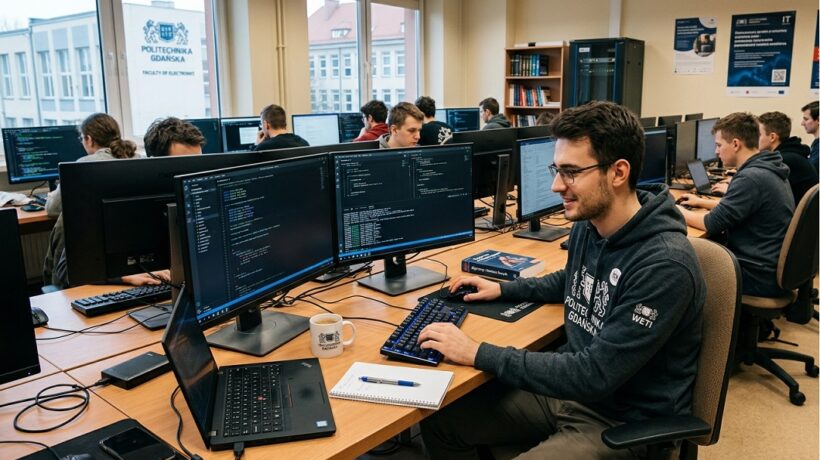
Wrocław and Warsaw have their own legends about social life, Gdańsk as well (the famous student club “Kwadrat” or “Akcent”). However, the reality of a computer science student at Gdańsk Tech is different. During the semester, social life is limited to eating pizza together during nightly coding sessions in the library or in student dormitories.
Student clubs come to life only after the session. During the classes, the ETI building (especially the new one) is open until late in the evening and you will always meet dozens of people with laptops there. It is a specific kind of bond – the “brotherhood of arms” of people who jointly fight against errors in the code and non-working projects with AKO.
Practical tips: How not to drop out before the end of the second year?
- Master LaTeX: At Gdańsk Tech, many laboratory reports (especially in physics and electronics) require professional typesetting. LaTeX will allow you to avoid problems with divergent patterns in Word and make your reports look professional.
- Git from day one: Do not keep the code in the “project1”, “projekt_final” folders. Use Git. Lecturers at Gdańsk Tech appreciate the ability to work with repositories, and in team courses (PZ) it is an absolute requirement.
- Take advantage of the consultations: Lecturers at Gdańsk Tech, despite being strict on exams, are usually very helpful during consultations. If you come with a specific question about a problem you’ve been sitting on for a few hours, you’ll get clues that you won’t find in any textbook.
- Take care of the hardware: Computer science at Gdańsk University of Technology requires a working laptop with a Unix system (macOS or Linux). Many tools used in labs (e.g., architecture-specific compilers) are difficult to configure on Windows.
Frequently asked questions about IT studies at Gdańsk University of Technology
Is there a lot of physics in computer science at Gdańsk Tech?
Yes, especially in the first year. It is general physics (mechanics, thermodynamics, electricity), which can be very difficult for people with purely IT profiles. There is much more physics at WFTiMS than at WETI.
Do I need to know how to program before college?
Theoretically, no, but in practice, people starting from scratch have a very hard time. The pace in the programming labs is lightning fast. A basic knowledge of programming logic will save you a huge amount of stress.
Is it difficult to support yourself at university?
Yes. The first three semesters are the most difficult. If you pass them, your chances of earning an engineering degree increase to 90%. Most people drop out in mathematics, physics and computer architecture.
WETI or WFTiMS – what to choose if I want to make computer games?
WETI will be a better choice due to its stronger focus on code performance, computer graphics, and low-level resource management, which is crucial in GameDevi.
Are part-time studies at Gdańsk University of Technology easier?
The substantive program is similar, but the level of requirements is sometimes distributed a little differently. The biggest challenge in part-time classes, however, is the lack of time – you have to master the same difficult material in much less time, often already working in the industry.
Is Gdańsk University of Technology better than Warsaw University of Technology (WUT)?
It depends on your goals. WUT has a bit more prestige nationwide, but Gdańsk Tech has unique connections with tech giants in the region (Intel) and offers a very modern infrastructure on WETI. In the Perspektywy ranking, both universities go head to head.
How long is an average day for a computer science student at Gdańsk Tech?
Be prepared for “windows”. You can have classes from 8:00 am to 8:00 pm with a few breaks. Laboratories require prior preparation, so realistically the time spent on studies is 10-12 hours a day , including your own work at home.
Studying computer science at the Gdańsk University of Technology is a marathon, not a sprint. It is a study for people who are not afraid of hard, engineering work and are ready to sacrifice their social life to understand how modern technology works at the very grassroots. If your goal is only a high salary in IT, you may want to consider lighter private colleges. However, if you want to be an elite engineer who can solve any technical problem – PG is the place for you.
What should you do now?
- Check the current point thresholds in the Gdańsk University of Technology reservation system.
- Start learning math for proofs, not just matriculation schemes.
- Download a free C course and write your first one-way list management program. This is your ticket to a quieter first semester.
All in one place.