


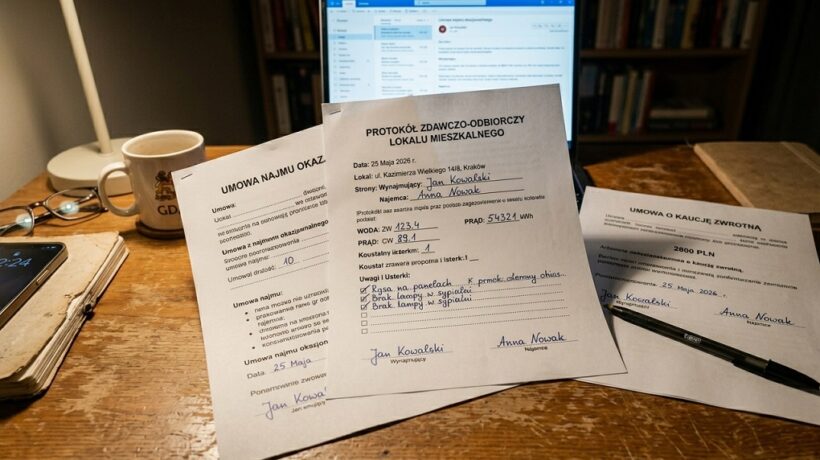
Recovery of deposit in Gdańsk at the end of the academic year
According to the Act on the Protection of Tenants’ Rights, the owner of an apartment in Gdańsk is obliged to return the deposit to you within 30 days from the date of vacating the premises and signing the handover protocol. To receive 100% of the amount paid, you must prove that the technical condition of the room is due to “normal wear and tear” and not to your negligence. The key to success in the academic year 2026/2027 is precise photographic documentation made on the day of handing over the keys and a written confirmation of the settlement of the media.
Rental market analysis in Gdańsk: Why is the deposit a flashpoint?
In the 2026/2027 season, the average deposit for a single room in Wrzeszcz or Przymorze oscillates between PLN 1500-2500. When renting entire two-room apartments in new investments at Beniowskiego or Arkońska Streets, these amounts reach up to PLN 6000. For a student, it is often the equivalent of two months of living in the Tri-City, including lunches at the Academic Bar and dozens of SKM rides.
Owners of apartments in Gdańsk are increasingly using the so-called “flat rate for cleaning” or trying to finance the refreshment of the walls with your money. You need to know that according to the law, painting the walls after the standard, one-year lease period is the responsibility of the landlord, unless you have caused them to become grossly dirty (e.g. flooded with wine in a private dormitory in Siedlce). Remember: the deposit is used to secure claims for damages, and is not a free renovation fund for the owner.
Comparison: What is “normal wear and tear” and what is “damage”?
The table below will allow you to assess whether the landlord has the right to deduct funds from your deposit when moving out of an apartment in Gdańsk.
| Element of the apartment | Normal Wear (No Deductions) | Damage (Owner deducts from the deposit) |
| Walls | Slight dust, furniture marks | Hole holes left by dowels, grease stains, inscriptions |
| Floors (panels) | Minor scratches from an office chair | Deep dents, swollen panels from spills |
| Home Appliances | Natural wear of gaskets, filters | Broken induction hob, torn refrigerator handle |
| Bathroom | Limescale deposits on fittings | Cracked sink, mold resulting from lack of ventilation |
| Doors | Hinge creaking | Broken handle, holes in the veneer |
September 20, 2026
Right to invoices and receipts
You need to remember one overriding rule: the owner of an apartment in Gdańsk has no right to estimate damage “by eye“. If after giving up a room in Wrzeszcz you receive a message that “I deduct 500 PLN for a scratched floor”, it is an attempt to extort your money. In the Polish legal system (and according to the standards for 2026/2027), the deposit is your property, which is only in the deposit. Every zloty that disappears from it must be covered by accounting documents.
Every penny must have its own account
The owner is obliged to present you with a VAT invoice or fiscal receipt for each service or item by which he reduces the deposit.
- If he claims that you broke the faucet in the bathroom in an apartment in Przymorze, he must show a receipt for buying a new faucet and an invoice from a plumber for installing it.
- He cannot “value” his cleaning work at PLN 300 if he does not run a registered cleaning company and does not issue a document for it.
- A valuation “off the bat” is legally ineffective. Without a document confirming the actual cost incurred, the deduction is illegal.
If the owner insists on a lump sum (e.g. “a hundred for a hole in the wall”), request that scans of the invoices be sent. In 2026, with widespread digitization, the lack of an invoice for an alleged repair is a clear signal that the owner simply wants to keep your money for themselves without actually fixing anything.
Depreciation, not “new for old”
Another trap: the owner cannot demand money from you for a new armchair from Ikea in Matarnia if the old one was 5 years old and you only scratched it slightly. You have the right to demand that depreciation be taken into account. Items in rental apartments wear out naturally. If a table in an apartment in Żabianka has been used for 10 years, its market value at the time of your move out is close to zero. The owner cannot finance the replacement of furniture with new ones from your deposit.
When the Tax Office becomes your ally
Many landlords in the Tri-City, especially in older tenement houses at Wajdeloty Street or in the vicinity of the University of Technology, are still trying to circumvent the tax system. If you come across a recalcitrant landlord who illegally holds your bail and does not respond to substantive arguments, you have a powerful tool in your hand: the Tax Office.
How to check a dishonest owner?
Most lease agreements concluded with students are now occasional rentals. It requires reporting to the Tax Office within 14 days of the start of the lease. If the owner has not done so, he loses all the privileges resulting from this form of agreement (e.g. easier eviction), and additionally exposes himself to severe financial penalties for tax avoidance.
- Ask for confirmation of the lease application: If the landlord is having trouble returning the deposit for a room in Siedlce, ask him for a copy of the application to the relevant office (e.g. the First Tax Office in Gdańsk at Rzeźnicka Street or the Second Tax Office at Kołobrzeska Street).
- Failure to report is your advantage: If the landlord admits (or you know) that he rents “illegally”, remind him that as a citizen you have the duty (or right) to inform the state authorities about the suspicion of committing a fiscal crime.
- Consequences for the owner: The penalty for an undisclosed source of income can be up to 75% of rental income. In comparison, the return of your deposit (e.g. PLN 2000) is a ridiculous cost for the owner.
NOTE: Don’t treat it as blackmail, but as an enforcement of transparency. An honest landlord who pays taxes (e.g. a flat rate of 8.5%) will have no problem presenting invoices for repairs. A dishonest person, seeing that you know the topography of Gdańsk tax offices and the procedures of the National Tax Administration (KAS (National Tax Administration), usually makes a deposit transfer very quickly.
What to do when the owner avoids contact? (Hard procedure)
If 30 days have passed, you have not received invoices, and the deposit for the apartment at the Oliwa Campus has not returned to your account, go on the offensive:
- Final Demand for Payment: Send them by registered mail (with acknowledgment of receipt – this is crucial in court!). Write in it: “Due to the lack of presentation of cost documentation (invoices/receipts) confirming the legitimacy of deductions from the deposit paid on…, I call for the full amount to be returned… within 3 days to the account…”.
- Signal control: Add an annotation that in the event of failure to pay, the case will be referred to court, and at the same time you will submit an application to the competent Tax Office to check the correctness of the payment of tax on the rental of the premises at [Twoja Ulica]Street.
- Use the Citizens’ Advice Bureau: In Gdańsk at Dyrekcyjna Street, you can get support in formulating such letters.
Remember E-E-A-T: Your evidence is the foundation
Your strongest proof in 2026/7 is the metadata of your photos. Each smartphone records the date and GPS location of the photo. If you have photos of a clean apartment from the day you moved out with an assigned location in Gdańsk-Oliwa, no landlord will win against you in court, claiming that you “left a shit”.
Local pro-tip: Owners of apartments in the coastal strip (Jelitkowo, Brzeźno) are often in a hurry to move out students in June to prepare the premises for tourists for Open’era or the summer season. Take advantage of this rush – demand that the “clean” protocol be signed right away. When tourists enter, the owner will no longer be able to prove that it was you who destroyed something.
How to pass an apartment in Gdansk step by step
- Audit 14 days before moving out: Take a walk around the room in the Gdańsk University of Technology Student Town or a private dormitory. Check that each bulb is lit. Replacing a light bulb costs 15 PLN, the owner in Gdańsk can calculate 50 PLN “service” for it.
- General cleaning: Landlords in the Tri-City are sensitive to cleanliness in the kitchen and bathroom. If you leave a dirty oven in an apartment in Oliwa, expect to deduct PLN 200-300 for a cleaning company.
- Handover protocol: This is your most important document. It must contain meter readings (water, electricity, gas/heat from GPEC). If you live near the Oliwa UG Campus, make sure that the heat settlement takes into account the heating period.
- “Exit” photos: Take 50 photos of every corner, cabinet interior, and floor. In the event of a dispute in court or before a student mediator, this will be your only hard evidence.
- Confirmation of key passing: Never leave keys in a box without a receipt. This opens the way to accusations that someone entered the apartment after you left and caused damage.
The most common mistakes students make when recovering a deposit
Why do students of the Gdańsk University of Technology or MUG lose money? The most common mistake is the lack of input protocol. If you did not write down that the parquet was scratched when you moved into the tenement house in Wrzeszcz, the owner will attribute it to you in 2027.
Another mistake is “moving the deposit”. Many students think that they may not pay for the last month, asking for a deposit to be credited towards rent. In most occasional lease agreements, this is strictly prohibited and may result in the calculation of penalty interest and problems with references, which are becoming standard in Gdańsk.
Frequently asked questions about deposit refund in Gdansk
How much time does the owner have to return the deposit in Gdansk in 2026?
In accordance with the applicable law (Article 6(4) of the Act on the Protection of Tenants’ Rights), this deadline is 30 days from the date of vacating the premises by the tenant. This deadline runs from the moment you physically hand over the premises and sign the protocol. In Gdańsk, many owners include 14-day deadlines in their contracts, which is more advantageous and binding for you. However, if you have a clause about “60 days” in your contract, it is invalid because the law specifies a maximum deadline. Remember to provide the owner with your account number in writing on the day of handing over the apartment to be returned (it is best to enter it directly into the handover protocol).
Can the owner deduct from the deposit for painting the walls after a year of study?
In 90% of cases – no. The walls naturally get dirty, and refreshing the premises after a one-year lease is the operating cost of the landlord. The exception is when the walls are grossly damaged (e.g. holes after installing TV mounts without permission, subtitles, traces of flooding). If the owner in Wrzeszcz insists on deducting for “refreshing”, request invoices for materials and labor. Remember that in Gdańsk in 2027 it is standard to rent apartments of a high standard, where minor abrasions from the chair at the desk are considered normal use of the premises by a student.
What to do if the owner does not want to return the deposit despite the lack of damage?
If 30 days have passed and the money has not been credited to your account, the first step is to send a Final Pre-Court Demand for Payment. You can do this by registered mail with acknowledgment of receipt. In the letter, set a deadline of 7 days for the return of the funds, otherwise the case will be referred to court. Students in Gdańsk often benefit from free legal advice at law faculties (e.g. the Student University Legal Clinic of the University of Gdańsk). Often, just a letter with a lawyer’s stamp or a mention of referring the case to a civil court makes the deposit “miraculously” find its way into the account within a few hours.
Can the deposit be higher than one rent?
Yes. The law allows a deposit of up to 12 times the monthly rent for ordinary rentals and up to 6 times for occasional rentals. However, on the Tri-City rental market in 2026/2027, the standard is a deposit of 1 to 2 monthly fees (rent + administrative fees). If the owner of an apartment in Żabianka demands a deposit of 3 months’ rent, a red light should come on. This may mean problems with the financial liquidity of the landlord and subsequent difficulties in recovering such a high amount.
How to settle utilities (water, electricity) when returning the deposit at the end of June?
The most common trap in Gdańsk is the settlement for heating with GPEC and water. These systems often have read cycles every 3 or 6 months. If you’re moving out in June, the landlord may not have a final invoice yet. In such a situation, you have two options: either you settle on the basis of meter readings and current rates (by entering it in the protocol), or the owner keeps a small part of the deposit (e.g. PLN 200-300) for a future invoice, and returns the rest immediately. Never agree to keep the entire deposit “until the bills come in.”
Does the handover protocol have to be on a special printout?
No, it can be handwritten, but it must contain key elements: date, place (e.g. Wita Stwosza Street, Gdańsk), page data, meter readings and a description of the condition of the premises. The most important clause is: “The owner does not raise any objections to the technical condition and cleanliness of the premises”. If this record is found on a document signed by the landlord, recovering the deposit becomes a formality, and the landlord loses the right to later claims that “he did find a scratch on the bathtub”.
What if the washing machine broke down in the room – who pays?
It depends on the cause of the failure. If the washing machine in the apartment in Siedlce has stopped working due to old age (wear of the programmer, wear of bearings), the cost of repair is borne by the owner. However, if the failure is due to your mistake (e.g. washing shoes that damaged the drum or not cleaning the filter), the owner has the right to deduct the cost of the repair from your deposit. Before moving out, check all household appliances. If something doesn’t work, report it to the owner right away instead of waiting until the day the keys are handed over.
Is a refundable deposit in Gdańsk taxable?
For you, as a student, the deposit is tax-neutral – it is your money, which is only temporarily “lying” with the owner. The owner also does not pay income tax on it, because the deposit is not his income (he becomes it only when he legally retains it for damages). This is an important argument in a discussion with a dishonest landlord who could claim that the deposit is lower by “tax”.
Where to look for help in Gdańsk when the owner is aggressive or dishonest?
In addition to the aforementioned clinic at the University of Gdańsk, it is worth going to the Municipal Consumer Ombudsman in Gdańsk (74 Partyzantów Street). Although advocates mainly deal with business-client relations, they often help students analyze lease agreements. You can also seek support from tenant organizations. Remember that in Gdansk there is a strong student community on FB groups (e.g. “Gdansk – I rent/I’m looking for an apartment/room”), where dishonest landlords are quickly stigmatized.