


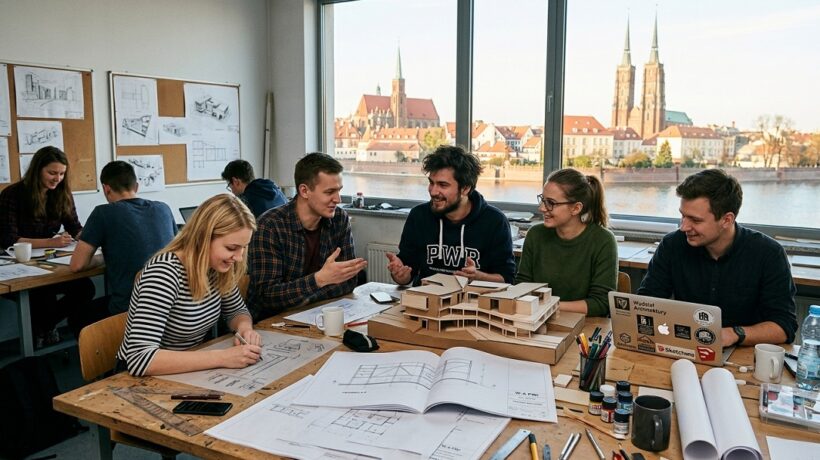
Architecture at Wrocław University of Science and Technology (WUST) — everything they won’t tell you officially
Getting into the Faculty of Architecture of the Wrocław University of Technology (W1) is a two-stage process that requires you to be fluent in exact sciences and have above-average manual and spatial skills at the same time. The Wrocław admission system is considered one of the most selective in Poland, because, unlike many other technical universities, WUT puts great emphasis on the drawing exam, which can eliminate even people with a perfectly passed matriculation exam in mathematics. You must understand that the fight for the index in the field of Architecture does not begin on the day of the publication of the results of the matura exams, but many months earlier, in drawing rooms, where the technique of drawing perspective and operating chiaroscuro is developed.
Recruitment system for WUT Architecture – how are points calculated?
The ranking formula for Architecture at the Wrocław University of Technology is specific and differs from the standard conversion rate used at other faculties of the university. Your final grade depends on three main components: the result of the drawing exam, the results in mathematics, and the score in a foreign language and an additional subject.
Components of the ranking formula
The Wrocław algorithm rewards versatile people. The points from the drawing are converted in such a way that they constitute a significant percentage of the overall grade, but it is the high matura exam in mathematics (extended level) that is the foundation that allows you to jump over the point thresholds.
- Drawing exam: This is an aptitude test where you can score a maximum of 660 points. This is a critical value – without obtaining the minimum threshold in the drawing (usually about 240-300 points, depending on the resolution of the University Senate for a given year), you do not take part in the further recruitment process, even if you have obtained 100% in extended mathematics.
- Mathematics: What counts is the result from the extended or basic level (the conversion rate for the extension is much more favorable). Mathematics in Architecture serves as a filter for logical thinking.
- Foreign language and additional subject: Typically, physics or art history is scored. It is worth knowing that art history is a strategic choice for people who feel weaker in calculations, while physics better prepares for later classes in construction and building mechanics.
Drawing exam at WUT – what to expect in the classroom?
The entrance exam for the Faculty of Architecture of the Warsaw University of Technology usually takes place in June, in the campus buildings at Wybrzeże Wyspiańskiego or in the vicinity of Prusa Street. It lasts two days and is divided into two separate sessions, each lasting 180 minutes.
Part 1: Drawing from Nature (Still Life)
On the first day, you will face a drawing from nature. In the middle of the exam room, a composition consisting of geometric solids, everyday objects, fabrics, and sometimes architectural fragments (e.g. plaster casts) is placed.
- Technical requirements: You need to demonstrate the ability to correctly transfer the proportions to a B2 format sheet (50×70 cm).
- Evaluation criteria: Examiners check primarily the construction of solids, the correctness of the converging perspective and the method of handling the value (shading). A disqualifying error is the so-called “falling apart” of the composition or an erroneous perspective in elements lying below or above the horizon line.
September 20, 2026
Part 2: Imaginary Drawing (Thematic Task)
The second day of the exam tests your spatial imagination and design skills. You get a text theme, e.g. “City square in the shadow of skyscrapers” or “Interior of a futuristic station”.
- Creativity vs Technique: Here, it is not only a nice drawing that counts, but the logical arrangement of elements in space. You have to prove that you understand the scale of man in relation to architecture. Adding human silhouettes, vehicles or greenery is essential to convey the realism of the scene.
- The most common pitfalls: Students often forget about the shadow cast by objects or can’t cope with a multiconverging perspective. WUT rigorously assesses the purity of the line – avoid excessive smudging of the pencil with your finger (the so-called “dirty”), which is considered a lack of professionalism in the Wrocław School of Drawing.
Drawing schools in Wrocław – is the course necessary?
The reality of recruitment at WUT shows that over 90% of people who get into Architecture have previously attended specialist courses in architectural drawing. Wrocław offers a wide selection of studios, many of which are located in districts such as Śródmieście, Biskupin or the vicinity of Grunwaldzki Square.
Why is self-teaching rarely enough?
Examiners from WUT are looking for a specific style of drawing that is characteristic of the Wrocław university. Drawing schools teach:
- Composition rules: How to fill out Sheet B2 so that the work doesn’t seem too small or “cut off”.
- Working speeds: 180 minutes for a complex composition is very little time. Without practiced hatch schemes, you won’t have time to finish the job.
- Operating with a pencil: You will learn when to use a hard pencil (e.g. H2) for construction and when to use a soft pencil (e.g. B6) for the deepest shadows.
When choosing a course in Wroclaw, look for those that organize exam simulations in conditions identical to those at the University of Technology. This will allow you to control stress, which can be paralyzing during the exam.
Point thresholds and statistics – how many points do you really need?
Architecture at WUT has been at the forefront of the fields with the highest thresholds for years. In recent years, the thresholds have oscillated between 380-450 recruitment points on a total scale (after taking into account the conversion rate of the figure).
Opportunity analysis
If your result in the drawing exam is about 350-400 points (average level), you need to make up for the score with a very high high matura exam in mathematics (above 80% from the extension). If, on the other hand, you are an outstanding cartoonist and score more than 550 points on the exam, your pressure on the matura results decreases a bit, although mathematics still remains a prerequisite for jumping over the reserve list.
- Number of people per place: Usually, 3 to 5 candidates compete for one index.
- Reserve lists: At Architecture, reserve lists move more slowly than at other WUT faculties, because people who decide to go in this direction rarely choose it as a “backup option”.
Matura exam in Art History or Physics? Selection strategy
This is one of the most common dilemmas of candidates for Architecture in Wrocław. WUT accepts both subjects, but they have a completely different impact on your future at the faculty.
- Art History: It is chosen by people with a more artistic profile. The knowledge gained during studying for this subject will be directly useful to you in the first year of studies (history of ancient and medieval architecture). It also makes it easier to understand an architectural detail, which translates into the quality of the drawing.
- Physics: This is a pragmatic choice. Studying Architecture is not only about drawing, but above all about engineering. Already in the second semester, you will meet the mechanics of buildings and structures. Physics extended at the matura exam gives a solid foundation, without which passing technical subjects at WUT becomes a huge challenge.
The reality of studying – what awaits you after a successful admission?
Getting to the Architecture Department at WUT is just the beginning of the road. The E-1 building, which houses the faculty, will become your second home, and the legendary “hall” will become your second home, and the legendary “hall” will be the place for night sessions while gluing mock-ups.
Design studios
The Wrocław faculty is famous for its strong emphasis on physical modeling. Already in the first year, you will build mock-ups from cardboard, foam and wood. Recruitment tests your eye for drawing, but studies will verify your manual skills and patience.
- Software: You will quickly need to master programs such as AutoCAD, Revit, ArchiCAD or Rhino. WUT relies on modern BIM technologies, so computer skills are just as important as hand-drawn drawing.
- Atmosphere of the faculty: Architecture at WUT is a specific community. A small number of students per year (compared to Computer Science or Civil Engineering) is conducive to integration, but also generates a lot of pressure during design corrections, where your ideas are publicly evaluated by professors.
A collision with reality – why do students of Architecture at WUT lose their nerves?
Getting into the Faculty of Architecture of the Wrocław University of Technology is a success that quickly gives way to the brutal everyday life of academia. Many students who have been polishing the line in drawing schools for years experience cognitive shock in the first weeks of October. Architecture at WUT is not an “art study” with the addition of mathematics – it is a difficult engineering major, where a subjective assessment of the aesthetics of your project meets the merciless laws of physics and construction.
The biggest problem that almost half of the first year does not cope with is time management. The specificity of working at the Faculty of Architecture (W1) is based on a continuous design process. You can’t learn everything two days before the session. Designs, mock-ups and technical drawings require hundreds of hours of systematic work, which, combined with strict deadlines for submitting works (the so-called “handovers”), leads to chronic sleep deprivation and burnout at the very beginning.
Descriptive geometry – the subject where the dream of a diploma ends
If you ask any senior student of Architecture at WUT about the biggest admission filter after getting into college, you will hear one answer: Descriptive geometry. It is the legend subject, usually located in the first and second semesters, which generates the largest number of deletions from the list of students.
Why is it so difficult to draw a line?
Descriptive geometry requires almost superhuman spatial imagination and mathematical precision from you. You have to master the Monge method, marked projections and complex constructions of solid penetration, using only a pencil, compass and pencil.
- Technical rigor: On W1 there is no room for errors of the order of 1 mm. If the penetration line of the roof with the chimney shifts by a millimeter, the entire geometric structure is considered wrong.
- Pace of classes: The material is transmitted instantly, and colloquia (often called “slaughterhouse”) takes place under enormous stress under time pressure.
- Lack of understanding of logic: Many students try to learn construction by heart. This is the easiest way to failure. On the WUT you have to feel the line – you have to “see” a three-dimensional object in 2D projections before you touch the sheet with a pencil.
Building Mechanics and Structures
The second big wall that students in the second and third year (Semesters 3-5) face are technical subjects: Building Mechanics, Statics and Structures (concrete, steel, wood). It is here that the greatest sifting of people with an artistic soul who cannot cope with hard calculations takes place.
Problems with construction items:
- Mathematics in practice: These are no longer simple integrals. You have to count bending moments, shear forces and stresses in structural elements. One mistake in the sign at the beginning of the calculation causes your dream building to “collapse” in reality, resulting in an unsatisfactory grade from the project.
- The difference between “nice” and “stable”: Professors of construction at WUT rarely let themselves be seduced by aesthetics. If your project assumes huge glazing without visible supports, and you cannot prove computationally how this building is to stand – the project will be rejected.
- Accumulation of knowledge: Each subsequent item from this block is based on the previous one. If you “slip” through the statics on the three, you will probably not pass the concrete structures in the first term, because the deficiencies in the foundations will come out when dimensioning the reinforcement.
When does the critical moment occur? Analysis of the most difficult semesters
There are two turning points at UTK Architecture, where students most often resign or are removed from the university.
Semester 1: The Great Sifting
This is the time to verify predispositions. Plotted geometry combined with History of Ancient Architecture and pre-design creates an explosive mixture. Students cannot withstand quantitative pressure. You have to draw 20 A3 boards a week, learn hundreds of Latin dates and dates, and “grind” solid plans at night. This is where people who have understood that architecture is 90% tedious technical work and 10% drawing give up.
Semester 5: Structural Wall
It is the “to be or not to be” of the future architectural engineer. In the fifth semester, the most difficult projects accumulate: general construction, building installations and advanced constructions. It is at this time that students most often take the so-called “dean’s leave” because they are physically and mentally unable to handle the number of corrections and calculations.
Mock-ups and nights in the “Main Building” – logistics that finish off
Architecture at WUT is a very expensive study in terms of logistics. No one talks about it at open days, but the student’s budget must take into account:
- Mockup materials: Modelling cardboard, balsa, plexiglass, glues, knives – one competition mock-up for classes can cost from 200 to 500 PLN. You need a few of them per semester.
- Large format printing: Printing design boards in professional printing houses in the vicinity of Grunwaldzki Square is a cost that can ruin a student’s wallet before the final handover.
- Equipment: A laptop with a powerful graphics card for rendering (3ds Max, V-Ray, Lumion) is an expense of 6-9 thousand zlotys. Without it, you will not be able to prepare projects for higher semesters.
Physical exhaustion is another factor. The legendary “hall” at the Faculty of Architecture at Prusa Street saw hundreds of students sleeping on the floor before submitting their projects in the morning. Lack of sleep leads to mistakes in projects, and mistakes to negative grades from corrections – this is a vicious circle that is the main cause of depression and resignation in this field.
Why do WUT students resign on their own?
More often than not, architecture students give up of their own free will. The reason is the imposter syndrome and toxic work culture.
- Subjectivism of assessments: On design items, your work that you’ve been sitting on for two weeks can be crushed by the supervisor within 30 seconds during proofreading. Not everyone has the mental resilience to hear that their vision is “worthless” or “dysfunctional.”
- Comparing yourself to others: There will always be people on the year who “make better renders” or “glue mockups faster”. In the small, closed environment of the architecture faculty, it is easy to fall into complexes, which leads to a loss of motivation.
How to survive the most difficult objects?
If you want to avoid dropping out of college, implement this strategy:
- Plotted geometry: Don’t miss any lecture and exercises. Buy Prof. Lewandowski’s textbook and redo each task three times. If you don’t understand shadow construction – look for tutoring from older students as early as November. December is too late.
- Mechanics and Construction: Make friends with students from Civil Engineering (Faculty W2). They have this knowledge in their little finger and often help architects understand the logic of static calculations.
- Corrections are your policy: Never go to proofreading empty-handed. Lecturers at WUT appreciate the process. Even if your project is poor, but you show progress week by week, you have a better chance of passing than the person who brings the “ready-made” at the end of the semester.
- Invest in the base: Legendary databases of questions and sample projects from previous years are circulating at WUT. Obtaining them is half the success in exams in the History of Architecture or General Construction.
What exactly to do to get into WUT Architecture?
To successfully go through the hiring process, you need to follow a plan. Here is a list of steps you should take:
- Start a drawing course no later than September of the pre-high school year. Two years of study is the optimal time to develop the technique, one year is the absolute minimum.
- Focus on Extended Mathematics. Don’t let go of tasks in analytical geometry and stereometry – they are the best exercisers for the imagination needed for the entrance exam.
- Collect a portfolio of works. Although WUT does not require you to submit your portfolio before the exam (only a drawing made on site is evaluated), having your own collection of works allows you to monitor your progress.
- Sign up for the IRK WUT system immediately after its launch (usually May). Keep an eye on the deadlines for paying the recruitment fee, which in the case of Architecture is higher due to the organization of the drawing exam.
- Practice drawing on B2 format. Many people make the mistake of drawing at home on A3. Switching to a format four times larger without practice results in poor management of sheet space.
- Browse exam topics from previous years. They are available on the website of the WUT student government or in the faculty archives. Try drawing them with the timer set for 3 hours.
Frequently asked questions about Architecture in Wrocław recruitment
Is the drawing exam at WUT more difficult than in Warsaw or Krakow?
The Wrocław style is specific – it puts less emphasis on the painterly nature of the drawing, and more on engineering precision, construction and purity of value. If you learn to draw according to the guidelines of the Warsaw University of Technology, you may have difficulty getting into the Academy of Fine Arts, but at the University of Technology you will be at the forefront.
Can you use a ruler on a drawing exam?
Absolutely not. The use of a ruler or any mechanical aids results in immediate disqualification and zero points from a given day. All lines, including the complicated perspective, must be taken “out of hand”.
How many pencils to take to the exam?
Prepare a set of at least 10 pencils of different hardness (from 2H to 8B). Also take a good bread band (for pulling out the lights) and a sharpener with a container so you don’t waste time running to the trash can.
What if I get sick on the day of the drawing exam?
WUT usually does not provide for additional dates for the entrance exam. If you do not show up in the room, you lose the chance to be recruited in a given year. Exceptions are considered individually by the admissions committee only in extreme random cases, but this is not the rule.
Do I have to pass physics at the matura exam to get into Architecture?
It is not compulsory, but physics is one of the elective subjects in the ranking formula. If you pass it better than art history or geography, it will be included in your score.
Is there mathematics at Architecture at WUT?
Yes, mathematics accompanies students during the first semesters (mathematical analysis, descriptive geometry). It is not as advanced as in Computer Science, but it requires a solid foundation from high school.
Can I go to a master’s degree at WUT after a bachelor’s degree in Architecture at another university?
Yes, recruitment for second-cycle studies is based on a portfolio and grade point average. Wrocław is happy to accept students from other centers, as long as they demonstrate a high level of design in their diploma theses.
Enrollment in Architecture at the Wrocław University of Technology is a challenge that tests your fortitude and determination. Success depends on the balance between systematic learning of mathematics and daily drawing training. Remember that in Wroclaw, precision, construction and understanding of space are important. If you dream of designing buildings that will change the skyline of cities, start preparing now.
Check the schedule of drawing courses, reserve time to learn extended mathematics and follow the official announcements of the Faculty of Architecture of the Warsaw University of Technology. Don’t wait – the June exam on the Oder is approaching faster than you think.