


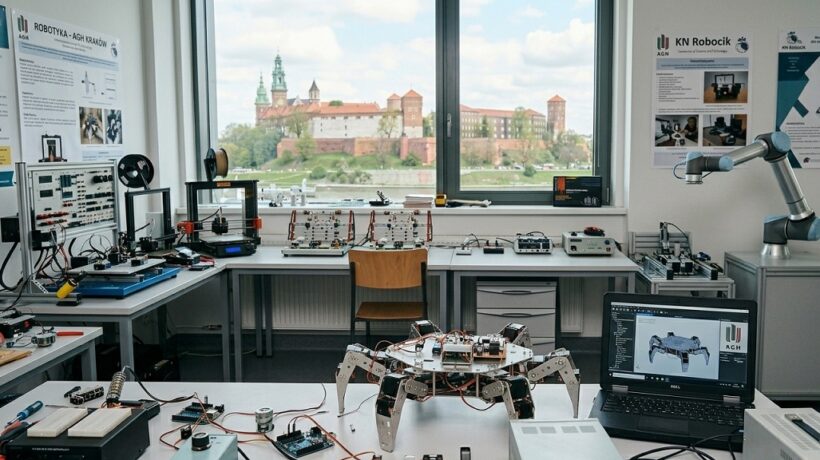
Automation and Robotics at AGH: Equipment, Laboratories and Night Forging
Automation and Robotics (AiR) at the AGH University of Science and Technology in Krakow, implemented mainly at the Faculty of Electrical Engineering, Control Engineering, Computer Science and Biomedical Engineering (EAIiIB) and the Faculty of Mechanical Engineering and Robotics (WIMiR), is one of the most technically difficult fields of study in Poland. The statistics are inexorable: in the first year, about 180-220 people usually start their studies at one faculty, of which only 55-65% of the original composition take the diploma exam on time. The largest reduction in the number of students occurs between the second and third semesters, when the theoretical mathematical foundations collide with the rigor of laboratories and the specific requirements of control departments.
When and why do students drop out of the list?
The screening mechanism at AGH UST has a two-track character: administrative deletion and silent resignation. Administrative deletion takes place when the balance of ECTS credits shows a deficit exceeding the permissible limits specified in the AGH UST Studies Regulations. For most semesters at AiR, this limit is between 12 and 15 ECTS credits, which in practice means that failing two major subjects (e.g. Control Theory and Mathematical Analysis) almost automatically generates a procedure for removal from the list of students.
Silent resignation is a phenomenon that intensifies at two times: in mid-November and at the turn of March and April. The results of the first colloquia in mathematics in the Main Building (A-0) and the entrance exams in electronics in building C-3 are a psychological barrier for many students. Students who got into college with the highest results in the matura exams are often unable to accept the 0/1 grading system used in control laboratories. There is no “grey area” at AGH UST – the control algorithm either works and stabilizes the facility, or the system falls into oscillations, which results in an unsatisfactory grade without the possibility of negotiation.
Objects-Conquerors (Critical Path at AGH)
In the course of studies at AiR, there is a set of subjects with the status of “blockade”. Failure to pass them interrupts the so-called technological chain of education, making it impossible to enrol in courses from subsequent years in the USOS system.
1. Control Theory (Classical and Discrete)
- Location: Building B-1 (Auditorium halls and basements, where the actual research stations are located).
- Form of selection: This is an unquestionable direction of the course. The exam consists of a task-based part (design of PID controllers, stability testing using the Nyquist/Hurwitz method) and a theoretical part. The biggest filter, however, are laboratories. Tickets take place at the beginning of each class – failure to answer the question about the physical interpretation of transmittance results in being asked to leave the room. Failure to pass even one report makes it impossible to take the exam.
- Chain of Locks: Failure to pass Control Theory blocks Digital Control, Optimal Control, and Robot Control. In practice, this means a loss of the entire year.
2. Metrology and Measurement Systems
- Location: The B-1 building and the halls in B-2.
- Form of selection: An object-trauma for many years. The difficulty does not lie in theory, but in the development of test protocols. Managers require pharmacy precision in calculus of measurement uncertainty. Incorrect rounding of the result or incorrect plotting of points on the graph results in a “reflection” of the protocol. A three-fold reflection of the protocol means a 2.0 rating from the labs.
- Chain of Locks: Blocks objects related to process diagnostics and vision systems.
September 20, 2026
3. Mathematical Analysis (1 and 2)
- Location: Main Building A-0 or rooms in buildings A-3 and A-4.
- Form of selection: Classic theoretical filter. Half colloquia are held under strict conditions. Most people fall out on multiple integrals and Fourier series. The specificity of mathematics chairs at AGH UST is that they require proofs of theorems, not just the ability to count problems.
- Chain of Locks: It blocks most of the major subjects in the second year.
4. Fundamentals of Electronics and Digital Technology
- Location: Building C-3 and rooms in C-2.
- Form of selection: Laboratories require proficiency in building chips on breadboards. Entrance fees are often in the form of 0/1 – one wrong answer to three questions disqualifies a student from a given lesson.
- Chain of Locks: It blocks Microprocessor Technology and Real-Time Systems.
5. Microprocessor technique
- Location: Building B-1, computer laboratories.
- Form of selection: It requires proficiency in assembler and C language at a low level. The tasks consist in handling interrupts and timers in the STM32 family microcontrollers. Students complain about errors in synchronization of processes that are difficult to debug in real time.
- Chain of Locks: A key subject for the specialization of Robotics and Autonomous Systems.
6. Technical Mechanics and Strength of Materials
- Location: Building D-4 or rooms in building B-2.
- Form of selection: For AiR students with an “electrical” profile, mechanics is a mental barrier. Solving truss systems and calculating stresses in machine components requires a specific engineering approach that coding-minded people lack.
- Chain of Locks: Blocks Robot Construction and Manipulator Dynamics.
The most difficult semester – Analysis of material accumulation
Undoubtedly, Semester 3 is the “bottleneck” of Automation and Robotics at AGH. This is the moment when a student completes general mathematics courses and starts the actual engineering subjects. There are collisions in the timetable that the USOS system does not solve automatically. At the same time, the student must prepare:
- Complicated protocols in Metrology (Building B-1).
- Designs of logic systems (Building C-3).
- Tasks in Mathematical Analysis 2 (Building A-0).
- Getting started in Matlab/Simulink in terms of Control Theory.
The average workload in the third semester is about 30-40 hours per week outside of class. The biggest logistical problem is the accumulation of deadlines for submitting reports at the end of the semester. Often, four different departments set deadlines for the same week of January, which leads to the phenomenon of “night forging” in the Main Library of the AGH University of Science and Technology or the Provincial Library on Rajska Street (popular due to its longer opening hours).
Registration in USOS
For a student of Automation and Robotics at AGH, the USOSweb system (especially the token registration module for language courses and subjects of free choice) is the first element verifying the ability to strategically plan. At the EAIiIB faculty, registration for laboratory classes is often done on a first-come, first-served basis.
- Group logistics: Laboratories in subjects such as PLCs or Vision Systems are held in small sections (usually 10-12 people). Being 30 seconds late with registration in the USOS system results in being included in the group ending classes at 8:00 p.m. in Building B-1.
- Impact on results: The statistics show a direct correlation between the time of the end of classes and the results from the entrance tickets. Students who finish their laboratories late in the evening, living on the outskirts of Krakow (e.g. in the area of the Ruczaj or Bieżanowa housing estates), lose time commuting by tram lines 13 or 20, which drastically reduces the time to prepare a report for the next day. This generates a domino effect – lack of sleep leads to errors in the calculation of measurement uncertainty in building B-2.
APD and JSA System – Technical Diploma Barrier for AiR
Many students who have survived the “sieve” of Control Theory are taught on the last straight: the diploma procedure in the APD (Diploma Thesis Archive) system. At AiR AGH, engineering work is usually a construction project combined with the implementation of control algorithms.
JSA (Uniform Plagiarism Prevention System) and the source code
AiR departments apply rigorous parameters in the JSA system. The most common technical mistake is to miscite open-source libraries in C++ or Python code. If the JSA system shows a high similarity factor in the programming part (which happens with standard implementations of PID controllers), the promoter can block the work from defense.
- Corrective procedure: The student must then submit a written explanation to the Dean, deconstructing the algorithm line by line to prove the independence of the work. Failure to comply with the deadlines in APD results in removal from the list during the diploma semester, which requires a paid resumption of studies (cost approx. PLN 1500-2500).
Advanced Hardware and Software
Information Gain: Official brochures speak of “modern equipment”. The reality in buildings B-1 and C-3 looks like this:
- Development environments: You will need to master TIA Portal (for Siemens S7-1200/1500 controllers) and TwinCAT (Beckhoff). The difficulty is that student licenses are time-limited, which forces forging in laboratories after hours (the so-called “free hours” in room 110 in B-1).
- Industrial Robots: Working with Fanuc and Kuka robot arms Here, an error in dot notation or an incorrect definition of the tool’s coordinate system (TCP) risks damaging the gearbox. Departments rigorously draw disciplinary consequences for non-compliance with safety procedures (OHS).
- Matlab/Simulink – Toolboxes: AiR at AGH UST requires proficiency in the Control System Toolbox and the System Identification Toolbox. Students most often fail projects because they are not able to correctly estimate the parameters of a real object based on noisy data.
Erasmus and mobility
Going to the Erasmus+ program for an AiR student at AGH UST is a decision with a high administrative risk. Due to the unique profile of subjects such as Discrete Control Theory in Building B-1, it is very difficult to find a foreign university with an identical syllabus.
- Program differences: Upon return, the EAIiIB Dean’s Office often imposes an obligation on the student to make up for the differences. If these differences exceed the ECTS limit, the student loses a year. That is why AiR AGH for Erasmus is mainly attended by people with an average of over 4.5, who have the intellectual “reserve” to make up for two programs at the same time.
Night Locking
When the AGH UST Main Library (al. Mickiewicza 30) closes, AiR students move to dedicated zones:
- Building D-17: A modern IT center, where projects from Microprocessors are worked on until late at night.
- “U-2” Club: Although associated with entertainment, it serves as an informal reading room during the day and in the evenings.
- Night logistics: Krakow has a well-developed night network (lines 600+), but for a student camping in a lab in B-1, night buses departing from the “AGH / Akademia” stop are crucial. The waiting time for a bus in winter (20-30 min) is a real waste of time, which AiR students optimize by using city bikes (Lajkonik) to reach the “Olimp” or “Babilon” dormitory faster.
Survival Procedures
If a student fails to pass the first and second terms, the only way is to enrol in conditional or repeat the semester.
- ECTS rates: At AGH, the cost of repeating a course is calculated as the product of the missing ECTS credits and the rate per point. In the 2023/24 academic year, the rate oscillated between PLN 120-150. Acquiring Control Theory (6 ECTS) is an expense of about 900 PLN.
- Deficit regulations: The permissible point deficit after the first year at EAIiIB is usually 12-15 ECTS. Exceeding this value means that it is not possible to enter for the next year. The USOS system then automatically blocks the registration for items.
- Commission will: The board exam before the board of the institute (e.g. the Department of Automation and Robotics in B-1) is the final procedure. The application to the Dean must be substantiated (e.g. gross injustice of the examiner or procedural errors). The chances of a dealership switching to AiR are close to 5-10%. The committee usually consists of three professors, and the exam is oral at the blackboard. This is an extremely stressful process and rarely ends with a positive assessment if the substantive deficiencies are evident.
Student internships and their role in completing the year
Internships on AiR (usually 4 weeks) are not a formality. The student must independently find a company that corresponds to the study program (industrial automation, robotization, PLC programming). The bureaucracy associated with the practice log is rigorous. Each day must be described in terms of the learning outcomes included in the syllabus. Failure to accept the internship log by the faculty supervisor makes it impossible to settle ECTS credits for internships (usually 4-6 ECTS), which, with a tight balance of points, may become a direct cause of deletion from the list of students in September.
Logistics and cost of living in Krakow and academic performance
The logistics of the AGH UST campus is relatively advantageous (a compact area between Mickiewicza Avenue and Reymonta Street), but the AiR student spends a lot of time on the way to specialized laboratories. The travel time from the dormitory at the AGH UST Student Campus to the buildings on Mickiewicza Avenue (e.g. B-1) is only 10-15 minutes on foot, but the problem is the lack of free places in the study zones (the so-called “coworking”).
The cost of living in Krakow directly affects the results. Due to the murderous schedule of classes (often classes from 8:00 to 20:00 with “windows”), AiR students are unable to take up full-time gainful employment. The lack of space in the dormitory forces renting a room in the area of Krowodrzy or Czarna Wieś (Czarnowiejska/Lea Street), where prices in 2024 exceed PLN 1500 per room. Financial pressure often forces students to give up their studies in favor of working in IT, where the entry thresholds for people who can program in C++ (a skill acquired in the first year of AiR) are very tempting.
The most important questions of AGH UST students
What if I don’t pass the entrance exam from Electronics in building C-3?
Failure to pass the entrance exam at the laboratories in Electronics or Digital Technology in building C-3 is a critical situation, but procedurally defined in the regulations of the department. Usually, the regulations allow one or two corrections of entrance exams per semester (the so-called “retake dates of labs”). However, if you exhaust the absence limit or do not prepare for the next entry, the instructor gives an unsatisfactory grade from the entire laboratory module. In the USOS system, 2.0 then appears, which blocks the possibility of taking the theoretical exam. The only way to save is then to apply for conditional enrolment (condition) in the next academic year, which is associated with a fee for ECTS credits. It is not technically possible to “sign up” to another group during the semester to make up for the entrance fee, due to the rigid OHS limits in rooms C-3.
How to bypass the Control Theory block in the following semesters?
Control Theory (TCS) is the subject with the highest degree of sequentiality. If USOS shows a lack of a positive assessment with TCS after the retake session in September, the system will automatically block you from registering for courses such as Digital Control or Optimization Theory. There is no legal way to “bypass” this blockade without the consent of the Vice-Dean for Education. You can write an application for the so-called “registration with deficit”, asking for admission to higher semester courses despite the lack of TCS. The EAIiIB Dean’s Office usually rejects such requests, arguing that without knowledge of TCS, the student will not understand advanced control algorithms. The only viable strategy is to pass TCS in the September campaign or repeat the year and focus solely on that one item.
Does the Dean of EAIiIB/WIMiR agree to the third date of the exam?
Officially, the AGH UST Studies Regulations provide for two exam dates: basic and retak. The third term, commonly referred to as the “rector’s term” or “dean’s term”, is not the student’s right, but only the goodwill of the lecturer with the Dean’s consent. In the AiR field, due to the large number of students, departments rarely agree to a third term so as not to create precedents. Exceptions are random situations (e.g. a documented hospital stay during a session). If the whole group thinks that the exam was grossly difficult, the starost of the year can negotiate with the department in building B-1 for an additional exam, but it usually takes the form of an oral “question”, which is even more difficult to pass than the written exam.
What does the resumption of studies at AiR look like after deletion?
Resumption of studies is possible if you have completed at least the first year of study. The procedure consists in submitting an application to the Dean for permission to reactivate. The biggest pitfall with the resumption is the differences in the program. If the study program at AiR has changed during your absence (e.g. new modules in machine learning have been added or the microprocessor syllabus has been changed), the Dean will assign you a list of subjects to complete. You have to pay for them at the current ECTS rate. Resumption often involves the need to repeat the entire semester, which is expensive, but allows you to maintain your AGH UST student status without having to go through the recruitment process again.
Can Metrology reports be written in groups?
At AiR AGH, laboratories usually take place in two- or three-person sections. Even though you take measurements together in buildings B-1 or B-2, reports (protocols) usually have to be written individually. Departments use anti-plagiarism systems (JSAs) even for technical reports. If the two protocols have identical error analysis descriptions or the same language errors, both students will receive a 2.0 with no room for improvement. The key is individual interpretation of the results. You can consult the results of the calculations with each other, but the final conclusions must be unique. It is worth taking the time to carefully cross out the characteristics in programs such as Origin or Matlab, which raises the rating in the eyes of the hosts.
Can I change the faculty at AiR AGH during my studies?
The transition between faculties (e.g. from WIMiR to EAIiIB) is technically possible, but in practice extremely difficult. It requires the consent of both Deans and a high grade point average (usually above 4.0). The main problem is the differences in the program. AiR at WIMiR has a more mechanical profile, while at EAIiIB – electrical and IT. Transferring in the second year, you can have up to 20-30 ECTS credits to make up for in subjects such as Signals and Systems or Fundamentals of Electronics. The cost of making up for these differences is high, and the risk of mismatching the level of the new group is significant. Most students decide to take such a step only in extreme situations.
Where is the cheapest place to buy parts for Robotization projects?
In the higher semesters of AiR, you will have to build your own mock-ups of robots or control systems. AGH UST provides access to laboratories in B-1 and C-3, but you often have to finance consumables (motors, sensors, PCBs) yourself. AiR students most often use local electronic stores in the area of Czarnowiejska Street or order components in the group order system from China. It is also worth joining scientific clubs (e.g. KN Integra), which have their own budgets for parts and provide equipment (3D printers, laser cutters) for their members, which drastically reduces the costs of implementing semester projects.