


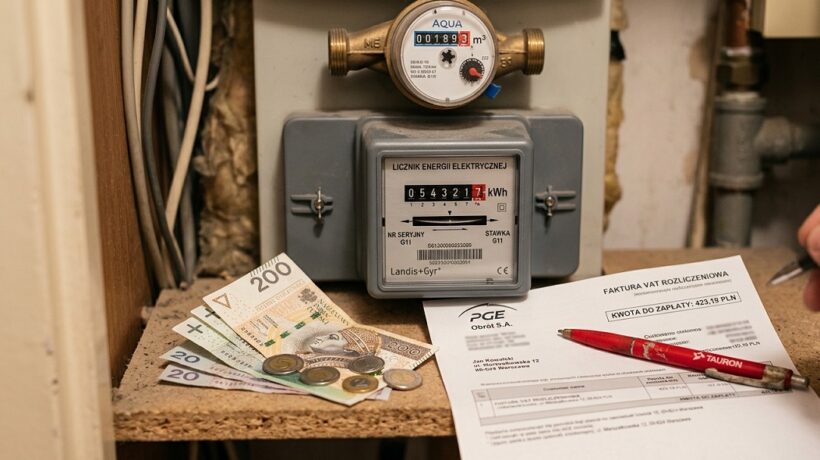
Utility billing: How to read electricity, water and gas bills
Regardless of whether you are just taking your first steps in the bustling corridors of the University of Gdańsk, the University of Technology or the Academy of Music, or you are planning your big leap into independence with a map of the Tri-City in your hand, or maybe you are parents who watch these first, adult decisions of their children with love and care – this article is for all of you. I remember that feeling very well, a mixture of excitement and a slight panic, when I first had to face an invoice for electricity that looked like an advanced mathematical formula. All those tables, codes, kilowatt hours, cubic meters… Where does this come from? Why so many? How to read it at all?
Step by step, without haste, we will dispel all doubts. The purpose of this journey is not only to understand numbers, but above all to gain a sense of control, peace and confidence that you can consciously manage your household finances. Because knowing what and how we pay for is not just a technical skill – it is the foundation of financial security and peace of mind, so necessary during the intense period of studies and entering adulthood. So let us remove the veil of secrecy from these accounts!
How to control utility bills and not overpay?
You may think: “The most important thing is to pay the amount at the bottom and that’s it!” Well, my dears, such an approach is a bit like sailing on a rough sea without a map and compass – it can work, but the risk of running aground (financially!) is considerable. Understanding bills is your map and compass. Why?
- You are the captain of your own boredom: Utilities (electricity, water, gas, heating, Internet) are an important part of the monthly cost of living, especially in the Tri-City. Knowing how much and what you pay for allows you to plan your expenses realistically. You avoid unpleasant surprises, such as a sudden, high equalization bill just before a session or a planned trip. Control over the flow of money is the basis of financial balance.
- Knowledge = savings: Only when you understand that an hour of gaming on a powerful gaming PC costs X pennies, and a long, hot shower consumes Y liters of precious water (and the energy to heat it!), you begin to see the connection between your habits and the numbers on your bill. This awareness is the first step to changing habits. Turning off the lights, shorter showers, cooking under cover – these small gestures, multiplied by days and months, really reduce bills.
- Home room included in the price: Living together is the art of compromise, and utility billing is often one of the most hot spots. When everyone understands how fees are charged and has access to bills, it is easier to divide fairly and avoid suspicion or mutual grievances (“Because you always leave the computer on!”, “And you are always sitting in the bathroom!“). Transparency is the key to good relations with roommates.
September 20, 2026
We break it down
Let’s take a typical bill, e.g. for electricity. Although the graphic design may vary depending on the supplier (e.g. Energa, Tauron, Enea, PGE, and in the case of PGNiG/Orlen gas or water – local companies such as Saur Neptun Gdańsk or PEWIK Gdynia), the structure is usually similar. Here are the key sections you need to pay attention to:
- Seller/supplier and operator details: Who sells you energy/gas/water (seller) and who owns the network through which this energy flows (operator/distributor – e.g. Energa Operator). Here you will find their addresses, tax identification numbers, hotline numbers and, importantly, the bank account number to which the payment should be made.
- Recipient/payer data: your data (or the person for whom there is a contract, e.g. the owner). Please check carefully the address of the collection point (address of the apartment!) and your unique Customer Number/Payer ID. It is crucial when contacting the supplier and making payments (you often have to write it in the title of the transfer!).
- Invoice number and billing period: Each invoice has its own unique number. The billing period specifies the time (from-to) for which the fees are charged. It can be a month, two months, a quarter, half a year, or even a year, depending on the billing system.
- Energy/Gas/Water (PPE) Point of Consumption: A unique, long number identifying a specific meter and installation in your apartment.
- Tariff group: Determines the rates at which you are billed. For households, the most common electricity tariffs are:
G11: A single, fixed rate for energy around the clock. The simplest, but not necessarily the cheapest if you use a lot, e.g. at night.
G12: Two time zones – the more expensive “day” (peak) zone and the cheaper “night” (off-peak) zone. The hours of the zones are determined by the operator (often, e.g. daytime 6-13 and 15-22, night 22-6 and 13-15). Ideal if you can shift energy-intensive activities (washing, washing, loading) to night hours.
G12w: Similar to G12, but cheaper zone, it also covers all weekend hours (Friday evening to Monday morning) and public holidays. It is very beneficial for people who spend weekends at home and perform most of the “power-hungry” activities at that time. Gas and water tariffs are usually simpler, depending mainly on the group of consumers (home, industrial).
Meter readings and consumption
- Meter number: It should match the number on your physical meter in your apartment/cage.
- Previous state: Meter reading from the end of the previous billing period.
- Current status: Meter reading from the end of the current billing period.
- Reading Type: Key! It can be:
– Actual (R): Made by an employee (collector), remotely (in the case of meters with remote reading) or provided by you. The most accurate.
– Estimated (S) / Forecast (P): Calculated by the system based on your historical consumption or (for new customers) a standard profile. It may deviate from reality! If the bill is based on estimates only, the true settlement will happen later.
Consumption: The difference between the current state and the previous state. It is for this number of units (kWh, m³) that you pay (plus fixed fees). If you have a G12/G12w tariff, the consumption will be broken down into individual zones.
Detailed components of the fee: Here the bill breaks down into atoms:
- Active Energy / Gas / Water & Sewage fee: The product of consumption (kWh/m³) and the unit price for your tariff.
- Distribution fees (Electricity/Gas): The costs of maintaining the network through which energy/gas reaches you. They are divided into:
a) Network rate fixed component: A fee for the mere “readiness” of the network to deliver the medium. You pay it regardless of consumption.
(b) Variable component of the network rate: Charge based on the amount of energy/gas consumed
c) Subscription fee: Cost of customer service, invoicing, etc. Constant.
d) Other (Electricity): You can find here, for example, a quality fee (related to maintaining energy parameters), a RES fee (to support renewable energy sources), a cogeneration fee, a capacity fee (depending on consumption during peak demand).
Net + VAT = Gross Total: Final Amount
- Consumption history: Often on your bill (especially an annual one) you will find a chart or table showing your consumption in previous months/years. Helpful in following trends.
- Forecasts for the next period (if you are in the advance system): Information on the amount of expected advances for the following months. ATTENTION! This is not the amount to pay NOW!
- Account balance: Whether you have an overpayment (+) or underpayment (-) from previous periods.
- AMOUNT TO BE PAID and PAYMENT DATE: The Holy Grail of the bill! Clearly indicated the amount you need to deposit and the final date by which the money must be in the provider’s account. Being late may result in interest being charged.
Checking your meters regularly is your secret weapon! It allows you to verify bills, track consumption and quickly detect possible failures (e.g. leaking tap).
Electricity (Electricity) meter:
- What does it look like? Older models are discs and drums (inductive), newer ones are digital displays (electronic)
- What do we read? Always full kilowatt hours (kWh). The decimal digits or on a red background indicate parts of kWh and can be omitted for billing purposes (but can be useful for observing instantaneous consumption).
Electronic meter – OBIS codes: Pay attention to the small numbers (OBIS codes) displayed next to the consumption value, because they tell you what you are seeing:
- 1.8.0 (or 15.8.0 according to the new standard): Total electricity consumption (sum of zones).
- 1.8.1 (15.8.1): Consumption in zone I (daily/peak) of the G12/G12w tariff.
- 1.8.2 (15.8.2): Consumption in zone II (night/off-peak/weekend) in the G12/G12w tariff.
The display can also show the date, time, current tariff zone – the values change every few seconds or when you press a button (if there is one).
- Gas meter: It usually has cylinders with numbers. We read full cubic meters (m³) – digits before a comma or on a black background. The decimal ones (on a red background) are parts m³ (liters).
Water meter (water meter):
What does it look like? Most often it has drums with numbers and sometimes small hands. There are usually two: one for cold water (it can have blue markings or the inscription ZW/Zimna Woda) and one for domestic hot water (red markings, DHW/DHW), if it is supplied centrally (from the municipal network or a building boiler room). If you heat water yourself (with a gas stove, electric boiler), you only pay for the consumption of cold water + the cost of energy to heat it.
What do we read? For billing purposes, the most important are full cubic meters (m³) – usually black digits. The red numbers or hands show liters (in order: hundreds of liters, tens of liters, liters) – we omit them in the reading for the bill, but they are super useful for checking for micro-leaks.
PRO TIP: Turn off all taps and appliances that draw water (washing machine, dishwasher). Observe the smallest hand or the last red digit on the water meter. If it moves – there is a leak somewhere (e.g. a leaking toilet cistern – very common!).
Remember! You pay not only for the supply of water (cold and possibly warm), but also for the discharge of sewage. The amount of wastewater is usually equal to the SUM of cold and hot water consumption.
Advance system vs. actual consumption
The way you pay for utilities is of great importance. You need to know in which system you are billed:
- Payment “in arrears” – actual billing: Every month (or other set period) you receive an invoice based on the actual meter reading (or the reading you provide). The plus is full control, you pay for real consumption, while the minuses The amount of bills can fluctuate greatly (e.g. high heating bills in winter), which makes it difficult to plan a budget.
- Payment “in advance” – advance system (Forecasts): This is a very common solution. You pay a fixed amount regularly (every month, two months) – an advance, also known as a forecast. It is calculated by the supplier on the basis of:
– Your historical wear and tear (if you live there longer).
– Estimates based on average consumption for a similar household or data for this property from the past (if you are a new tenant).
– Periodic settlement (equalization): This is a key moment! From time to time (half a year, a year), the supplier takes an actual meter reading and compares the actual cost of your consumption during this entire period with the sum of the advances you have paid. The result can be twofold:Overpayment: You have used less than forecasts. You paid too much. The surplus is usually automatically credited to future receivables (it will reduce subsequent bills) or, at your request, can be returned to a bank account.
Underpayment: You have used more than forecasts. You paid too little. An additional amount to be paid will appear on your checking account, which you must pay within the set deadline. Sometimes the underpayment can be large if the forecasts were greatly underestimated or your consumption increased (e.g. due to a cold winter, the arrival of a new roommate, the purchase of energy-consuming equipment).
Why is it important? You must remember that the monthly advance payment is not the final fee. This is just the expected installment. To avoid the shock of your annual billing, check your meter readings regularly (e.g. once a month) and compare it with the forecasts on your invoice. If you see that your actual consumption is significantly different from your forecasts (especially if it is higher!), contact your supplier. You can ask for a recalculation of forecasts and an increase in advances to spread the potential underpayment into installments, instead of paying a large amount in one go. You can also frequently post your readings online, which is what you can do with your forecasts.
Lump sum for water (Mainly in older buildings)
What is it? The lump sum is often confused with the fee “for everything without limit”. Nothing could be further from the truth! A lump sum is also a form of advance payment/forecast, but based on averaged data (e.g. the number of people in the apartment, historical consumption of the apartment/building), and not necessarily on an individual meter (which in the lump sum system may not be in the apartment at all, or its indications are not the basis for monthly payments). You pay a fixed monthly amount for water and sewage.
The devil is in the annual settlement: The most important element of the lump sum system is the annual settlement of the entire building. The manager (cooperative, community) compares the indication of the main water meter installed at the entrance of the installation to the building (which measures the total water consumption by all residents and for administrative purposes) with the sum of lump sums collected from all tenants during the year.
Why the differences and potential surcharges? There is almost always a difference between the sum of lump sums and the indication of the main meter. It may result from:
- Underestimates in lump-sum forecasts.
- Breakdowns and leaks in common areas of the building (e.g. a broken pipe in the basement)
- Water consumption for administrative purposes (washing cages, watering greenery)
- Measurement inaccuracy of water meters (main and possible individual ones).
- Unfortunately, sometimes also from water theft or manipulation of meters by dishonest neighbors.
How is the difference divided? This difference (underpayment or sometimes overpayment) must be settled. It is divided among all residents of the building according to the adopted regulations – e.g. in proportion to the number of people living in the premises, in proportion to the area of the apartment, and if there are individual water meters (even with a lump sum!) – in proportion to their indications.
Consequences for you: This means that even if you personally save a lot of water, you can get a high bill at the end of the year for an underpayment if the overall consumption in the building was high (e.g. due to a breakdown or the extravagance of the neighbors). Therefore, being in the lump sum system:
- Take an interest in the annual results of the water settlement in the building (information should be available from the manager).
- If you have water meters in your apartment (even if you pay a lump sum), check them regularly. Compare your consumption with the lump sum paid – this will give you some orientation whether you are “generating” a potential overpayment or underpayment on an annual basis.
- Pay attention to possible leaks in the common areas and report them to the administration.
Billing utilities with roommates
Do you live together? Congratulations! But also a challenge. The key to harmony is a clear and fair distribution of media costs. How to do it?
Set the rules at the start: Before the first bill appears! The most common methods:
- Equally: You divide the total cost of the bill by the number of people. Simple and fast, but it can be considered unfair if the wear is very uneven.
- From the room/person in the room: If the rooms are of different sizes or a couple lives in one, you can share the costs proportionally.
- Mixed system: For example, you divide fixed fees (subscription, fixed transmission fees) equally, and variable fees (for consumption) – in proportion to the number of people or in more detail (if, for example, it is known that someone consumes much more electricity by specific equipment).
- Sub-meters: In some apartments (rarely) sub-meters may be installed, e.g. electricity sub-meters for individual rooms. This is the most accurate method, but it requires additional installation.
Technology to Help
Instead of doing complicated calculations in Excel or on a piece of paper, use an app! Tools like Splitwise, split payment features in banking apps (like Revolut) are designed to manage shared spending. You enter the bill, who paid, how it is to be divided (equally, percentage, into specific amounts), and the application itself monitors the balances and reminds about settlements. It’s really a game-changer in a shared apartment!
Who pays? Establish one person responsible for physically paying the bills and the deadline by which the rest will donate their share to them. Trust and timeliness of all parties are important.
Understanding is the first step, action is the second. Even small changes in habits can bring measurable savings:
Electricity: Holy Trinity: Turn off the light, replace the bulbs with LEDs, turn off devices from the socket/strip (stand-by also eats up electricity!). In addition: optimize the operation of the refrigerator (do not put hot food, defrost regularly, do not open unnecessarily), use “eco” programs in the washing machine and dishwasher, boil only the necessary amount of water in the kettle, do not leave chargers in sockets after charging the devices.
Water: Shorten the shower by 2 minutes a day (that’s thousands of liters saved per year!), turn off the water when brushing your teeth/density/dishes, use aerators on the taps (they aerate the stream, reducing consumption), wash only when the washing machine is fully loaded, report any leaking taps and flushes to the owner immediately! (drop by drop, it can be up to several cubic meters per year!).
Gas/Heating: Adjust the flame to the bottom of the pot (don’t waste gas heating the air), cook under the lid, use an electric kettle instead of a gas kettle to boil water (usually faster and more efficient), dress warmer instead of turning on radiators to the max, lower the temperature by 1-2 degrees at night and when you leave the house (each degree less is about 6% savings on heating!), Do not cover the radiators, vent them regularly, ventilate briefly and intensely (a wide-open window for 5-10 minutes), and not through an ajar window for hours.
We have reached the end of our journey through the world of media! I hope you feel much more confident now. Understanding bills is not a secret knowledge reserved for experts – it is a practical skill that each of you can master. It is your tool for conscious management of the household budget, for saving money (which can be spent on pleasures, developing passions or simply a quieter life) and for building good relationships with roommates.
Don’t be afraid of numbers, don’t be afraid to ask. Read contracts, analyze bills, check meters. Be active participants, not just passive payers. Remember that every step towards understanding these mechanisms is a step towards your financial maturity and independence. Now, when the next invoice appears in your life, look at it not with fear, but with curiosity and competence. Because you have just gained a new, valuable skill that will serve you for years. You are ready to face these challenges! Good luck on your way to mastering home media management in the beautiful Tri-City!