


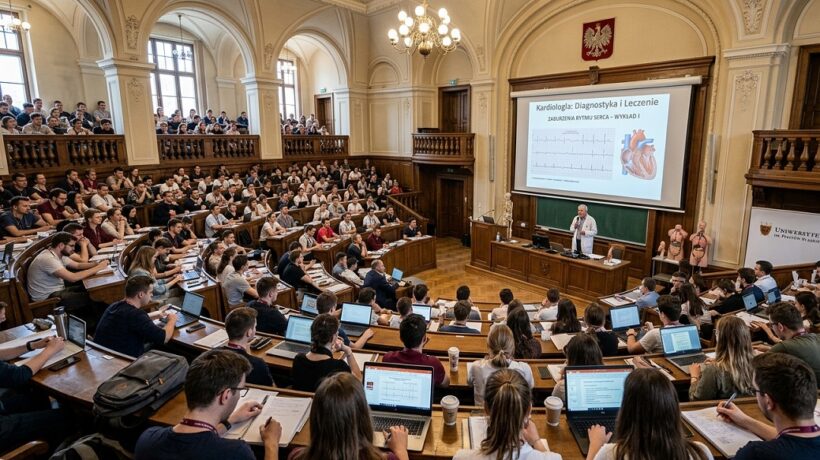
Medicine at the Jagiellonian University: The Most Difficult Subjects and Student Challenges
The prestige of the oldest medical school in Poland attracts thousands of high school graduates every year with results close to 100%. However, what does studying medicine in Krakow look like when the dust settles after the inauguration? The reality is not serial romances, but many hours of sessions in the Medical Library in Prokocim, the struggle against the archaic approach of some cathedrals and the logistical nightmare of moving between Krakow’s Grzegórzki and the south of the city. If you are counting on partnership relations with the staff, you may be disappointed – hierarchy still dominates here, and the student is often just another number in the USOS system.
The most difficult subjects in the medical field of the Jagiellonian University
It’s no secret: the most difficult subjects in medicine are those that generate the most sifting and force students to buy out conditions. Below is a list of “kilers” who have been building the reputation of the Krakow Collegium Medicum for years.
Descriptive Anatomy
A legendary subject from the first year, taught in the Cathedral at 12 Kopernika Street. This is where the first big selection takes place. The practical exam, or the famous pins, consists in recognizing 40-50 structures marked in human preparations. You have several seconds to do it. You must enter the name in English and Latin. A mistake in the end? The point is lost. In addition, there are tickets for each exercise and a huge mare, i.e. Lochenek’s manual, which you need to know almost by heart.
Biochemistry
If you survive anatomy, biochemistry awaits you in your second year. This item is known for its murderous multiple-choice tests, which often use negative points. This makes uncertainty kill the result – students often leave the exam with a negative balance, which automatically means that they will have a retake session. The cathedral requires a detailed knowledge of the metabolic pathways and enzymes whose names you will dream of at night.
Physiology
Here it is not enough to “forge” – here you have to understand. Physiology at the Jagiellonian University is based on the Cracow school of Prof. Konturek. Exams can be descriptive or test, and the level of detail of the body’s regulatory mechanisms is extreme. It is a subject that verifies whether you are suitable for a clinically thinking doctor or just be able to memorize facts. Without the exchange of questions from previous years, passing this in the first term borders on a miracle.
Pharmacology with Toxicology
The third year is the “final boss” before entering the clinics. Pharmacology is a blocking subject – if you don’t pass it, you won’t be allowed to take classes in hospitals in your fourth year. The number of drug names, their doses, interactions and indications is overwhelming. It is here that decisions about the dean are most often made to avoid being removed from the list of students.
| Subject | Difficulty (1-10) | ⚠️ Chance of a condition | ⏳ Study time (weekly) |
| Descriptive Anatomy | 🟥 10 | 🔴 High | 40h+ |
| Biochemistry | 🟧 9 | 🚨 Very high | 30h |
| Pharmacology | 🟧 9 | 🔴 High | 35h |
| Physiology | 🟨 8 | 🟡 Average | 25h |
September 20, 2026
What does the session and retake session at the Jagiellonian University look like
A medical session in Krakow is a state of permanent stress. It usually starts with kindergartens – pre-session dates that are supposed to be a “chance”, but often turn out to be a trap because the material is not yet mastered. If you miss the first term, you enter retake mode. The retake session at the Jagiellonian University in September is the so-called September campaign – the worst-case scenario, because while others are resting, you are camping in the Medical Library at 7 Medyczna Street.
The biggest problem is the administration and USOS. The system often works late, and entering “last-minute” grades makes it impossible to schedule a revision date. It is worth knowing the mechanism of the point block – failure to pass a course with a high number of ECTS credits prevents conditional enrolment for the next year. Then all that remains is to repeat the year, which is associated with huge costs.
Is it difficult to stay in medicine at the Jagiellonian University? (Statistics)
The question: is it difficult to make a living in medicine, bothers everyone. The answer is yes, but the first and second years are the worst. It is estimated that after the first year, the sifting rate is about 10-15%. Most people fail anatomy and histology. The university does not do “screening” on purpose for sports, but the rigor of credits is set in such a way that people with weaker mental condition or lack of regularity simply cannot cope.
The best chances of survival are given to “workers” – people who are able to give up social life for 3-4 months in a semester. If you count on creativity and flexibility, at the Jagiellonian University you may feel stifled by the rigid framework of syllabi.
Which year drops out the most students?
If you think that after passing anatomy in the first year you are already “safe”, the Krakow Collegium Medicum will quickly prove you wrong. The statistics are inexorable: although the largest quantitative sifting actually generates the first year, the real mental crisis hits the second. This is when the most difficult semester in the entire education cycle falls – the third.
The accumulation of biochemistry, physiology and histology creates the so-called “wall”. In the first year, you are still motivated by the pride of getting into a prestigious field. On the second – you realize that you have five more years of sleeping four hours a day. Why do students drop out on their own, despite good grades? Often the reason is burnout. Looking at friends from other universities who enjoy the charms of Krakow, while you are analyzing the Krebs series for the tenth time, can break the greatest enthusiast. Subjects such as biochemistry or histology are mentally exhausting not only with the volume, but also with the specific rigor of the exams, where one mistake on the entrance card can ruin the chances of the first exam date.
Is it possible to reconcile work and studies?
Let’s be brutally honest: is it possible to reconcile work and studies at the Jagiellonian University in Medicine? In the classic dimension – no. The system of classes at the medical school is designed to fill your time from 8:00 to 20:00, including commuting between departments. If you don’t have financial support from your parents, you are faced with a choice: a condition due to absence or chronic sleep deprivation, which will end in a retake session anyway.
Top students rarely work more than a few hours a week (usually tutoring). Every hour spent at work is an hour taken out of the “mares'” study. Lack of sleep is the standard here, and “normal functioning” is an abstract concept. Often the only salvation to repair the budget or mental health is the dean’s office, which more and more people decide to do after the second year.
The reality of apprenticeships: Shock in a collision with the system
You read about “patient contact” in folders, but what internships look like after the first year is a cold shower for many students. A nursing practice (120 hours) is often four weeks of being a “help to everything”.
- Deep Water: You will often be thrown into tasks that the university did not teach you. Washing patients, changing bedding, transporting patients for examinations – this is your everyday life. Contact with blood, secretions and death can be traumatic for 20-year-olds.
- Documentation and bureaucracy: No one in the cathedrals teaches how to fill out fever cards or how to navigate hospital systems. During internships, you are a “ghost” – often no one has time to instruct you, and the time pressure on the ward is enormous.
- No soft preparation: The biggest problem is the first contact with a claiming or terminally ill patient. The university focuses on theory, and practice verifies your resistance to stress and ability to work under pressure.
It often ends up that you photocopy documentation or stand against the wall for half of the internship, because no one has an idea what to do with the student. This is the moment when many answer the question of whether it is difficult to stay in the field of study mentally.
Survival Strategies: How the Best Do
Students with the highest averages are not always the most talented, but the best organized. Their success is based on three pillars:
- Absolute selection of knowledge: They know that you can’t learn everything from a textbook that has 1200 pages. They use question exchanges, but treat them as a signpost, which in a given department is an “immortal” exam question.
- Stress management: They do not allow for cumulation. If they know that they are in for a tough September and the September campaign, they start a slow repetition as early as July.
- Study hygiene: Although it sounds like a joke, the best sleep more than those who fail. They understand that the brain with a sleep deficit will not remember complicated pharmacological mechanisms.
The truth about medicine at the Jagiellonian University is that these are studies for people with a titanium psyche. Sifting is calculated into the system, and a condition or commission is the only way for many to survive to graduation. If your motivation is only prestige, you will rely on the first better colossus in histology. However, if you survive those first years, you will gain resilience that no other university can give you.
USOS system and ECTS credit trap
Most students are afraid of the “barrel” of the exam, but the real killer is the mathematics of ECTS credits. At the Jagiellonian University, each subject has its own weight. Anatomy or Pharmacology are “mares” for a dozen or so points, while minor seminars are only 1-2 points.
Why is it important? Because there is such a thing as a point debt limit. If you fail an item for 2 points, you get a condition and move on. However, if you “beat” a course for 12 points, you can exceed the acceptable deficit, which automatically means that you will be removed from the list of students without the possibility of conditional enrollment.
Many students mistakenly assume that “it will work out somehow”, and then they see the USOS system as a decision not to promote for the next year. You have to keep an eye on your periodic achievement card like an eye in your head – there is no room for errors in calculation here.
Hidden Costs of Studying – How Much Does “Free” Medicine Cost
The tuition fee for full-time studies is PLN 0, but medicine at the Jagiellonian University generates costs that are rarely talked about:
- Medical equipment: Right from the start, you need a white coat (preferably two), changing shoes for classes in hospitals (the so-called “crocs”) and a stethoscope. A good model (e.g. Littmann) is an expense of PLN 400-700.
- Manuals: Medical mares are ridiculously expensive. The set of Lochenek’s volumes is several hundred zlotys. Of course, there are PDFs and libraries, but with the pace of learning at the Jagiellonian University, having your own copy with selections is often necessary.
- Premiums and insurance: Third-party liability insurance for a medical student (necessary for internships), contributions to the local government, access to paid medical databases – these are small amounts that add up to hundreds of zlotys a year.
Scientific career and STN
There is a culture of “scientific” at the Jagiellonian University. If you think that just passing the LEK (Medical Final Exam) in 6 years is enough for your dream specialization, you are wrong. The best students enroll in Student Scientific Clubs (STN) as early as the first and second year.
This is an additional burden: writing review papers, collecting data for clinical trials and going to conferences. Why do people do this when they can barely make sense of anatomy? Because points for scientific activity are crucial when recruiting for a residency and give a chance for the Rector’s scholarship, which in Krakow is quite substantial and allows you to really relieve the household budget. If you don’t get into this loop early, you’ll have a “blank CV” in your sixth year compared to the rest of your year.
Mental health and the barrier of the “Jagiellonian pride”
It’s a taboo subject, but at CM, burnout begins at university. The university offers psychological support and assistance from the Student Ombudsman, but there is still a belief in the community that “medicine must hurt”.
The greatest sifting in medicine does not always result from a lack of knowledge, but from nervous breakdowns. If you see that you can’t cope, the health dean is not a reason to be ashamed. In Krakow, there is a network of therapists specializing in working with medical students – they know the specifics of “scientific mobbing” and the pressure that prevails in some departments. Don’t wait until the dealership admits that your body is saying “enough”.
FAQ – What do you need to know before recruiting?
How much does a condition at the Jagiellonian University cost?
The cost of a condition at the Jagiellonian University depends on the number of ECTS credits assigned to the course. The rate for 1 point changes every year, but for a “large” subject such as anatomy or biochemistry you will pay from 3000 to 6000 PLN. This is a painful punishment for stumbling at the session.
What happens after the failed third term?
According to the study regulations, the third term is the last chance. After failing it, they are deleted from the list of students. You then have 7 days to apply for a board exam (commission), but it is only granted in justified cases (e.g. a procedural error of the department). An alternative is to apply for a repetition of the subject/year.
How to get the legendary “question exchanges”?
Officially, they do not exist. In fact, they circulate on closed Facebook groups and Google Drives. Each year has its own “library”, which you will usually gain access to after a few weeks of acquaintance with people from the group. Without stock exchanges, studying here is like getting lost in a fog.
Is the dean’s office really a “state within a state”?
Yes. The dean’s office at the CM is a place where procedures and deadlines rule. Don’t count on empathy if you’re one day late with your application. Clerks are the guardians of the system, and their humor can determine your fate at the university more than knowledge of physiology. Be polite, have a set of documents and don’t argue if you’re not 100% right.