


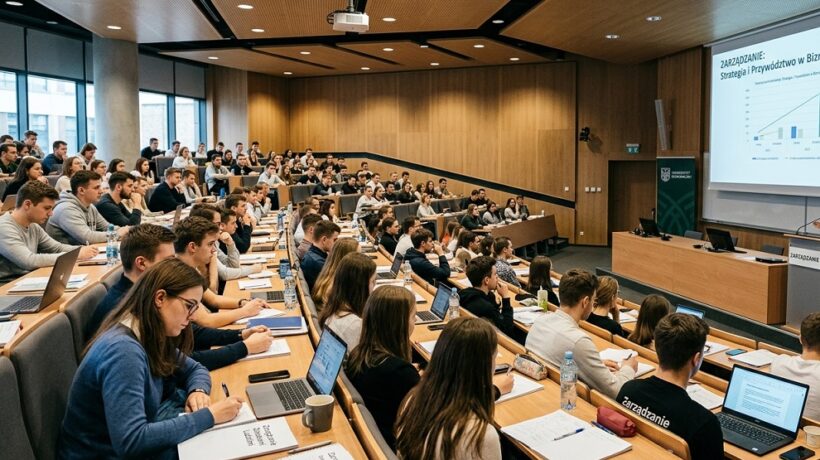
Management at Cracow University of Economics (UEK): The Most Difficult Subjects
Choosing to study Management at the Cracow University of Economics (UEK) is a natural step for many high school graduates towards a career in business, finance or marketing. The reputation of the university and the location of the campus in the very center of Krakow, at 27 Rakowicka Street, attract thousands of candidates every year. However, statistics and screening of first– and second-year students show that a diploma from this university requires passing through a number of subjects that for many turn out to be an insurmountable barrier.
The management at CUE has a variety of opinions – from admiration for the modern campus and proximity to corporations, to voices of frustration related to the rigor of some departments. The following analysis sheds light on what studies in this field of study really look like, which exams generate the most entries in the USOS system with the content “no pass” and what determines whether a given student will survive to defend a bachelor’s or master’s degree.
The most difficult subjects in Management (UEK)
The Management degree program is designed to combine soft knowledge with hard analytics. It is quantitative and technical subjects that pose the greatest challenge. Below is a list of courses that most often end with a retake session or the need to purchase a condition.
Mathematics
Mathematics in the first semester is the first serious contact with the academic pace for many students. The program includes linear algebra (matrices, systems of equations) and mathematical analysis (derivatives, integrals, study of the course of variability of functions).
- Form of classes: Lecture and exercises.
- Method of examination: A written exam, often consisting of a task-based and theoretical part.
- Difficulty: Very high for people with humanistic profiles.
- Why did students fail: The main problem is the pace imposed by the instructors and the need to be fluent in using schemes that were not present in high school.
- Question Exchange: It exists, but the tasks are modified regularly, which makes it impossible to learn by heart.
- Risks: This is often where the first deletion from the list of students occurs if the student does not use two deadlines and does not submit an application for a commission paper.
Descriptive and mathematical statistics
This subject usually appears in the second or third semester. It requires not only counting, but above all interpreting the results.
- Form of classes: Exercises in computer laboratories (using Excel or Statistica) and lectures.
- Method of examination: Partial colloquia and a large final exam.
- Difficulty: High due to the abstractness of some concepts (probability, hypothesis testing).
- Teachers’ approach: The Department of Statistics at CUE is known for its high substantive requirements.
- Risk of the condition: Very large. Statistics is a subject that many students take as a condition until the next year.
September 20, 2026
Financial accounting
Accounting is often called the “language of business”, but for Management students it can be a foreign language. The course requires an understanding of the principles of recording business operations, balance sheet and profit and loss account.
- Form of classes: Exercises consisting in decreeing documents on “gallows” (T-accounts).
- Material Quantity: Huge. It is necessary to master not only the logic of accounting, but also the current provisions of the Accounting Act.
- The most common mistakes: Lack of account balancing, incorrect classification of assets and liabilities.
- Stress: High, especially during time colloquia, where a mistake at the beginning of the task affects the entire result.
Microeconomics and Macroeconomics
Although these are theoretical subjects, they require efficient use of graphs and mathematical models (e.g. the IS-LM model).
- Form of classes: Mass lectures in Hall D or C and smaller exercise groups.
- Method of examination: Multiple-choice tests, often with negative points, which makes “shooting” risky.
- Stress level: A medium but large syllabus volume makes learning need to start weeks before the session.
- Inquiries: They depend on the leader, but are rarely found in large cathedrals.
Analysis of the difficulty of subjects in Management (CUE)
| Subject | Difficulty (1-10) | 🧠 Stress level | ⏳ Study per week | ⚠️ Risk of the condition |
| Mathematics | 🟥 9 | 🔥 Very high | 10-15 h | 🔴 High |
| Statistics | 🟧 8 | ⚡ High | 8-12 h | 🚨 Very high |
| Accounting | 🟧 8 | ⚡ High | 10-12 h | 🟡 Medium |
| Corporate finance | 🟨 7 | 💬 Medium | 6-9 h | 🟡 Medium |
| Microeconomics | 🟨 7 | 💬 Medium | 5-8 h | 🟢 Low/Medium |
When do the most students drop out?
Analyzing the process of studying at CUE, it is possible to point out two key moments when the greatest sifting of students occurs.
The most difficult semester: The first year and the adaptation shock
Most people drop out or are crossed out after the first semester. The most difficult semester is usually the first or second semester. This is due to the clash of expectations with reality. Many students choose Management, thinking that it will be studies based on “case studies” and discussions about marketing. Meanwhile, the first year is hard work on the basics: mathematics, microeconomics and law.
The shock after high school is real. The lack of ongoing testing of knowledge (lack of daily oral answers) makes students postpone their studies until the last minute. The first colloquium in mathematics in mid-November often ends in a massive failure, which is the first warning signal.
The September Campaign and Burnout
The second critical moment is the end of the second semester. People who have “slipped through” the winter with one condition often cannot cope with the accumulation of material in the summer session (e.g. Statistics + Finance). The September campaign in Krakow can be stressful – while friends from other universities are finishing their holidays, CUE students spend whole days in the Main Library at Rakowicka Street, trying to save the year.
Mental problems and lack of sleep are common phenomena during this period. Even very good high school graduates, accustomed to certificates with a belt, cannot cope with failure, which is the first “unregret” in their lives at USOS. Is it difficult to make a living on Management? Yes, if you do not have the ability to select material and resistance to stress.
Detailed analysis of critical objects
Simply indicating the names of courses is not enough to understand why the sifting of students in Management at CUE remains at a constant level. The problem is not only the volume of material, but the specificity of the requirements of individual departments, which have been considered a selection “sieve” for years.
Mathematics – the barrier to abstraction
In the first year, mathematics (conducted, m.in, by the Department of Mathematics in Hall C) strikes students not so much with the difficulty of calculations, but with the need to prove theorems and operate on matrices. Students most often pour water through:
- Investigation of the course of function variability: This is where errors in second-order derivatives appear, which affects the entire chart.
- Indefinite and definite integrals: Lack of proficiency in substitution and through parts methods leaves the exam sheet half empty.
- Linear Algebra: Many people do not understand the concept of the space base or self-values, which is crucial for passing the second colloquium.
Statistics – the trap of interpretation
In the case of Descriptive and Mathematical Statistics (often carried out in Hall D), the biggest difficulty is not the substitution for standard deviation or variance into the formula. Students lose points en masse on:
- Statistical inference: Misinterpretation of p-value or improper selection of a parametric test for a hypothesis.
- Linear Regression: The problem is to understand what the coefficient of determination really means in an economic context.
- Question Exchange: Although there are legends about repetitive tasks, the department regularly changes the input data, which for people who learn diagrams by heart ends up with a negative result in the USOS system.
Corporate finance – flow logic
This subject in the second year often generates the highest number of revision sessions. Students are unable to:
- Valuation of investment projects (NPV, IRR): A single error in the discount rate (WACC) invalidates the entire multi-page model.
- Break-even analysis: Distinguishing between fixed and variable costs in complex case studies can be problematic under time pressure.
- Working capital management: Understanding the cash conversion cycle requires a holistic view of the company, which is lacking in people who only learn from textbooks.
Anatomy of Resignation – Why and When Do Students Leave?
Analyzing the statistics, you can see that resignations on Management are not evenly distributed. There are specific moments when students decide to cross themselves off the list of students or submit their resignation themselves.
Semester 1: Shock and Verification (December/January)
This is the time of the first wave of resignations. The main reason is disappointment with the profile of the studies. Many people choose Management, hoping for creative workshops, and they collide with organizational theory and hard mathematics. In addition, the approaching first winter session and the vision of the September campaign paralyze people who are unable to impose the rigor of self-study.
Semester 3: Entry into Major Subjects (October/November)
The second critical moment. Students who “slipped through” the conditions in the first year suddenly realize that the lack of foundations in mathematics prevents them from understanding statistics or econometrics. This is when most decisions arise to change from university to private or to switch to extramural mode in order to be able to work and pay ECTS credits for subsequent repetitions of subjects.
Why do the best quit?
Often, people with high averages disappear from the list of students. The reason is usually burnout and perfectionism. These students cannot withstand the pressure of combining their studies with their first ambitious internships in Krakow corporations (e.g. at the Mogilskie roundabout or in the Business Park in Zabierzów). They choose a job, recognizing that practical experience in Excel is more valuable to them than fighting for every grade in the index.
Management Internships – Theory vs. Krakow Labor Market
Management internships are an element of the program that arouses extreme emotions. On the one hand, they are a chance to enter the profession, on the other – a bureaucratic burden.
What does it look like in reality?
Most CUE students are looking for internships in Krakow’s shared service centers (BPO/SSC). Companies such as State Street, HSBC, Capgemini and Shell regularly recruit students from Rakowicka.
- What do students not cope with? The biggest problem is the lack of proficiency in Excel at an advanced level (pivot tables, VLOOKUP, simple macros) and business communication in English. The university teaches management theory, but it does not teach how to write a professional report for a client from the USA or London.
- Formal errors: Students often leave formalities to the last minute. Failure to sign the internship supervisor in a timely manner results in the failure to pass the module in USOS, which may lead to the need to purchase a condition, despite the actual completion of the job.
How to survive the internship?
The key is to choose a place that offers real tasks, not just archiving documents. It is worth targeting finance, HR or logistics departments in large companies located in districts such as Czyżyny (near Jana Pawła II Avenue) or Ruczaj (near Czerwony Maki). Although it takes a lot of time to get there by tram 52 from the UEK campus to Ruczaj, the experience gained there is a bargaining chip on the labor market.
Where to work after Management?
Studying at the CUE in Krakow gives you a unique location advantage. The city is a hub for international business, which determines career paths.
Popular career paths:
- Junior Financial Analyst / Accountant: Starting in a corporation in audit or accounting. Earnings at the start (2024/2025) oscillate between PLN 5500 – 7000 gross.
- Junior Project Manager: Work in IT or operations. It requires Agile/Scrum certificates, which are rarely mentioned in studies, so it is necessary to further education on your own.
- HR & Recruitment: A very popular course for people who prefer “soft” management. Krakow is a hub of recruitment companies serving the whole of Europe.
- Own business: Thanks to the business incubators operating at the CUE, some students set up start-ups, although it requires great determination while passing the most difficult subjects.
Is it worth it? ROI (Return on Investment) Analysis
Management at CUE should be treated as a networking platform and a base of theoretical knowledge. A diploma from this university still opens many doors in Krakow, but in itself does not guarantee a high salary. The true value of studies comes when the student is able to translate theory (e.g. from lectures in Hall S) into practical solutions in the first work.
What do internships in Management look like?
Internships in Management are mandatory and usually have to last at least 3-4 weeks (depending on the program and the number of ECTS credits assigned to the module). The student has to find an internship place on their own, which is stressful for many people without experience.
The realities of contact with the labour market
Krakow offers great opportunities thanks to the presence of corporations in such districts as Czyżyny (Comarch), Zabierzów (Krakow Business Park) or Bonarka. However, the first contact with the practice is often painful. The university teaches theories (e.g. inventory management models), and at work, the student collides with Excel sheets with thousands of rows or simple administrative work.
The most common problems during internships
- Documentation: Filling out the internship diary, obtaining signatures and opinions of the tutor. Any formal error may result in the internship not being recognized by the coordinator at the university.
- Connecting with Learning: Students often try to do internships during the semester (e.g. in the 3rd year), which, with a busy schedule of classes in the buildings of Pavilion S or C, leads to chronic fatigue.
- Lack of technical preparation: The university does not always teach specific ERP or advanced SQL systems, which are standard in Krakow’s shared service centers (BPO/SSC).
The realities of a student’s life in Krakow
Studying at CUE is not only about learning, but above all about logistics and the cost of living in one of the most expensive cities in Poland.
Cost of living and rent
Krakow has ceased to be a cheap city for students. Prices for renting a room in the vicinity of Rakowicka, Lubicz or Grzegórzki streets start from PLN 1300-1600 plus utilities. An alternative is the CUE dormitories (e.g. Fafik at Racławicka Street or Amor), but the number of places is limited.
Students looking for savings often choose further districts such as Mistrzejowice or Bieńczyce, which is associated with daily commuting. MPK Kraków operates efficiently, but trams 4, 18, 52 are extremely crowded during rush hours. Getting from Ruczaj (where the Jagiellonian University campus is located) to the CUE can take up to 45-50 minutes.
Daily logistics
The CUE campus is compact, which is a big advantage compared to the Jagiellonian University or PK scattered throughout the city. However, moving between the Sports Pavilion and the Main Building requires time discipline, especially when the break between classes is only 15 minutes.
Time to rest is a luxury commodity. A Management student who wants to have a good CV is usually looking for a part-time job or internship from the 2nd year. Combining work in a corporation at the Mogilskie roundabout with studying for a colloquium in Accounting is a standard that leads to quick burnout.
Why do good students drop out?
The screening mechanism at CUE does not always apply to the most vulnerable people. Students who were top students in high school often drop out. Why is this happening?
- The Problem of Perfectionism: Trying to learn everything 100% in every subject is impossible. You should be able to prioritize courses for 5-7 ECTS, at the expense of those for 1-2 ECTS.
- Lack of material selection skills: Hundreds of definitions are often given in lectures. The key is access to the question exchange and knowledge of what a given professor really requires on the exam.
- Memory overload: Subjects such as Law or Economic History require you to cram in a huge amount of facts in a short period of time.
- Stress related to corrections: The “condition” mechanism is expensive. One failed correction costs several hundred zlotys (depending on the number of ECTS credits per subject). Financial pressure is superimposed on academic pressure.
Frequently asked questions by Management students at CUE
How much does a CUE condition cost?
The cost of a condition depends on the number of ECTS credits assigned to the course. The rate for one ECTS credit is determined annually by the Rector’s order (usually it oscillates between PLN 100 and 150). If the course has 5 ECTS, the cost of repetition can be up to PLN 750.
Is it possible to have two conditions at the same time?
Theoretically, yes, as long as the sum of missing ECTS credits does not exceed the limit of credit debt allowed in a given year/semester (usually it is about 10-12 ECTS). However, it should be remembered that two conditions from difficult subjects (e.g. Mathematics and Statistics) are almost a guarantee of problems in the next year.
What happens after failing the third term?
According to the study regulations, the student is entitled to the first and retake dates. The third term (the so-called extended session) is rare and depends on the goodwill of the lecturer or the decision of the dean. If a student fails the course, he/she must apply for conditional enrolment for the next semester or year.
How does the commission (commission exam) work?
A commission may be requested from the Dean in the event of justified objections to the impartiality of the instructor or the form of the exam. However, this is an “atomic option” – the exam takes place in front of a committee of several people, and the requirements are usually very strict.
Does the Dean’s Office help students
The dean’s offices at the CUE are computerized and most matters are handled by USOS. Opinions about the service vary, but the key is to meet the deadlines for submitting applications. Once the cut-off date is exceeded, the system is blocked and official assistance becomes impossible.
Where to get old questions and study materials?
The main source is Facebook groups for specific years and older years. Students exchange files, studies and photos of exam sheets from previous years. It is also worth using the resources of the CUE Main Library, which has access to many online databases.
Is it possible to reconcile a full-time job and full-time studies in Management?
In the first year, this is extremely difficult due to the large number of “contact” hours and difficult quantitative subjects. In the third year, with the right schedule, many students switch to a 3/4 or full-time work system, but this is at the expense of their private lives and grades.
What is a “dean’ and when is it worth taking it?
Dean’s leave is a break in studying without losing your student status. It is worth considering it in the case of serious health or personal problems or when the number of accumulated conditions makes it impossible to continue learning. This allows you to “clear out” the backlog without being crossed off the list.
What does the “chase for entries” look like?
Currently, most of the ratings are entered directly into the USOS system. However, in the case of some seminars or elective classes, it is still important to have personal contact with the lecturer during duty hours (consultation hours), which students commonly call “chasing an entry”.
Is Management at CUE worth it
Despite the large sifting of students and difficulties with subjects such as Statistics, the UEK diploma is recognizable in Krakow corporations. However, it is crucial that studies are not the only activity – employers on the Krakow labor market value the combination of theory from the CUE with practical experience gained during their studies.
September 20, 2026