


Active learning methods: TOP 3 that will transform your lessons (and the teacher’s secret weapon)
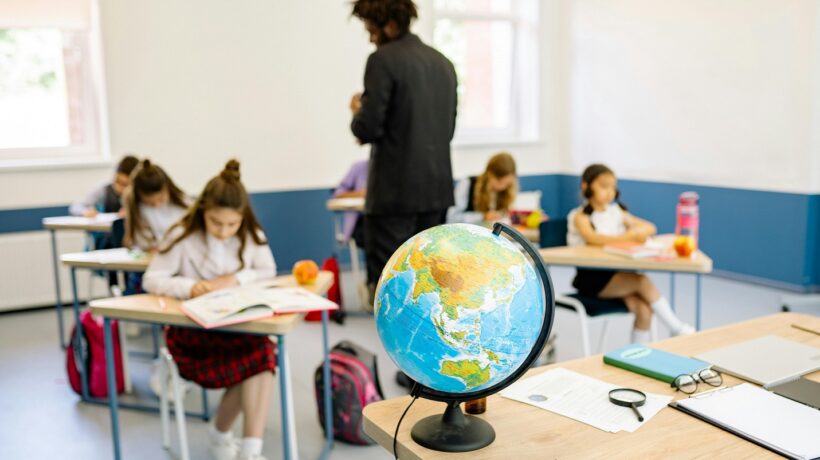
You know it all too well. An afternoon lesson, a silence in the classroom so thick you could cut it with a knife. A few pairs of eyes staring out of the window, the rest fixed blankly on their textbooks. Despite your efforts, questions, and encouragement, there is nothing but passivity from behind the wall of desks. It is one of the most frustrating experiences in our profession, making us wonder: how do we reach their minds and hearts? The answer lies in active learning methods – powerful tools that transform the classroom from a lecture hall into a vibrant laboratory of thought and action.
In this article, you won’t find dry theory. We will focus on three universal, highly effective methods that work in every classroom and for every subject. I will show you how to implement them and, more importantly, reveal a secret solution to the problem that is their biggest drawback: the enormous amount of time required for preparation.
Why is a traditional lecture no longer enough?
For decades, the ‘teacher talks, student takes notes’ model was the foundation of education. However, the world is moving forward at pace, and our students, immersed in a digital, interactive reality, require different stimuli. Passive information absorption is simply ineffective. Research in neuroeducation proves beyond doubt that the brain learns best through action, experience, and emotion. We remember only a fraction of what we hear, but significantly more of what we independently do, say, or experience.
Furthermore, the goal of today’s school is no longer just the transmission of encyclopaedic knowledge, which anyone can find in a few seconds on the internet. Our task is to shape the ‘4Cs’ of future competence: creativity, critical thinking, collaboration, and communication. None of these skills can be learned through passive listening to a lecture. They require practice, trial and error, and interaction – which is exactly what active learning methods provide.
3 Universal active learning methods your students will love
Here are three pillars of modern pedagogy that will allow you to engage even the most reluctant students.
Brainstorming – creativity without limits
Brainstorming is much more than just throwing around loose ideas. It is a disciplined technique for creative thinking, where the key principle is the deferral of judgement. During the idea generation stage, every thought—no matter how absurd—is valuable and welcome. It is this suspension of criticism that opens students’ minds, eliminates the fear of giving a ‘stupid answer’, and unleashes layers of authentic creativity. Students learn to build on the ideas of others, and innovative solutions emerge from the chaos of seemingly unrelated thoughts.
In practice, classroom brainstorming works perfectly as a lead-in to a new topic or a summary of a unit. In History, you can collectively generate hypotheses about the causes of the fall of the Roman Empire. In English, you can look for unusual interpretations of a poem, and in Biology, create a list of ways to protect the local ecosystem. It is a method that teaches that everyone’s voice in the group matters.
Knowledge experienced, not just memorised
Drama is a technique that involves taking on roles and acting out scenes to gain a deeper understanding of a problem, phenomenon, or emotion. It is learning by doing in its purest form. A student who briefly ‘becomes’ Antigone, torn between divine and human law, no longer needs to memorise her dilemmas – they experience them. It is a powerful tool for building empathy and understanding that cannot be achieved by reading definitions from a textbook.
The drama method has infinite applications in school. In a PSHE (Personal, Social, Health and Economic education) lesson, students can act out a scene of assertive refusal, learning how to handle peer pressure. In Government and Politics, they can hold a mock trial, and in Physics, they can role-play as molecules in different states of matter, helping them to visualise abstract processes. Drama engages the whole person – body, mind, and emotions – making learning a lasting experience.
Mind maps – Organising the chaos of information
Mind maps, also known as mental maps, are a graphical method of note-taking that reflects the natural, radiant way our brains function. Instead of linear, monotonous notes, the student creates a tree-like structure where increasingly detailed branches stem from a central concept. The use of colours, symbols, and drawings further activates the right hemisphere of the brain, supporting creativity and the memorisation process.
Mind maps in teaching are an excellent tool for synthesising and organising knowledge in every subject. They can serve as lesson notes on the French Revolution, an essay plan for a set text, a summary of cell structure, or a graphical representation of English grammar tenses. Creating a mind map forces the student to actively process information, select the most important content, and recognise the connections between them.
The common denominator of success and… the biggest challenge
All these creative methods of working with students share a common denominator – they hand over the reins and the responsibility for the learning process to the students themselves. Instead of being passive recipients, they become active discoverers, creators, and researchers. This is precisely why these methods are so effective and yield lasting results. However, as every teacher knows, they face one fundamental barrier.
Their greatest enemy is time. Preparing an engaging drama script, devising intriguing opening questions for a brainstorming session, or gathering inspiring materials for a mind map takes hours of work. It is creative and satisfying work, but often a luxury that we simply cannot afford amidst a mountain of responsibilities.
Your creativity and your time – How to reconcile the irreconcilable?
These methods are brilliant, but preparing them is time-consuming. AI can prepare materials for a debate, create a game-based quiz, or suggest a case study in a matter of seconds. This technological revolution, happening right before our eyes, offers a solution to this age-old dilemma. Artificial intelligence is no longer a futuristic curiosity, but a real, accessible tool that can become every teacher’s most valuable assistant.
Artificial Intelligence: A teacher’s assistant for the 21st century
Imagine having a creative partner by your side who works for you 24/7. That is exactly how artificial intelligence functions in education. In the context of active learning methods, its help is invaluable.
Instead of racking your brain for a brainstorming topic, you can ask AI to generate 20 intriguing, open-ended questions in 10 seconds to spark a lively discussion on photosynthesis or totalitarianism. You will be surprised by their originality and relevance.
Instead of spending hours writing a drama script, you can task the AI with creating a brief description of a moral dilemma for a historical figure or literary character. Your students will receive a ready-made, engaging foundation to act out and interpret, while you save a significant amount of time.
And what about mind maps? You simply provide the AI with a main topic, for example, ‘Romanticism’, and in a matter of seconds, it will suggest key branches and sub-branches (characteristics of the era, philosophy, major creators in Poland and Europe, key works). Such a skeleton becomes an excellent starting point for a map that students will complete and develop during the lesson.
September 20, 2026
Transform theory into practice with the ‘Artificial Intelligence for Schools and Teachers’ guide
Knowing about active learning methods is one thing, but being able to implement them instantly without pulling all-nighters is a completely different quality of work. To bridge the gap between theory and practice, the guide ‘Artificial Intelligence for Schools and Teachers’ was created.
This isn’t just another textbook on educational innovation. It is a toolbox—a practical collection of ready-to-use prompts, strategies, and video guides that allows you to immediately harness the potential of AI in education. Thanks to it, you will reclaim hours of your life, surprise your students with fresh ideas in every lesson, and create engaging materials during a coffee break.
Stop choosing between an innovative lesson and a free evening. With our guide, you can have both.
Applying active learning methods is no longer a pedagogical whim, but a necessity and the measure of modern education. It is the key to developing the competencies our students will need to navigate the future. Until recently, the biggest obstacle to their widespread use was the time barrier. Today, thanks to technology, that barrier is disappearing. The combination of your passion, experience, and relationship with the student, alongside the unlimited creativity and speed of artificial intelligence, is the future happening right here and now.
Beyond the Big Three: A brief overview of other effective methods
While brainstorming, drama, and mind maps form the foundation, a modern teacher’s toolkit is far more extensive. It’s worth exploring other creative methods that can be rotated or combined to keep lessons dynamic and fresh.
The Project-Based Learning (PBL) method is one of the most comprehensive forms of “learning by doing.” By working over an extended period on a specific problem or task—such as creating a social campaign, building a DNA model, or organising an exhibition—students develop a wide range of competencies, from planning and time management to collaboration and public speaking.
On the other hand, the Oxford Union-style debate is a formalised discussion on a pre-set motion. It teaches the art of argumentation, the culture of debate, and respect for opposing views. It’s an excellent tool for developing critical thinking in Citizenship, History, English, or Ethics. It requires in-depth preparation and source analysis, engaging students long before the lesson even begins.
Shift in perspective: Teacher as Facilitator, not a lecturer
Adopting active learning methods involves a fundamental shift in how we perceive the role of the teacher. We stop being the sole source of knowledge—the all-knowing ‘lecturer’ standing at the front of the class. Instead, we become something far more vital: the architect of the learning process, a moderator of discussion, and a guide through the world of information.
Our primary task is no longer to provide ready-made answers, but to ask the right questions—open-ended questions that provoke thought, encourage reflection, and open up new avenues of enquiry. We monitor group work, intervene when a discussion veers off track, ensure a safe atmosphere, and help students arrive at their own conclusions. This change in perspective is crucial for the success of active teaching methods.
How to assess what is hard to measure? Formative assessment in action
A natural question arises: how do you assess a student’s work during a debate or a brainstorming session? The traditional grading scale seems inadequate here. This is where formative assessment comes in; its goal isn’t to dish out a grade, but to provide the student with feedback that helps them grow.
Instead of judging the ‘correctness’ of ideas, we focus on observing and appreciating the process: engagement, listening skills, the way they argue, creativity in finding solutions, or the ability to collaborate in a group. Short, constructive feedback (e.g., ‘It was great that you listened to Katie’s arguments before presenting your own. Next time, try to back up your point with a specific example’) is far more valuable to a student than any mark.
Overcoming resistance: What to do when students don’t want to be active?
Every teacher has encountered a situation where suggesting group work is met with a sigh of resignation or outright resistance. Student motivation is key, and passivity can stem from many causes: fear of being judged, shyness, a lack of self-confidence, or simply being used to the traditional lesson model.
To break down this resistance, it is vital to introduce active methods gradually and build a safe atmosphere where there is a ‘right to be wrong’. Start with short, simple pair-work tasks before moving on to more complex group projects. Explain the ‘why’ to your students—tell them exactly which skills they are practising during a debate or a drama session. Praising them just for having a go, rather than only for a perfect result, can work wonders in fostering openness and courage.