


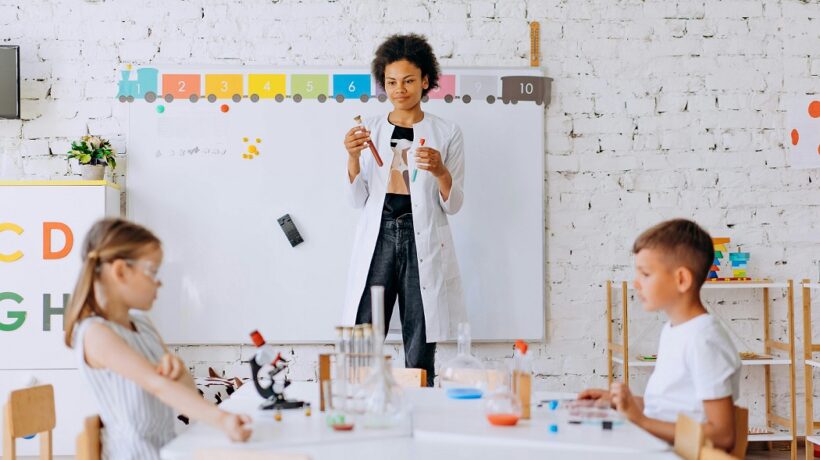
Fun science experiments and activities for children
In the era of dynamic technological and social changes, Polish education faces the challenge of preparing students not only to take exams, but above all to live in a world that requires flexibility, critical thinking and problem-solving skills. The research method, implemented through experiments and experiments, ceases to be a curiosity, and becomes the foundation of modern didactics. This article is a comprehensive guide that will indicate how to effectively implement learning by doing in 2025, in accordance with the applicable regulations and the real capabilities of institutions.
Why the Research Method Is Crucial in Education
The traditional model of teaching, based on knowledge transfer, is becoming insufficient. Experimentation is not only “playing with science”, but a strategic tool for building key competences, the importance of which is emphasized by both the latest neurodidactic research and the directions of changes in education law.
Experiment in the updated curriculum
- Fun science experiments and activities for children
- Why the Research Method Is Crucial in Education
- Experiment in the updated curriculum
- From STEM to STEAM – the role of art and creativity in science
- Legal requirements and safety – what every teacher needs to know in 2025
- Planning and Execution of Experiments – A Practical Guide for Teachers
- Step 1: Defining teaching objectives
- Step 2: Selection of experiences for the age and capabilities of the group
- Step 3: Resources and budget – how to do learning at a cheap cost?
- Step 4: Documentation and evaluation – how to measure the effects of learning through experience?
- Common Challenges and Turnkey Solutions (FAQ)
- Good practices – inspiring examples from Polish institutions
- Evaluation and assessment in the project method
- How does an explorer's brain learn?
- New competencies and risk management
- Experiment as part of larger educational projects
September 20, 2026
Although the full implementation of the amendment to the core curriculum is a continuous process, the trends for 2025 clearly indicate a shift away from encyclopaedism in favor of developing practical skills. The key assumptions that every teacher should take into account are:
- Interdisciplinarity: The core curriculum increasingly promotes the combination of knowledge from various subjects. The experiment becomes an ideal field for projects integrating biology, chemistry, physics, mathematics, and even art or technology.
- Focus on competence: Instead of asking “what does the student know?”, “what can the student do with this knowledge?” becomes crucial. The research method directly develops such competencies as:
Critical thinking: Analyzing results, formulating conclusions, questioning assumptions.
Troubleshooting: Hypothesis making and verifying them.
Group cooperation: Division of roles and tasks during the implementation of the experiment.
Creativity and innovation: Searching for non-standard solutions.
From STEM to STEAM – the role of art and creativity in science
The acronym STEAM (Science, Technology, Engineering, Arts, Mathematics) is an evolution of the popular STEM model. The inclusion of the Arts component (Arts, Design, Humanities) highlights that innovation is born at the intersection of science and creativity. In school practice, this means that a scientific experiment can be combined with:
- Creating aesthetic documentation (drawings, infographics, models).
- Device design (e.g. construction of a simple water filter from recycled materials).
- Presentation of results in theatrical or film form.
Such an approach not only makes classes more attractive, but also engages students with different predispositions, including humanists and artists in the scientific process.
Legal requirements and safety – what every teacher needs to know in 2025
The organization of experiments imposes a special responsibility on the teacher and the headteacher. The most important legal and organizational aspects are:
- Liability: The teacher is responsible for the safety of students during classes (in accordance with the Teacher’s Charter and the Civil Code). It is crucial to exercise due diligence.
- Laboratory regulations: Each room where experiments take place (even simple ones, in a kindergarten room) should have clearly defined safety regulations, which students are familiar with.
- Health and Safety Instructions: When using laboratory equipment or chemicals (even food products), it is necessary to discuss health and safety rules.
- Parental consents: For more advanced or unusual activities (e.g. field trips, experiments with the use of fire under close supervision), it is advisable to obtain written consent from parents.
Planning and Execution of Experiments – A Practical Guide for Teachers
Effective implementation of the research method requires careful preparation. The following steps will help you organize the process from A to Z.
Step 1: Defining teaching objectives
Before you choose a spectacular experiment, ask yourself, “What do I want my students to learn?” The goal should be related to the core curriculum.
- Bad example: We’re going to make a volcano out of soda and vinegar, because it’s cool.
- A good example: The aim of the course is to illustrate a chemical reaction (acid + base -> salt + water + CO2), discuss the concept of neutralization and observe gas release.
Step 2: Selection of experiences for the age and capabilities of the group
Preschool education (3-6 years):
- Objective: Arousing curiosity, learning through the senses, observing simple phenomena.
- Examples: Mixing primary colours, playing with water (what sinks and what floats?), planting and observing the growth of beans, sensory games with non-Newtonian liquid (potato flour and water).
Early Childhood Education (grades I-III):
- Objective: Introduction to the scientific method (problem -> hypothesis -> observation -> conclusion).
- Examples: Building a simple electrical circuit with a battery and a light bulb, creating a rainbow using a prism or a glass of water, studying the properties of a magnet, building a compass.
Grades IV-VIII:
- Objective: Systematic work using the research method, use of measurements, documentation.
- Examples: Testing the pH of various substances using red cabbage decoction, building a simple model of the solar system, studying the process of yeast fermentation, constructing a wind turbine.
Step 3: Resources and budget – how to do learning at a cheap cost?
The lack of a professional laboratory is not an obstacle. In 2025, creative resource management and obtaining external funds are becoming crucial.
- Kitchen as a laboratory: Use food products (vinegar, soda, oil, sugar, salt, dyes) – they are cheap, safe and easily available.
- Recycled materials: Plastic bottles, cartons, straws, caps are an excellent construction material.
- Grant programs: Actively seek information about grants for the development of STEAM education, e.g. as part of government, EU or corporate foundation programs. More and more funds are allocated to innovations in education.
- Local cooperation: Get in touch with a local university, tech company, or rural housewives circle. They are often willing to share their knowledge and sometimes equipment.
Step 4: Documentation and evaluation – how to measure the effects of learning through experience?
The evaluation cannot be reduced to checking whether the experiment “worked”. It is worth using formative assessment and various forms of documentation:
- Worksheets: Structured forms with space for a hypothesis, description of the coursework, drawing and conclusions.
- Design portfolio: A collection of the student’s works (photos, notes, reports) documenting their progress.
- Group presentations: Students discuss their results in front of the class by practicing communication skills.
- Self-assessment and peer evaluation: Students learn to evaluate the contribution of their own work and that of their colleagues to a group project.
Common Challenges and Turnkey Solutions (FAQ)
We answer the questions most often asked by teachers planning to introduce experiments in their lessons.
1. I don’t have access to a lab or specialized equipment. What to do?
- Solution: Create a “mobile laboratory” in the form of a cart or a box containing basic, safe materials (measuring cups, pipettes, magnifying glasses, vinegar, soda). Conduct experiments in a regular hall or, weather permitting, outside. Outdoor education is a powerful tool.
2. How to manage an experiment in a large class (25+ students)?
- Solution: Apply the test station method. Divide the class into smaller groups (4-5 people) and prepare a few different, short experiments. The groups rotate through the stations. Assign roles in each group (e.g., leader, clerk, logistician, spokesperson).
3. How to include students with special educational needs in experiments?
- Solution: Vary tasks. A student with dysgraphia can document the course using a camera on their phone, and a student with difficulty concentrating can receive a simpler, one-step task. Use multisensory experiences that engage different senses.
4. I’m afraid that the experiment won’t work. What then?
- Solution: Turn failure into a lesson! A failed experiment is the best opportunity to learn. Ask the class, “Why is the result different than we expected? What could have gone wrong? How can we modify the procedure to check this?” In this way, you teach the essence of the scientific method – verification and adaptation.
5. How to find time for experiments with an overloaded curriculum?
- Solution: Treat the experiment not as an add-on, but as the main method of implementing the topic. Instead of an hour of theory about pressure, do a 15-minute experiment with a bottle and balloon. The educational effect will be much more lasting and deeper, and you can spend the saved time analyzing the results.
Good practices – inspiring examples from Polish institutions
- “Eco-patrol in the Municipal Kindergarten No. 12 in Toruń”
The children set up a composter in which they observe the process of decomposition of organic matter. They regularly measure its temperature and humidity. It is an interdisciplinary project combining nature, mathematics (measurement) and environmental education. - “School Festival of Science at the Explorers Primary School in Poznań”
Once a year, students from grades IV-VIII prepare their own stands with experiments, which they present to younger colleagues and parents. The project teaches independence, responsibility and the ability to popularize science. For this purpose, the institution obtained funds from the local program to support educational initiatives.
The implementation of the research method in everyday school and kindergarten practice is not a whim, but a necessity. It is an investment in human capital – in a generation that will be able to think analytically, cooperate and bravely face the challenges of the future. In the reality of 2025, the teacher-experimenter is a guide to the world of knowledge, not just its provider. It’s time to roll up your sleeves and start exploring the world with your students.
Evaluation and assessment in the project method
The key dilemma of teachers implementing the research method is the way it is assessed. The traditional gradual scale seems inadequate to assess a process in which errors and failed attempts are a natural part of learning. In the reality of 2025, compliance of assessment with the Intra-School Assessment System (WSO) requires a well-thought-out strategy that honors both the process and the effect.
It is necessary to move away from zero-one grading, where only the correct final result counts. Instead, the assessment should become a comprehensive analysis of the student’s competencies at different stages of work. The elements subject to formative assessment (and in summary also summative) should be:
- Ability to formulate questions and research hypotheses: Is the student able to define the problem independently? Is his hypothesis logical and verifiable in school conditions?
- Planning the research process: Assess the ability to design the steps of the experience, anticipate the materials needed, and divide the tasks within the team.
- Implementation and documentation: Reliability in conducting observations, precision in recording results (regardless of whether they confirm the hypothesis), as well as aesthetics and transparency of the documentation (e.g. in the form of a lapbook, blog or presentation).
- Analysis and inference: This is a key stage in which we assess a student’s ability to interpret results, connect facts, and formulate logical, evidence-based conclusions. It is especially valuable when the student can explain why the experiment may have produced unexpected results.
- Social competences: The ability to communicate effectively in a group, negotiate, solve problems together and accept criticism constructively.
A tool supporting such an assessment can be a criterion project evaluation card, clearly communicating to students what will be taken into account. This allows for transparency of the process and teaches young people self-assessment and responsibility for individual stages of work.
How does an explorer’s brain learn?
Understanding why a research method is so effective requires looking at the learning process from a neuroscience perspective. Experimentation engages the brain in a way that is incomparable to passive assimilation of information, which directly translates into the durability of the acquired knowledge.
When a student conducts an experiment on their own, their brain activates many areas at once. Multisensory learning – involving sight, hearing, touch, and sometimes even smell – creates a dense and rich network of neural connections. Information encoded in this way is much easier to recall than a fact remembered only verbally. What’s more, the moment of discovery, the so-called “aha!” effect, causes a release of dopamine in the brain. This neurotransmitter, associated with the reward system, acts as a “save” button for the memory traces that are formed, amplifying them and motivating them to continue searching.
That is why students often remember the course of a self-made volcano made of soda for years, while the definition of a chemical reaction learned from a textbook fades from memory after a few days. The teacher, by designing experiences, thus becomes the architect of a brain-friendly learning environment – an environment that naturally stimulates curiosity and maximizes the potential for memorization.
New competencies and risk management
The introduction of experiments into everyday school life forces a redefinition of the role of the teacher. He ceases to be the only source of knowledge and answers (“the sage on stage”) and becomes a facilitator of the discovery process (“guide at his side”). This change requires the development of new competencies, primarily the ability to ask open-ended questions that provoke thinking, instead of giving ready-made solutions. The role of the teacher is to inspire, moderate discussions, support in difficulties and take care of a safe space for making mistakes.
An integral part of the facilitator’s role is advanced risk management. Safety concerns are natural, but they should not paralyze operations. A professional approach is based on conscious judgment, not avoidance. A practical tool is a simple risk assessment matrix that the teacher can create before any more complex experience. It involves the assessment of two factors:
- Probability of an adverse event (low, medium, high).
- Potential severity of effects (low, medium, high).
An experiment in which the risk is low in both dimensions (e.g. testing the buoyancy of objects in water) requires only basic supervision. On the other hand, an action where the probability is low but the potential effects are medium (e.g. working with hot water in a solubility test) already requires the implementation of specific preventive measures: eye protection, working in small groups, demonstration by the teacher. Such a conscious approach not only guarantees safety, but also models a responsible and mature approach to research work for students.
Experiment as part of larger educational projects
Individual experiments, while valuable, reach their full potential when they become part of larger, interdisciplinary educational projects. The project entitled “School Air Quality Monitoring System” can integrate knowledge from chemistry (air composition), biology (lichen scale), physics (construction of dust sensors), computer science (data analysis and visualization) and civic education (presentation of results to the local community).
Such ambitious, long-term projects have a much better chance of obtaining external financing, which in 2025 is often crucial for innovative institutions. When preparing a grant application, emphasis should be placed on such aspects as:
- Methodological innovation (learning by doing, project method, STEAM).
- Development of key competences (critical thinking, cooperation, problem solving).
- Sustainability of results (e.g. creation of a permanent research station, raising environmental awareness).
- Cooperation with the environment (parental involvement, partnership with a local university, technology company or forest district).
Investing time in preparing a good project is not only a chance to get funds for modern equipment, but above all a way to build a culture of innovation in the school and to really involve students in solving authentic problems.