


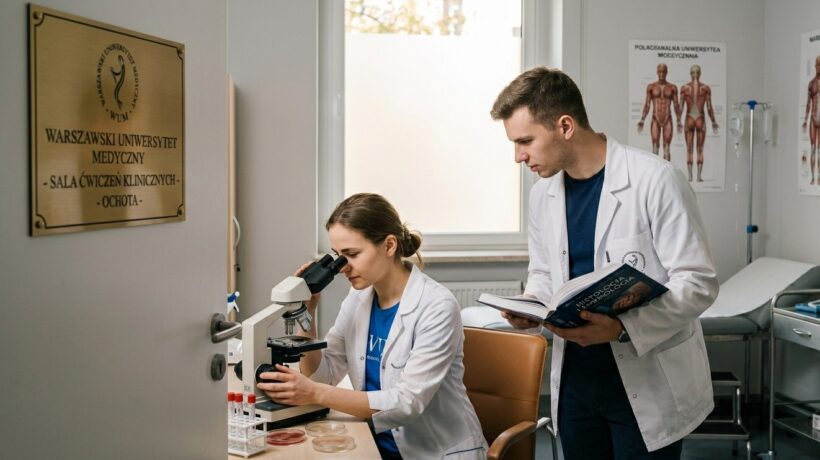
Medical Studies in Warsaw: WUM vs. Private Universities – 2026/2027 Guide
The choice of medicine in Warsaw in the academic year 2026/2027 is a decision between the prestige bought with Lindley’s blood and the “premium client” model at private universities, where tuition fees exceed the annual earnings of a mid-level programmer. If your goal is a doctor’s degree obtained in the capital, you need to understand one thing: in Warsaw you don’t study “medicine”, you study either “at the Medical University of Warsaw” or “in private”. The Medical University of Warsaw (WUM) is a juggernaut with the Banach Campus, where the hierarchy is harder than the concrete in the Warsaw University of Technology Main Building, while players such as Lazarski University or Kozminski University offer infrastructure from the 21st century, but they are still fighting for recognition in the eyes of the heads of the old date from the hospitals of the Ministry of Interior and Administration or at Wołoska Street. Be prepared to spend PLN 60,000 – 85,000 for a year of education on paid paths and ZTM logistics, which will force you to travel between Ochota, Wilanów and Prague.
WUM vs. Private in the reality of Warsaw 2026
Warsaw is the most expensive market for medical education in Poland. In 2026, the reality is merciless: stationary (full-time) at MUW is a fight for fractions of points from the matura exam (biology and chemistry at the level of 92%+), and anything below this line is entering the world of huge money.
Medical University of Warsaw (WUM) – Banach and Lindley Campus
Studying at the Medical University of Warsaw is an entry into a system that is based on the legendary “pins” (practical exams in anatomy on time) at Collegium Anatomicum at Lindleya Street.
- Location: A stretch between the Department of Anatomy on Lindleya Street (near the Central Station) and the Library and Information Centre (CBI) on Banacha (Ochota) is your daily ritual. Trams 1, 7, 9, 25 will be your second home.
- Climate: Here you are the number in the USOS system. The academic hierarchy is felt at every step. “The Stock Exchange” (a collection of questions from previous years) is the only way to survive the “colossi” of biophysics or histology.
- Hidden costs: Even if you study for free, Warsaw will get to you. Renting a room in Ochota (Grójecka Street, Dickensa Street) costs 2800 – 3500 PLN. Kebab at Alika’s pod Banacha is your main meal during the windows.
September 20, 2026
Private universities (Łazarski, Kozminski, UM MSC)
Lazarski University (Świeradowska Street, close to the Wilanowska Metro) and Kozminski University (Jagiellońska Street) are new players who are already well-established in 2026.
- Łazarski: Medicine here is a pro-student approach. There is no “bullying” for sports, which is a common accusation against the Medical University of Warsaw. World-class medical simulators, smaller groups, but… tuition fees in 2026/27 oscillate around PLN 75,000 per year.
- Maria Skłodowska-Curie Medical University (UM MSC): Located in the center (Anielewicza Street), it offers slightly lower price thresholds, but the clinical infrastructure is scattered throughout Warsaw (from Prague hospitals to facilities in Otwock).
Figures (2026):
- MUW (part-time/evening): approx. PLN 58,000 / year.
- Lazarski University: approx. PLN 78,000 / year.
- Kozminski University: approx. PLN 82,000 / year.
- Studio apartment rental (Ochota/Mokotów): 4500 PLN+ (all-in).
Recruitment strategy (IRK vs. own systems)
Recruitment at MUW goes through the IRK system. Dates are key – if you don’t upload a scan of your high school diploma by mid-July, you’re out. At private universities, the order of applications often counts when meeting the minimum score.
- Red Flag: Beware of “enrollment fees” at private universities. It is often 2000-3000 PLN, which is lost if you resign after getting to the MUW on the reserve list.
ZTM logistics and the Varsovian Card
Medicine in Warsaw is a constant movement. Anatomy on Lindley, biochemistry on Banach, pediatrics on Żwirki and Wigury.
- Purchase a 90-day ticket (50% student discount) immediately after receiving your ELS card.
- Obtaining the Varsovian Card (requires PIT settlement in Warsaw or registration) will reduce the cost of a quarterly ticket by another few dozen zlotys.
Equipment (Apron, Stethoscope, Skull)
Don’t buy a Littmann stethoscope in your first year – in physiology, the simplest model will suffice, and you’ll still use it mainly to measure the blood pressure of your classmates. The real expense is atlases (Netter, Sobotta). Search for used ones on FB groups “Medical Marketplace Warsaw”.
Insurance and USOS
Make sure that the university has registered you for insurance (if you do not work on a contract of mandate and are not covered by your parents’ insurance). In the USOS system, check the status every week. Not passing ECTS for health and safety or library training may block you from approaching the winter session.
Table: Comparison of MUW vs. Private Universities (Data for 2026/27)
| Feature | WUM (full-time) | WUM (evening) | Lazarski University | Kozminski University |
|---|---|---|---|---|
| Tuition (year) | 0 PLN | approx. PLN 58,000 | approx. PLN 78,000 | approx. 82 000 PLN |
| Location | Ochota / Śródmieście | Ochota / Śródmieście | Wilanów / Mokotów | Prague-North |
| Clinical Base | Best (Teaching Hospitals) | Best (same hospitals) | Cooperation (e.g. Ministry of Interior and Administration) | Cooperation (e.g. Międzylesie) |
| Approach | Hierarchical, traditional | Hierarchical, traditional | Partner, modern | Business, high standard |
| Progi (Matura) | Extremely high (92%+) | High (80%+) | Medium (70%+) | Medium / High |
| System IT | USOS | USOS | Own (Virtual University) | USOS |
Why do most students rely on the first year?
- Anatomical shock (Lindley’s): The first entry into the prosectorium and the first “pin” (a practical exam where you have 30-45 seconds to recognize the anatomical structure indicated by the pin) is the moment of verification. Students rely because they try to learn from books, instead of spending time in “pins”.
- Lack of time management: Medicine in Warsaw is not only about learning, it is 2-3 hours a day at ZTM. If you don’t study on tram line 9 going through Aleje Jerozolimskie, you will lose out on the material.
- Cost of living: Many students (and their parents) underestimate Warsaw. Inflation in 2026 has made a “cheap” apartment an oxymoron. Casual work in medicine is almost impossible for the first 3 years. If you don’t have a “financial cushion” for PLN 4000 per month (except for tuition), the dean will be waiting for you after the first semester.
- Ignoring “The Stock Market”: At the Medical University of Warsaw, trying to be “honest and ambitious” by not using questions from previous years is suicide. The system is constructed in such a way that without a “stock exchange” it is impossible to process the material from biochemistry or physiology a week before the exam.
Anatomy of Prestige: Where the Heart of Clinical Warsaw Beats
When choosing medicine in Warsaw, you are primarily buying access to the patient. In 2026, the distance between MUW and “private” in this aspect has been drastically shortened, but the hierarchy still exists.
- MUW and “Mother’s Hospitals”: While studying at the Medical University of Warsaw, your natural environment is giants: the Central Clinical Hospital (CSK) at Banacha Street and the Clinical Hospital of the Child Jesus at Lindleya Street. This is where the “real medicine” of emergencies and transplantology takes place. The downside, however, is the massiveness. In clinical classes, a group of 6-8 people crowded at one patient’s bed is still a standard. In the USOS system, the fight for “good” clinics (those where they actually let you touch the patient, and not just stand in the corner) resembles a battle for PE tokens.
- Private offensive (Łazarski and KUL): Lazarski and Kozminski University do not have their own multi-profile hospitals, so they “rent” departments throughout the city. Their students end up in places such as the Hospital of the Ministry of Interior and Administration at Wołoska Street, the Bródnowski Hospital or prestigious private institutions (e.g. Medicover in Wilanów).
- Advantage: The clinical groups are smaller (3-5 people). More often you get an ultrasound head in your hand or assist in simple procedures.
- Disadvantage: Logistical spread. You can have a seminary in Wilanów at 8:00 a.m., and psychiatry classes in Bródno at 1:00 p.m. Without a car or a working city card with a pre-loaded quarterly ticket (ZTM), you have no chance of being punctual.
Tuition fees are just the tip of the iceberg
If you think that PLN 75,000 a year in Łazarski is the end of your expenses, 2026 will brutally verify your assumptions. Medical studies in Warsaw are a bottomless financial well.
- Fees for “conditions” and repeating the year: At the Medical University of Warsaw, the system is merciless. If you fail the legendary anatomy on Lindley in the second term, the cost of repeating the item in 2026 oscillates between PLN 12,000 – 15,000. At private universities, despite the partnership approach, the “condition” costs in proportion to ECTS – be prepared for PLN 5,000 – 8,000 for one subject.
- Compulsory third-party liability and occupational insurance: Already in the third year, when entering clinics, you must have third-party insurance for a medical student. Hospitals such as the one at Banacha Street require strict adherence to vaccination dates (hepatitis B is the basis) and up-to-date sanitary and epidemiological tests. The cost of these formalities in Warsaw branches (e.g. Medicover or LuxMed) is an additional few hundred zlotys a year.
- Premium Materials and “Exchange”: In 2026, Sobotta’s paper atlases are a luxury. Students are massively switching to subscriptions to platforms such as Complete Anatomy (approx. PLN 400/year). At the Medical University of Warsaw, “exchanges” (materials from previous years) circulate in closed groups on Discord. On the private market, more often people invest in preparatory courses for LEK from the 4th year, which costs another 2000 – 3000 PLN.
Simulation vs. Prosectorium
In 2026, the fight for the student has moved to medical simulation centers.
- MUW and Medical Simulation Center (CSM): Located on the Banach Campus, it is one of the most modern facilities in Central Europe. You have fully equipped operating rooms and phantoms that “die” if you administer the wrong drug.
- Łazarski and KU – The advantage of technology: Private universities have opted for VR and Anatomage sectional tables. Instead of the smell of formalin on Lindley, you have a virtual scalpel cut on a 4K screen.
- Students’ opinion: “A virtual table is great for learning topography, but nothing can replace the touch of a real fascia and nerve in the prosectorium.” The Medical University of Warsaw still holds the primacy in access to human preparations (Corpse Donation), which in Warsaw is a key argument “for” people aiming for surgical specializations (surgery, orthopaedics).
Life in the “medical triangle”: Ochota, Mokotów, Śródmieście
The logistics of studying medicine in Warsaw determine your place of residence.
Ochota (Banach/Grójecka region): This is where the heart of the Medical University of Warsaw beats. If you live on Dickensa Street or Bitwy Warszawskiej 1920 Street, you are the “king of life”. The CBI library is a walk away, and Lindleya Prosectorium is a 1, 7 or 9 tram ride in 10 minutes.
- Costs: Renting a studio apartment in this area in 2026 is an expense of about PLN 4800. Medical students often choose “rooms-stations” with older ladies from Ochota (cost approx. 2200 PLN), which allows for silence to study pharmacology.
Mokotów/Wilanów (for Łazarski): If you have chosen Łazarskiego, look for accommodation near Metro Wilanowska or in Służewiec. Tram line 17 is your link to the rest of the world. Avoid commuting from Białołęka or Tarchomin – medicine does not forgive being late for clinical seminars.
Praga-Północ (for Kozminski): KU is located at Jagiellońska Street. Medical students from KU often rent apartments on new buildings in the vicinity of the Port of Prague. It is prestigious, close to the second metro line, but it takes 45-50 minutes to get to the hospitals on the left bank (e.g. on Banacha Street, if you have an internship there).
Student Survival Culture: IFMSA, SKN and “Tokens
Medicine in Warsaw is not just about books, it is about networking, which starts in October.
- IFMSA-Poland Warsaw Branch: It is the largest student organization, operating mainly at the Medical University of Warsaw, but open to other universities. They organize foreign exchanges and preventive campaigns (e.g. in shopping centers such as Galeria Mokotów). Being at IFMSA means points for residency and a chance to go to Japan or Brazil for internships.
- Student Scientific Clubs (SKN): There are hundreds of clubs operating at the Medical University of Warsaw. SKN at Banacha Street (e.g. cardiology, general surgery) are places where selection begins early. If you want to assist with operations in 2026, you must be an active member of the circle, write scientific papers and publish in journals from the ministerial list.
- Token System (PE & Languages): At MUW, the token system is archaic and brutal. If you don’t “click” the gym on Trojdena Street in the first 5 seconds after the registration opens in USOS, you’ll be left with chess at 7:00 a.m. or a swimming pool at the other end of the city. At private universities, PE is usually included in “premium packages” (e.g. passes to network gyms such as CityFit).
LEK 2027: The Ultimate Test of Truth
In 2027, after 6 years of torture, you will meet everyone at the Medical Final Exam.
- Statistics: Private universities (Łazarski, KU) invest huge funds in preparing students strictly for the LEK tests.
- Warsaw internship market: After graduation, the fight for a postgraduate internship in Warsaw is brutal. The best places (e.g. Bródnowski Hospital, Ministry of Interior and Administration, Lindley Hospital) go to people with the highest average. As a graduate of Warsaw medicine, you have priority over people from other cities, but the competition is murderous. In 2026, an intern in Warsaw earns a decent salary, but still has to earn nights in private emergency help to support himself in the capital.
Do “private” acquaintances win over a MUW diploma?
In 2026, Warsaw is not only an educational hub, but above all the largest market for private medical services in this part of Europe. The headquarters of giants such as LuxMed (Postępu Street), Medicover (Jerozolimskie Avenue) or Enel-Med (Eurocentrum office building) determine the career path of young doctors faster than ministerial regulations.
- Advantage of private universities (networking): Students of Lazarski or KU have been “immersed” in the private healthcare ecosystem since their third year. Their clinical practices often take place in hotel-standard facilities, where they learn not only medicine, but also “customer service” – premium patient service. In 2027, when the market of doctor-entrepreneurs is booming, a private graduate has a ready-made network of contacts in medical corporations, which makes it easier for him to start in private practices even before completing his specialization.
- MUW and “Concrete Network”: MUW is building a network based on public authorities. If you dream of working at the Institute of Cardiology in Anin or at the Oncology Center in Ursynów (Roentgena Street), the logo of the Medical University of Warsaw in USOS is unbeatable. It is here that scientific cliques are formed, which decide who will receive a prestigious grant from the National Science Centre (NCN) or a residency in a besieged clinical hospital.
Residency in Warsaw: A brutal clash with the shortage of places
After 6 years of studying in Warsaw, you will face the reality of the Medical Final Exam (LEK) and the fight for specialization places. In 2027, Warsaw, despite its huge hospital base, suffers from a deficit of residency places in the so-called “prestigious” specializations (dermatology, ophthalmology, radiology).
- Ranking system: Your average from your studies (taken from USOS) and your LEK score are the only things that matter. Graduates of the Medical University of Warsaw and private universities end up in the same bag. However, it is the students of the Medical University of Warsaw, running through the corridors on Lindley or Banach Street for 6 years, who have the opportunity to meet the heads of specializations. In Warsaw, “volunteering” in the clinic after hours is the only way for the head doctor to want to take you on a residency when there are 15 people fighting for one place.
- Family Medicine as an asylum: If you don’t get into your dream plastic surgery, Warsaw in 2026 offers hundreds of places in family medicine. Private medical networks in Mokotów and Wola pay family residents internship allowances, which allow them to repay a student loan taken out for tuition fees in Lazarski.
WUM’s “Mill” vs. Private Mentoring
Medicine in Warsaw is an environment with the highest degree of toxicity and stress in Poland. In 2026, the approach to student mental health has become a bargaining chip in admissions.
- MUW (Culture of Effort): Banach and Lindley are still subject to the ethos of “medical torture”. Old-fashioned lecturers believe that if you don’t cry in front of the colossus of pharmacology, it means you’re not studying. Although the university has opened psychological support points, the USOS system and the rigor of absences are inexorable. The dean, for reasons of mental health, is treated here as a failure, not an element of regeneration.
- Private Universities (Mentoring Culture): Łazarski and KU sell “well-being” as part of the tuition package. You have a dedicated tutor of the year, tutors and a system that is supposed to “push” you through your studies, not “eliminate you”.
- Risks: Students of the Medical University of Warsaw often point out the lack of mental resilience in private life, which manifests itself during the first independent duty during an internship at the Wolski Hospital (Kasprzaka Street) or at the Bródno Hospital, where patients are not as “polite” as in private clinics in Wilanów.
Where to buy a stethoscope and where to buy a script?
As a medical student in Warsaw, you need to know the supply points that won’t peel your skin.
- Medical Stores: A cult point is the area of Lindley and Starynkiewicz Square. This is where there are wholesalers, where you can buy an apron (necessarily white, without a logo, with space for a stamp) for 30% cheaper than in the shops on the Banach Campus.
- Photocopying and Scripts: If USOS is the heart of the university, then the photocopying points in the vicinity of Pasteur Street are its lungs. Despite digitization, you still need paper “coloring books” and scripts for anatomy, which have been circulating among Warsaw medics for generations. Students from KU and Łazarski more often use ready-made packages printed by the university, but they still end up in Ochota in search of “legendary questions”.
Erasmus+ and internships abroad
Warsaw in 2026/2027 is an international hub. Going on Erasmus in medicine is a logistical masterpiece, but worth the effort.
- WUM (Global Partnerships): WUM has signed agreements with top universities in Germany (Charité), Sweden (Karolinska University) and Italy. Leaving here is a prestige, but returning and making up for the differences in the program at USOS is a journey through torment. You often have to pass subjects with a promotion before leaving.
- Private (Targeted Mobility): Private universities more often organize short, intensive clinical internships (e.g. 2-4 weeks) in hospitals in the USA or Dubai. It is more of a “premium medical tourism”, but it gives an entry in the CV, which opens the door to private specialist hospitals in Warsaw, a city that loves certificates from abroad.
What to choose for 2026/2027?
If you have the results from the matura exam that allow you to study full-time for free – choose WUM. The prestige, tradition, and access to the most severe clinical cases at Banacha are worth the stress and hierarchy. This is where you will form your “medical character”.
However, if you didn’t get into the day classes and you are faced with the choice: WUM Wieczorowe vs. Łazarski/KU, take into account your learning style.
- Choose WUM Evening if you want to have the same degree as the “elite”, you don’t mind being anonymous in the system and you plan to pursue a career in the public health care system.
- Choose Łazarski or KU if you value your time, modern infrastructure and plan a career in the private sector from the first year, and the tuition fee of PLN 80,000 per year is not a critical burden for your family.
Remember: Warsaw in 2027 is a city that does not forgive slowdowns. No matter what university, your main goal is to survive the first two years (anatomy, biochemistry, physiology). When you enter the clinics, the university’s logo on your apron will cease to matter – the only thing that matters is how quickly you can make an accurate diagnosis to a patient in the emergency department at Wołoska Street or Lindleya Street.
What do medical students in Warsaw really ask?
Is it easier/harder to get a residency in Warsaw after studying medicine at a private university?
In 2026, the result of the LEK (Medical Final Examination) is what counts. Clinical hospitals on Banach or Lindley look at your result when recruiting for a residency, not at the university’s logo. However, by studying at the Medical University of Warsaw, you have easier access to research clubs in these hospitals, which allows you to “hang out” with a specific professor. However, private universities have smaller groups, which means more time with the patient during clinical classes. Eventually, the head of the Bielański Hospital will ask you what you can do, not where you paid the tuition.
How much does it really cost to live as a medical student in Warsaw (excluding tuition fees)?
Adopt the “Survival+” model. Renting a room in 2026 is min. 3000 PLN with utilities. Food (if you cook yourself and don’t eat at CBI on Banach) is about 1200 PLN. ZTM tickets, photocopying (thousands of pages of scripts), aprons, going out once a month to “Hala Koszyki” – you will be locked in 5000 PLN per month. If you have to rent a studio apartment, add another 2000 PLN to it. Studying medicine at Lazarski “on credit” is a risky game, because the repayment will begin only after the internship, which in 2027 is still paid poorly in relation to the cost of living.
What are the famous “pins” at the Medical University of Warsaw and are they really that scary?
“Szpila” is a practical exam at the Department of Anatomy (Lindley). In the prosectoral room, there are several dozen stands with preparations (body parts). A pin is stuck in each one. You have 45 seconds (sometimes 30) to enter the precise Polish and Latin name of the structure on the card. Then the bell rings and moves on to the next station. Stress is paralyzing. Students at private universities often have similar exams, but the atmosphere at Lindley is unique – it’s a “baptism of fire” that builds bonds between MUW students more than any integration.
Is it worth subsidizing medicine at Kozminski instead of evening MUW?
Kozminski (KU) is a business prestige transferred to medicine. The infrastructure on Jagiellońska Street (Praga) is newer than in many buildings of the Medical University of Warsaw. If you value comfort, air-conditioned rooms and the approach of the administration, which replies to emails in an hour, not in a week – choose KU. However, if you want to be in the center of the medical world of Warsaw, the proximity of the Children’s Hospital on Żwirki i Wigury and the legendary (albeit painful) tradition – evening MUM (although paid) gives you the same status and access to staff as stationary ones.
What is the case of dormitories for medical students?
The Medical University of Warsaw has dormitories (e.g. DS2, DS2 bis) in the vicinity of the Banach Campus and Karolkowa Street. The cost in 2026 is approx. PLN 1200 – 1800 for a place in a 2-person room. It is difficult to get in, income is decisive. Private universities usually do not have their own dormitories, but they cooperate with private student dormitories (e.g. Student Depot at Suwak Street or BaseCamp). The standard there is a hotel standard, but the price is 3500 – 4500 PLN for a micro-room. Most of the “private” students end up in rented apartments in Mokotów anyway.
Is it possible to work in medicine in Warsaw?
In the first and second year (anatomy, histology, physiology) – forget it. If you are not a genius with a photographic memory, it will take you 10-12 hours a day to learn. From the fourth year (clinical subjects), some students take overnight stays as medical tutors or in private clinic registrations (e.g. LuxMed or Medicover). This is the only option to earn a “bread insert” without failing ECTS. Contract work in gastronomy is only possible during the holidays (unless you have a September campaign).
What are the “pitfalls” in the regulations of medical studies?
Pay attention to the attendance records. At MUW, 100% attendance at exercises and seminars is sacred. One unexcused absence = failure to pass the course and not being admitted to the exam. Even L4 from Medicover sometimes has to be stamped by a doctor from the student clinic of the Medical University of Warsaw. At private universities, the regulations are a bit more flexible (the possibility of doing homework with another group), but the rigor is still greater than in law or management.