


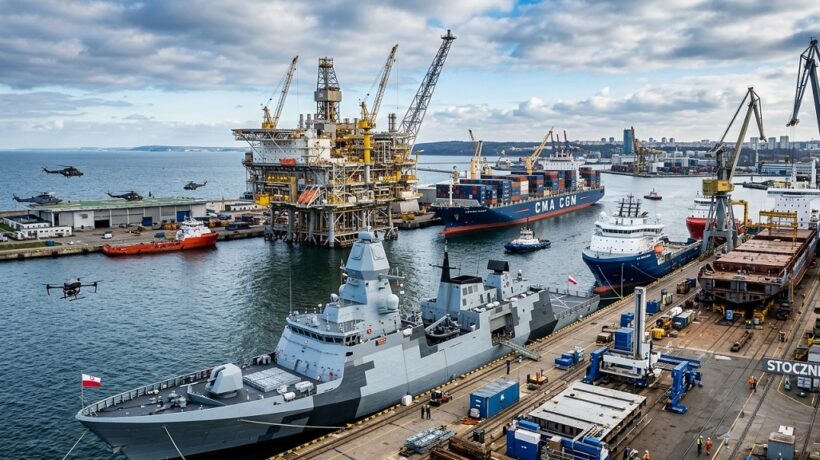
Ocean Engineering and Shipbuilding at Gdańsk Tech (2026/2027): The whole truth
Recruitment statistics and verification of progress in the field of Ocean Engineering and Shipbuilding (OiO) carried out at the Faculty of Mechanical Engineering and Shipbuilding (WIMO) of the Gdańsk University of Technology indicate a drastic level of selection. Data from the USOS system confirm that only about 55-60% of the originally accepted year of study successfully completes the first year of study. This means that almost every second student loses their student status before the start of the third semester. This process is not the result of a lack of places in laboratory groups, but of a rigorous system of verification of engineering knowledge, based on the so-called blocking objects and the specificity of the departments located in the historic Building B and newer machine laboratories.
Sifting statistics in the Tri-City
The phenomenon of students disappearing from the lists at USOS at Gdańsk Tech has a twofold character. The first mechanism is to remove students from the list by way of an administrative decision of the Dean. This usually takes place after the end of the retake session (the so-called September campaign), when the balance of points shows an ECTS deficit exceeding the permissible standards. According to the Gdańsk Tech Study Regulations, a student may apply for conditional enrolment as long as his/her credit debt is not higher than the set limit (usually 12-15 ECTS in the first year). Exceeding this barrier by at least one point results in the automatic initiation of the deletion procedure.
The second phenomenon is “quiet leaving”, i.e. giving up studies of one’s own free will. The largest wave of resignations falls on November and March – the periods in which the first colloquia in mechanics and mathematical analysis are held. Students, faced with the rigors of technical drawing and the demands of ship design departments, often come to the conclusion that the emotional cost of continuing their education outweighs their adaptability.
September 20, 2026
Critical Path in Ocean Engineering and Shipbuilding
The critical path is a set of subjects whose failure to pass de facto freezes the course of study. OiO is a field of study with a unique specificity – here, an error in the calculation of the ship’s stability on the exam results in an unsatisfactory grade without the possibility of negotiation.
Ship Theory (Stability and Unsinkability)
- Location: Classes take place mainly in Building B (Faculty of Ocean Engineering) and in the auditoriums of the Main Building.
- Elimination mechanism: This is the undisputed “kiler” of the second year. The exam consists of a written part (tasks on determining the parameters of the straightening arm curve) and a theoretical part. The biggest barrier is the requirement to perform the calculations flawlessly – a mistake in the sign when calculating the center of gravity of the ship disqualifies the entire work.
- ECTS blockades: The subject has a high weight (6-8 ECTS). Failure to pass Ship Theory usually blocks Ship Design, which automatically extends the study by a full academic year.
Technical Mechanics (Statics and Dynamics)
- Location: Lectures in the Novum Auditorium or the Main Building, exercises in Building B.
- Elimination mechanism: A subject verifying engineering predispositions. Elimination takes place through weekly tickets. A student who fails to pass three entries in a row loses the right to take the final exam. The written exam contains tasks in systems of forces and beams, where precision to the fourth decimal place is required.
- ECTS blockades: Failing Mechanics in the first year makes it impossible to enroll in Material Strength.
Mathematical Analysis (1 & 2)
- Location: Auditorium halls of the Main Building of the Gdańsk University of Technology.
- Elimination mechanism: A classic mathematical “sieve”. Examiners at Gdańsk Tech place a lot of emphasis on proof of theorems, not just calculations. The specificity eliminates people based on schemes from the matura exam. The pass rate in the first term often oscillates around 40%.
- ECTS blockades: Failure to pass the Mathematical Analysis makes it impossible to implement Hydromechanics and Numerical Methods at higher years.
Strength of materials
- Location: Laboratories in the basements of Building B and Mechanical Building.
- Elimination mechanism: The subject is considered one of the most difficult in OiO. The student must pass both the theoretical part and a series of laboratory tests (e.g. steel tensile test). Laboratory reports must be written by hand and are checked for the slightest substantive errors. One unaccepted protocol blocks the issuance of the final grade in USOS.
- ECTS Blocks: Blocks the Ship Structure and Ship Machinery and Equipment.
Ship Construction and Technical Drawing
- Location: Drawing rooms in Building B.
- Elimination mechanism: The requirement to make a huge number of drawings (so-called “tiles”) by hand or in CAD software. Timeliness is key here – failure to submit the project within the set deadline results in a 2.0 rating with no possibility of improvement in a given session.
- ECTS blockades: Failure to pass the project module in the 3rd semester usually makes it impossible to register for semester 5 courses.
Hydromechanics and Hydrodynamics of the Ship
- Location: Building B and the model swimming pool of the Gdańsk University of Technology.
- Elimination mechanism: A complex mathematical apparatus (Navier-Stokes equations). Examiners require an understanding of the phenomena occurring during hull flow. It is a subject with a high degree of abstraction, which many students “rely” on just before graduation seminar.
- ECTS blockades: Blocks the propulsion of the ship.
What do students of Ocean Engineering really can’t cope with?
An analysis of didactic processes at the Faculty of Mechanical and Naval Engineering (WIMO) shows that the biggest barrier is not a lack of theoretical knowledge, but the inability to synthesize data in complex engineering projects. Ocean Engineering and Shipbuilding is a major that requires proficiency in several areas at once: fluid mechanics, structural strength and advanced CAD modeling.
Design wall – “Tile” and technical documentation
The first point where students “imagined it differently” is the rigor of technical drawing and machine construction.
- Problem: The execution of the so-called “tile”, i.e. the detailed design of a fragment of the fuselage structure, requires hundreds of hours spent in the drawing rooms of Building B. Students often cannot cope with the rigor of the standards of classification societies (e.g. PRS, DNV). An error in the thickness of the plating sheet or the incorrect placement of the stiffeners (frames) results in the immediate rejection of the design by the examination team.
- Dissonance: Candidates expect visionary yacht design, but they are faced with tedious calculations of cross-sectional strength indicators, where each line in the drawing must be supported by calculations in the USOS system.
Applied Mathematics in Hydromechanics – Why Do Students Fail?
While Mathematical Analysis in the first year is a general “sieve”, Hydromechanics in the third semester is a specialized “sieve”.
- While Mathematical Analysis in the first year is a general “sieve”, Hydromechanics in the third semester is a specialized “sieve”.
- Statistics: The pass rate of partial colloquia in hydromechanics in the first term often does not exceed 30%. Failure to pass this subject blocks access to Ship Propulsion, which de facto ends the dream of graduating in 7 semesters.
Internships at OiO
According to the Gdańsk Tech Study Regulations, an OiO student must complete a professional internship lasting at least 4 weeks (160 hours), usually after the 6th semester. Although the Tri-City is a hub of the maritime industry, the process of passing internships is fraught with administrative pitfalls.
Location and specificity of internships in the Tri-City
Gdańsk Tech students most often carry out internships in entities such as:
- Gdańsk Repair Shipyard (Na Ostrowiu Street): Work in real conditions, often when docking ships. Students cannot cope with the physical strain and rigor of health and safety.
- Crist or Damen Shipyard (Gdynia): Internships in production preparation departments. Proficiency in AVEVA Marine or ShipConstructor software is key here. The lack of basic knowledge of these tools means that students are delegated to simple office work, which results in a negative opinion of the internship supervisor.
- Design offices (e.g. StoGda, NED Project): Location in the vicinity of Marynarki Polskiej Street or office buildings in Oliwa. These are the most desirable places where knowledge from Ship Theory is verified.
Pitfalls in the Practice Journal and USOS
The most common reason for failing internships is formal errors in the internship log.
- The description of the activities must coincide with the learning outcomes contained in the syllabus of the subject “Professional practice”. If the student enters “segregating documentation”, the internship coordinator in Building B will reject the application.
- Documents must be submitted to the Dean’s Office no later than 30 September. Being one day late results in an ECTS deficit (usually 4 points), which, in other “hanging” conditions, may tip the scales of being removed from the list of students.
Career prospects: Is there a real job after the OiO PG in 2026/2027?
Contrary to popular opinions about the collapse of the shipyard, the labor market for shipbuilding engineers in the Tri-City in the 2026/2027 cycle is experiencing a boom related to Offshore Wind Energy and the modernization of the navy (Miecznik program).
Where do graduates go?
- Offshore Structural Designers: Construction of wind towers and transformer stations in the Baltic Sea. Companies in Gdańsk (e.g. Equinor, Orsted) are looking for specialists in the stability of floating structures.
- Service engineers in repair shipyards: Supervision of class repairs. A demanding job, but the best paid to start with (earnings of PLN 7000–9000 net for a Junior in 2026).
- Luxury yacht designers: The Tri-City is the world’s center for catamaran construction (e.g. Sunreef Yachts at Marynarki Polskiej Street). This is where knowledge of Rhino software and surface modeling counts.
Is a PG diploma a guarantee of success?
Employers in Gdańsk and Gdynia do not look at grades in USOS, but at whether a student has undergone a “survival school” in Building B. An engineer who passed Ship Theory in the first term is considered to be the person with the highest analytical competence. However, those who slipped on the conditions have a problem with passing competency tests in design offices, which consist in solving a case from the stability of a damaged ship.
How much does it cost to “slack” a year at O&I?
Studying Ocean Engineering is a high-risk investment.
- Condition from Theory of the Ship (8 ECTS): With a rate of 150 PLN per point, the cost is 1200 PLN.
- Semester Repeat: If the student exceeds the acceptable ECTS deficit (e.g. 15 points) and the Dean agrees to repeat the semester, the cost increases to approx. PLN 3500-4500 (fee for all unpassed modules).
- Hidden costs: OiO students often have to buy their own licenses for specialized plug-ins for CAD programs or invest in laptops with enormous computing power (min. 32GB of RAM under CFDs), which is necessary to prepare Numerical Methods reports at home.
The most difficult semester
Undoubtedly, the most difficult moment is semester 4 (the end of the second year). It is a time of accumulation of three powerful engineering blocks: Ship Theory, Strength of Materials and Thermodynamics. Statistically, it is in June and September of the second year that most decisions are made to remove students from the list. Students fall into a psychological trap – after surviving the first year (mathematics and physics), they lower their vigilance, not realizing that the subjects at OiO are much more time-consuming.
In May of the second year, the so-called “ship marathon” begins. Students spend whole nights in the design rooms of Building B, trying to complete the buoyancy and stability calculations. If a student succumbs to the temptation and “lets go” of one of these subjects, a deficit of 8 ECTS puts him against the wall. Each subsequent stumble in the retake session means losing your student status or having to pay a high fee for the condition.
Survival Procedures
When the results in USOS light up in red after the second term, the student enters the area of administrative procedures of Gdańsk Tech.
Costs of the “condition”
Conditional enrolment (condition) consists in obtaining consent to enrol in the next semester despite failing the course. The cost of repetition depends on the number of ECTS credits. For example, if a course has 7 ECTS and the rate is 150 PLN per point, the student must pay 1050 PLN. For two such subjects, the amount exceeds PLN 2000, which is a significant burden for the student budget. Fees are paid to an individual sub-account in USOS under pain of not being allowed to take another session.
ECTS deficit
At OIO, the allowable deficit is variable, but usually after the 1st year it cannot exceed 12 ECTS credits. However, you should remember about blocking items. You can have a condition in Mathematics and move on to the second year, but having a condition in Strength of Materials in the third year will block the possibility of enrolling in construction subjects, de facto extending your studies without formal deletion.
Board Exam (Commission)
This is the final procedure. The application for the board exam is submitted to the Dean of WIMO within 7 days of the announcement of the results of the correction. The student must argue that the examiner violated the principles of impartiality or the form of the exam was inconsistent with the syllabus. Composition of the committee: Dean (as chairman), conducting examiner and other specialist in a given field. The chances of the commission being transferred to the ICU are estimated at less than 5%. Usually, the committee only confirms the student’s substantive deficiencies.
Tri-City logistics
The campus of the Gdańsk University of Technology is compact, but the logistics of the Tri-City can be treacherous for students of Ocean Engineering. The SKM Politechnika stop is about a 10-12 minute walk from Building B.
- Commuting: Students commuting from Gdynia or Wejherowo lose 2 to 3 hours a day on SKM trains. This time is often wasted because noise and crowding make it impossible to learn complex formulas in hydromechanics.
- Cost of Living vs Labor: Renting a room in Wrzeszcz costs about 1500-1800 PLN. The need to earn money for these fees collides with laboratories that require physical presence at the ICU. Lack of presence at the laboratory results in the lack of admission to the exam, which is recorded in USOS as a failure to pass.
- Libraries: The Main Library in the Main Building and the Faculty Reading Room in Building B have a limited number of textbooks from the “question exchange”, so the fight for access to materials begins in the middle of the semester.
Questions from students of Ocean Engineering
How do I write an effective Ship Theory Review Appeal?
The procedure of complaining about the assessment at the Gdańsk Tech requires demonstrating formal deficiencies. First, you need to go to the job (dates announced in USOS). During the inspection, it is worth comparing your answer with the official key. If the examiner did not accept the substantively correct answer, a written application should be submitted to the Head of the Department. The reference must be technical: “In task no. 2 I used the trapezoidal method according to the textbook X, side Y, which the examiner omitted.” Avoid emotional arguments. If the Head of the Department does not agree to the request, the only thing left is to apply for a board exam.
Is it possible to have 2 conditions from blocking items at the same time in the ICU?
Technically, USOS allows it, but the study program resists. You can have a condition in Technical Mechanics and Strength of Materials, provided that the sum of their credits is within the acceptable ECTS deficit. However, the consequences are drastic: you cannot sign up for follow-up items (Ship Construction). As a result, your schedule for the next year will be “holey”. You will only be able to take general subjects and language courses. In practice, this means that you will lose a year anyway because you do not close the seminary on time.
Does the grade in exercises affect the grade in the OiO exam?
It depends on the specific cathedral. In Technical Mechanics, the grade from the exercises is usually only a condition for admission to the exam (you must have passed it for USOS to allow you to enter the grade from the exam). However, in the Department of Hydromechanics, a high grade in exercises can give you extra points on the exam. Always check the “Passing Rules” in the course syllabus in USOSweb. Remember: failure to pass the exercises means automatic failure to take the exam on the first date, which results in losing the chance and having to write a correction as the first attempt.
Is it possible to transfer the grade from another technical university (e.g. from Mechanical Engineering to OiO)?
It is possible to transfer grades (rewrite grades) as long as the learning outcomes and the number of hours coincide by at least 80%. The decision is made by the teacher of a given subject at the Primary Care Centre. If you had Strength of Materials at another PG faculty, you need to download a study progress card and go to the lecturer. Warning: Departments at OiO rarely prescribe grades from general majors, claiming that the rigors of ship design require a specific approach to material loads.