


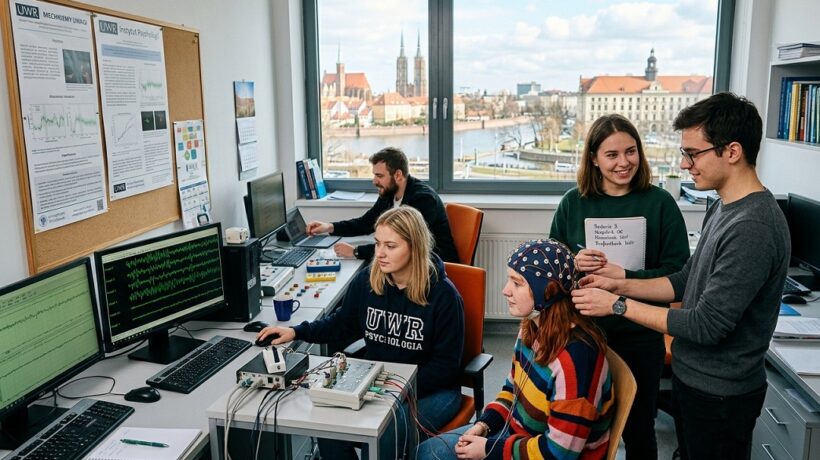
Psychology at the University of Wrocław (UWr): The most difficult subjects
Getting into psychology at the University of Wrocław (UWr) with a result close to 100% from the matura exam is just a ticket to an entry into a world that has almost nothing to do with the idea of “talking about feelings”. Already in the first months, within the walls of the building at 1 Dawida Street, you will encounter brutal selection. The statistics are inexorable: although a dozen or so candidates compete for one index every year, after the first year, from 15% to even 25% of students disappear from the lists. The reason is not a lack of empathy, but “mares”, i.e. filter objects that are designed to sift out people who cannot cope with hard science, statistics and biology. If you think that studying psychology in Wroclaw is a light humanities, be prepared for a cold shower.
Biological Basis of Behavior (BPZ)
Biological Foundations of Behavior is a subject that arouses paralyzing fear from the very first lecture. This is where most students see a 2.0 rating on their USOS account for the first time in their lives. BPZ is not general biology – it is a rigorous course in neuroanatomy and physiology, which is on a par with the level of detail of medical faculties at the Medical University.
What does science look like in practice?
Be prepared to flip through bulky neuroanatomy textbooks (e.g. Longstaff or Kalat) and memorize every slit, furrow, and nucleus in your brain. Learning BPZ is a multi-hour process – it is impossible to “read” it before the colloquium. Students spend entire nights trying to memorize neural pathways and synaptic mechanisms. This is often accompanied by the so-called “passes” during exercises, which test the knowledge from the last lecture. If you are not systematic, you will die in November.
What are the biggest problems?
The biggest nightmare is precision. It is not enough to write on the exam that something is happening in the “frontal salary”. You need to know the specific Brodmann field, know what neurotransmitters are involved in the process and what happens when they are missing. The questions are structured in an extremely detailed way, and a mistake in one letter of the Latin name of the structure may result in a missing point. The abstractness of the material is also a problem – you have to “see” the three-dimensional brain in your head, using only flat diagrams from books.
When and why do students FAIL?
The moment of crisis is usually the first winter session. Students who came to psychology with a humanistic profile are completely unable to cope with hard, biological terminology. It is the BPZ that generates the most conditions in the first year. Failure to pass this subject often acts as a chain block – without a foundation in biology, it is difficult to understand later neuropsychology or psychophysiology, which ultimately leads to being crossed off the list of students.
September 20, 2026
Methodology and Statistics – A Mathematical Wall at the Heart of the Humanities
If you have escaped from mathematics to psychology, at the University of Wrocław you will feel like in a trap. The methodology of psychological research combined with statistics is the second pillar of screening, next to BPZ. This is where psychology becomes an empirical science, based on numbers, formulas, and logical rigor.
What does science look like in practice?
Classes are divided into theoretical lectures and computer labs. In labs, you will work with programs such as SPSS or R. Forget about simple addition – you will calculate statistical significance, analysis of variance (ANOVA), correlations and regressions. Every week there are new tasks and reports that must be done perfectly in terms of form. These reports are often returned for improvement many times, which tires students more than studying for the exam itself.
What are the biggest problems?
The biggest challenge is not the counting itself (that’s what a computer is for), but the interpretation of the results. Students can often “click on” an analysis, but they don’t understand what the p-value means or why they can’t reject the null hypothesis. Exams in statistics at the University of Wrocław are famous for their tricky interpretative questions. Many people complain about the lack of logic – statistics require process thinking, which cannot be replaced by forging patterns by heart.
When and why do students FAIL?
Statistics are a sequential subject. If you don’t pass Statistics I in the winter semester, you often don’t get admission to Statistics II in the summer semester. This means an automatic condition and the need to repeat the whole year, because without statistics you will not start with a master’s seminar in higher years. Students “drop out” here because of the paralyzing fear of numbers (the so-called statistical fear) and the lack of regularity in submitting reports.
Psychometrics and Experimental Psychology – When Science Becomes Technical
In the second year of studies (3rd and 4th semester), there are more “mares” that verify your suitability for the profession of a researcher. Psychometrics teaches how to build psychological tests, and Experimental Psychology – how to design research so that it is not just an “observation of life”.
What does science look like in practice?
In Experimental Psychology, you have to design and conduct your own research from scratch. It is dozens of hours spent collecting data from respondents (often friends, which does not make things easier at all) and then processing them. Psychometry, on the other hand, is a hard theory about the reliability and validity of tests. You need to understand why one test “works” and another is worthless by using advanced statistical metrics.
What are the biggest problems?
The problem is the “technicality” of these items. You must operate on the standards of the APA (American Psychological Association) when writing reports. One mistake in the formatting of the bibliography, a poorly described graph or an improperly selected control group can disqualify the entire semester project. The students cannot cope with the enormous editorial and methodological rigor. What matters here is not the “interesting topic”, but the correctness of the procedure.
When and why do students FAIL?
The largest sifting occurs at the stage of final projects. Many people underestimate the time it takes to conduct an experiment reliably. When the deadline for submission arrives and the data is “dirty” or statistically insignificant, panic begins. Psychometry, on the other hand, “cuts” the theoretical exam, which is overloaded with operational definitions and calculations of measurement errors.
What to do to survive and not fall away
If you want to avoid being conditioned or removed from the list of UWr students, you need to implement the “Survival 101” strategy. The advice from older generations is brutal but effective:
- Get access to the exchange: In psychology at the University of Wrocław, “stock exchanges” (collections of questions from previous years) are sacred. Although the lecturers try to change the questions, certain patterns and “favorite” issues of professors have remained unchanged for years. Start looking for them as early as October.
- Regularity is not a cliché: In the case of BPZ and Statistics, the backlog from two weeks is impossible to catch up. If you miss one section in statistics, you won’t understand the next three. Learn in batches, every week.
- Self-help groups: Don’t try to count the statistics yourself. Find a group of people who grasp it better or want to “do” tasks together. Psychology at the University of Wrocław is a team sport – exchanging notes from lectures where you were not present will save your life.
- Don’t be afraid of consultations: Lecturers at Dawid, despite being strict, appreciate students who come with specific questions. If you don’t understand how ANOVA works – go to the office. It’s better than dousing a colossus.
- Master APA standards from day one: Purchase or download the current APA Editor’s Guide. You will use it until the end of your studies. Perfect reports are half the battle in passing the methodology.
Sifting Calendar – When the Adventure Statistically Ends
Understanding the mechanism by which students disappear from the lists at the Faculty of Educational Sciences and Psychology of the University of Wrocław will allow you to prepare for the moments of the greatest accumulation of stress. The screening in psychology is not even – it is more like two violent blows that verify who is suitable for a researcher and who has come here only for an “interesting diploma”. If you survive these two tipping points, your chances of getting to the master’s defense increase drastically.
Winter Session of the First Year: Cognitive Shock and Dream Verification
The first moment when USOS starts glowing red is February in the first year. This is where most people who have fallen victim to discrepancies in expectations drop out. Many high school graduates come to David with a vision of dream analysis or immediate entry into the therapeutic process. Instead, they get “passes” from the Biological Foundations of Behavior and logic, which requires mathematical precision.
Students resign on their own during this time, often without even approaching the second exam date. They feel that the psychology that is taught at the University of Wrocław – that is, psychology as an empirical science, not a humanistic story – does not suit them at all. It is here that the largest outflow of people occurs, who quickly move to fields such as sociology, pedagogy or cultural studies.
Summer session of the first year: “Slaughterhouse” in neuroanatomy and statistics
If February was a test of motivation, then June and September of the first year are a test of hard competencies. This is the time when the BPZ (Neuroanatomy) and Statistics I exams work like a guillotine. During this period, one no longer drops out “of one’s own free will”, but because of tough administrative decisions.
At the psychology department of the University of Wrocław, the limits of the ECTS credit deficit are rigorously observed. If you fail BPZ (for 8 points) and Statistics (for 6 points), your point debt is 14 ECTS. At many stages of studies, this is already the limit that makes it impossible to take the condition and forces you to repeat the whole year. Students, seeing the prospect of paying a few thousand zlotys for a year in which they will attend only two subjects, often make a decision to quit their studies altogether and start again in recruitment to another university or major.
Why do UWr students submit their indexes themselves? The psychology of failure
Apart from the difficulty of the subjects themselves, there are a number of systemic and psychological factors that make even talented students in Wrocław give up fighting for a diploma.
- Imposter syndrome and group pressure: Only “six” people get into psychology at the University of Wrocław. When you suddenly find yourself in a group where everyone was the best in their high schools, and in the first colloquium from BPZ the average grade is 2.0, a powerful crisis of self-esteem appears. Many students can’t stand the pressure of being average or weak compared to their exceptionally talented colleagues.
- Awareness of the “long road”: Around the third year of studies, many people receive the brutal truth about the profession of psychologist in Poland. A master’s degree is just an introduction. To work as a therapist, you will also have a 4-year, private school of psychotherapy, which costs from 40 to 60 thousand zlotys. This perspective, combined with exhausting exams in psychometrics or cognitive psychology, makes students find further effort unprofitable.
- Methodological burnout: The University of Wrocław puts great emphasis on the psychologist being a scientist. The constant writing of research reports, counting statistical significance, and the rigor of formatting APAs kill many people’s original passion for helping others.
The financial trap of the “condition”
No one at the open days talks about the fact that studying psychology in Wrocław can be very expensive if your leg curls up on an exam. At the University of Wrocław , each hour of classes that you have to repeat as part of conditional entry has its price.
- Fee mechanism: The fee for repeating a course is calculated on the basis of the number of ECTS credits or teaching hours (depending on the current Rector’s order). In practice, repeating one large “mare”, such as Cognitive Psychology or Neuropsychology, costs about PLN 1200-1800.
- Cumulative costs: The biggest drama begins when a student takes a condition in one subject and fails another one in the next semester. The point debt is growing, and with it the invoices in the USOS system. For many students, especially those who support themselves in Wrocław, the financial barrier becomes insurmountable, which directly leads to resignation from studies.
If you have already run into trouble and your grades from the colloquia do not inspire optimism, you need to switch to crisis management mode. Those who can calculate as well as calculate correlations will survive on David.
- Prioritization of “sequences”: If you have a choice between studying for a subject that is a “dead end” (it doesn’t block anything further) and studying for a sequential subject (e.g. methodology), always choose the latter. You collapse the methodology – you lose a year. You will collapse the history of psychological thought – you will take a cheap condition and move on.
- Dean’s terms are sacred: If you know that you will not pass the exam on the first date, do not go there “for recognition” if the teacher enters 2.0 into the system (which blocks you from taking the kindergarten in the next year if you repeat). Sometimes it is better to get sick leave and fight to get the term reinstated, as long as you have a real health basis for it.
- Fight for every point in the reports: In subjects such as Experimental Psychology, points in exercises and reports can “save” your final grade, even if you write the exam poorly. Never let go of APA formatting – these are the easiest points to get that only require accuracy, not genius.
Rescue guide for a student of the University of Wrocław
What happens if I fail a sequential course at the University of Wrocław and how does it affect the next semester?
Sequential subjects (e.g., Statistics I and II or Methodology I and II) are structured in such a way that the knowledge from the first semester is necessary to understand the second. At the University of Wrocław, failing the “one” automatically blocks the possibility of enrolling in the “two”. In practice, this means that your studies are extended by a year. The USOS system will not allow you to register for a higher stage, and you fall into the so-called “credit year” or you have to apply for a semester repetition. This is painful because you lose contact with your dean’s group and have to pursue an overdue subject with a younger year, which is often stressful and demotivating. In addition, if a given subject has a high ECTS weight (e.g. 6-8 points), you may exceed the limit of the allowable credit debt, which results in the need to submit an application for a repeat year.
How much does a conditional entry at the University of Wrocław really cost, how to submit an application step by step and how many times can you repeat the same subject?
The cost of a “condition” at the University of Wrocław depends on the faculty, but in psychology (Faculty of Educational Sciences and Psychology) the rate for 1 ECTS point is usually about PLN 100-150 (this value is indexed). If you fail BPZ, which has, for example, 8 ECTS credits, you will pay about 800-1200 PLN. The procedure is as follows: after issuing an unsatisfactory grade within the retake period, you must submit an application to the Dean for conditional enrolment for the next stage of studies via USOSweb. You usually have 7 days from the end of the retake session to do so. The dean issues a decision, and the system generates an invoice with a payment date. As for the limits – you can usually only repeat the same item once in conditional mode. If you fail it again, the Dean may not agree to the next condition, which ends up being removed from the list of students or having to change the major.
How to deal with exams with the principle of negative points and why do so many students in Wrocław fail because of it?
The principle of negative points (“minusing”) is the bane of test exams at the University of Wrocław. It consists in the fact that a fraction of a point is deducted for an incorrect answer (e.g. -0.25 or -0.5), while for a no answer you get 0. The strategy of “shooting” in the absence of knowledge is suicide here – you can end the exam with a negative result. To survive this, you have to use cold calculation. If you hesitate between two answers and are 50% sure – statistically it is worth the risk. However, if you are completely unfamiliar with the question – leave the field blank. Many students fail because they panic and try to mark anything, hoping for luck. At the University of Wrocław, tests are designed to promote knowledge certainty, not intuition. Before the exam, always ask about the exact negative point converter – this is key to determining your risk threshold.
What to do when I know that I will fail the mare’s subject – when to apply for the dean’s exam and when to fight for the board retake exam?
If you see that BPZ or Statistics have outgrown you, you have two choices. The commission exam (the so-called commission exam) is the ultimate weapon. You can apply for it within 7 days of the announcement of the results of the correction, but only if you have a reasonable suspicion that the exam was conducted incorrectly or your knowledge was assessed unfairly. The chances of a “commission deal” are small, unless there were actually procedural irregularities. If your problem is simply a lack of knowledge or personal problems – a better solution is a dean’s leave (health or random). Remember that it is best to write about the dean’s office before the session, if a random situation prevents you from studying. If you “fail” the session and only then ask for leave, the Dean can grant it, but with arrears to be made up for when you return. Fight to the end for every point, but if you feel that your mental state is close to a breakdown – choose the dean to save your student status and try next year with a clean slate.
Why is the third semester considered the “government of souls” and how many people actually drop out of the student lists before the summer session?
The third semester (the beginning of the second year) at the University of Wrocław psychology is the moment of the greatest accumulation of material. This is when general subjects end, and all the key “filters” come in at once: Cognitive Psychology, Psychology of Emotions and Motivation, Advanced Methodology and Statistics II. Students who have “slipped through” the first year are hitting the wall here. Fatigue of the material occurs – the passion for psychology fades under the influence of scientific rigor. Realistically, it is at the turn of the second and third semester that the most “spontaneous” resignations occur (the student stops coming to classes on his own). Statistically, before the summer session of the second year, the year can be reduced by another 10-15 people. This is the stage at which psychology ceases to be a dream and becomes a hard craft job that not everyone wants to undertake.
Studying psychology at the University of Wrocław is a fascinating, but extremely bumpy road. The most difficult subjects, such as BPZ or Statistics, are not there to destroy you, but to develop in you a critical and scientific approach to the human psyche. If you feel that a crisis is approaching – don’t wait. Contact older generations, look through the “exchanges” and start working systematically.