


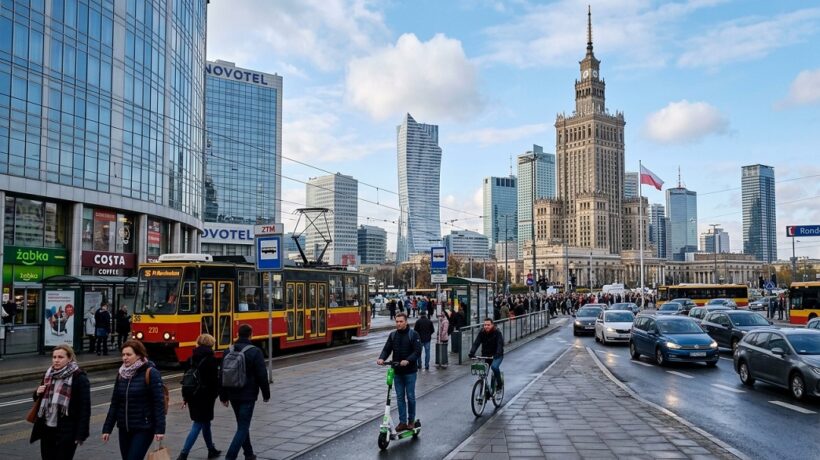
Student accommodation in Warsaw 2026: prices for rooms and studio flats
The Warsaw property market in 2026 is an environment in which the traditional approach to renting – ‘cheap and close to the university’ – has all but disappeared. When planning your budget for the 2026/2027 academic year, you must face a new pricing reality, influenced by energy costs, the professionalisation of the rental market and limited supply in key transport hubs.
In this article, you’ll find out how much you’ll need to set aside if you decide to live on your own or share a flat, and where to strike a balance between price and location in relation to Warsaw’s major universities.
The state of the rental market in Warsaw in 2026
In 2026, the Warsaw rental market is clearly divided into three segments: private student halls of residence (premium), secondary market flats managed by companies, and traditional rentals from private landlords. If you’re hoping for the kind of bargains seen in 2022 or 2023, you’ll need to adjust your expectations.
The main factors influencing prices are no longer just floor space, but above all the building’s energy efficiency rating and proximity to the underground lines (M1 and M2). In 2026, students are increasingly opting out of car ownership in favour of ‘door-to-door’ locations with their universities, meaning that room prices near stations such as Pole Mokotowskie, Politechnika and Świętokrzyska are reaching levels that, just a few years ago, were reserved for studio flats.
How much will a room cost in Warsaw in 2026?
Renting a room remains the most popular choice among students at the University of Warsaw, Warsaw University of Technology, Warsaw School of Economics and Medical University of Warsaw. However, the concept of a ‘cheap room’ has changed dramatically.
1. A room in a student flat (4–5 rooms)
This is the cheapest option, but it involves the most compromises. In 2026, the prices for this standard are as follows:
- Outlying districts (Białołęka, Rembertów, Wawer): PLN 1,400–1,700 + utilities.
- Neighbourhoods with good transport links (Bielany, Ursynów, Targówek, Bemowo): PLN 1,800–2,200 + utilities.
- Premium locations (Mokotów, Ochota, Wola): PLN 2,300–2,800 + utilities.
2. A flat in a new-build development (apartment blocks)
Students are increasingly opting for rooms in two- or three-bedroom flats in new-build properties, where the standard of finish is higher. Here, the price per room is often close to the cost of a studio flat in a less desirable location.
- Average cost: PLN 2,500–3,100 per month (often including service charges, but excluding electricity).
3. Private halls of residence (PDS)
September 20, 2026
By 2026, the network of private halls of residence in Warsaw (around Woronicza Street, Suwak Street and Praga-Północ) will be much more extensive.
- Single room with en-suite bathroom and kitchenette: PLN 3,200 – 4,200 (all-inclusive package – the price includes internet, gym access and utilities).
A studio flat in Warsaw – cost analysis for 2026
If you value your privacy and have a larger budget, a studio flat in 2026 is an expense that could eat up a significant portion of your household budget or your earnings from casual work.
Actual rental rates (rent payable to the landlord)
You need to distinguish between the amount shown in the property listing (the so-called rent) and the actual cost of living.
- Studio flat (20–30 m²) on the outskirts (e.g. Ursus, Włochy): PLN 2,800–3,300.
- Studio flats in the ‘student’ districts (Ochota, Mokotów, Praga-Południe): 3,500–4,500 PLN.
- Studio flats in the city centre or nearby Wola: 4,800 PLN and above.
The ‘Micro-living’ standard
In 2026, so-called micro-flats (15–18 m²) are very popular. Despite their small size, they are by no means cheap, owing to their modern fittings and prestigious locations. For a flat of this size near Rondo Daszyńskiego, you will pay around 3,600–4,100 PLN.
Hidden costs – what do you need to add to your rent?
The price quoted in the advert is rarely the final cost in 2026. As a student, you need to calculate your additional expenses carefully.
- Service charges: This is the biggest pitfall. In 2026, due to increases in the minimum wage (security, cleaning) and the costs of maintaining communal areas, service charges in older buildings amount to around PLN 400–600, and in new apartment blocks as much as PLN 800–1,100 for a studio flat.
- Utilities (Meters): At current rates, electricity and water cost around PLN 250–400 per month for a single person.
- Internet: A standard fibre-optic connection costs between 60 and 100 PLN.
- Deposit: By 2026, it had become standard practice to pay a deposit of twice the monthly rent. For a studio flat costing 3,500 PLN, you would need to set aside 7,000 PLN up front.
Comparison: Single room vs. Studio flat (Cost-effectiveness table 2026)
| Feature | Room (Shared flat) | Studio flat (Self-contained) |
| Average total cost | £2,200 – 2,800 PLN | £4,200 – 5,500 PLN |
| Upfront deposit | approx. 2,500 – 3,500 PLN | approx. 7,000 – 9,000 PLN |
| Privacy | Low (shared kitchen and bathroom) | Maximum (entirely yours) |
| Location | Usually better/closer to the city centre for this price | Further from the city centre for the same budget |
| Responsibilities | Cleaning rota, splitting bills with others | Full responsibility for the whole property |
Where should I look for accommodation near a specific university?
In 2026, commute times will be crucial. Here is a list of the best neighbourhoods in terms of price and transport links:
- University of Warsaw (Main Campus): Look in Praga-North or Targówek (near the Metro Line 2). Room prices here are 15–20% lower than in the city centre, and the journey takes 10–15 minutes.
- Warsaw University of Technology: You’ll find the best value for money in Ochota (the area around Filtrowa Street is expensive, but the area around Bitwy Warszawskiej Street is more affordable).
- SGH and WUM: Mokotów (Służew) is a hub for student accommodation. Avoid the office districts (‘Mordor’), where rents for studio flats are driven up by corporate employees.
- SGGW: Ursynów remains unrivalled. Thanks to the M1 underground line, you can live further away from the university (e.g. near Imielin station), where prices are more stable, and the journey to campus takes just a few minutes by bus.
Practical tips: How can you avoid overpaying in 2026?
- Look for properties during the ‘off-peak season’: The worst time to rent is September and October. If you can, sign a tenancy agreement in July or August – you could save as much as PLN 200–300 a month throughout the year.
- Check the energy performance certificate: By 2026, every flat must have one. A G rating means drastically high heating bills in winter. Aim for grades A–C.
- Short-term rentals: Be prepared for the fact that 90% of professional landlords will require a notarised declaration of submission to enforcement. This costs around PLN 400 (a one-off fee), but it is often a prerequisite for securing a lower rental price.
- Negotiate ‘utility costs included’: When booking rooms, try to choose offers with a fixed flat-rate for utilities. In 2026, fluctuations in electricity prices could ruin your monthly budget.
- Check 5G/fibre coverage: This is crucial for students. Older tenement blocks in Praga or Mokotów sometimes have problems with this, which means you have to opt for more expensive mobile plans.
FAQ – Frequently asked questions about rental prices in Warsaw in 2026
Is 2,500 PLN enough to rent a self-contained studio flat?
In Warsaw in 2026 – no. That amount barely covers the cost of a room in a good location or a room of a higher standard. A realistic budget for the cheapest studio flat, including bills, starts at PLN 3,500–3,800 on the outskirts of the city.
Which is cheaper: a state-run hall of residence or a room on the private market?
University halls of residence remain the cheapest option (around PLN 800–1,300 in 2026), but the number of places is severely limited. Unless you are on a low income, the private market (a room for around PLN 1,900) is your only alternative.
How much does a room for a couple cost in Warsaw?
Double rooms in 2026 will cost between PLN 2,600 and PLN 3,200 plus utilities. This is a popular option for reducing the per-person cost to around PLN 1,500–1,700.
Will rental prices fall in 2026 once the academic year begins?
No. In Warsaw, there is year-round demand for flats. After October, the supply simply shrinks, leaving only the most expensive or lowest-standard properties.
Is it worth renting a flat with someone else and sharing the costs?
Definitely yes. Renting a three-bedroom flat (around PLN 6,500–7,500) and splitting the costs between three people works out at a real cost of around PLN 2,300–2,500 per person, including bills, which is much better value than a studio flat on your own for PLN 4,500.
Choosing between a shared room and a studio flat in Warsaw in 2026 boils down to a simple calculation: is your privacy worth an extra 2,000–2,500 PLN a month? For most students, the best option remains a room in a well-connected district (Bielany, Ursynów, Praga-Północ), where the total cost of PLN 2,300 allows for a standard of living that meets modern requirements.
Micro-location analysis: Where does room price go hand in hand with logistics?
By 2026, Warsaw is no longer seen as a single, uniform market in terms of prices. The difference in the cost of renting a room between two stations on the same metro line can be as much as 400 PLN.
The impact of the ‘Express Tram’ and Metro Line 3 on prices in 2026
Infrastructure projects that were completed or were at an advanced stage in 2026 have reshaped the price landscape:
- The tram to Wilanów: This has caused room prices in the so-called Lower Mokotów area (around Sobieskiego Street) to rise by around 15%. Currently, a room in this location costs 2,100–2,400 PLN, which is still cheaper than the immediate vicinity of the Warsaw School of Economics, whilst offering a 15-minute commute to the university.
- Praga-Południe (around the Wiatraczna roundabout): Due to work on the third metro line, prices for studio flats in this area have risen to between 3,400 and 3,900 PLN. This is your ‘last chance’ to find a room here for under 1,900 PLN before this neighbourhood becomes a fully-fledged premium area.
Traditional Townhouse vs. Prefabricated Housing vs. Modern Construction
The technical standard of the building in 2026 directly determines the level of service charges, a factor that students often overlook in their calculations:
- Old tenement buildings (City Centre, Old Ochota): High ceilings (over 3 m) mean gas or electric heating costs are 30–40% higher. A room may seem cheap (e.g. PLN 1,800), but winter bills can push the actual cost up to PLN 2,500.
- ‘Wielka Płyta’ blocks (Ursynów, Bródno): The best value for money. A 12 m² room costs an average of 1,850 PLN here, and thanks to the thermal modernisation of the buildings, heating costs remain stable.
- Modern housing estates (so-called ‘infill developments’ and apartment blocks): Here, you pay for security (CCTV, security guards). A studio flat in such a building costs around PLN 4,200 + service charges, which in 2026 rarely fall below PLN 700.
The PRS (Professional Rental Sector) model – a revolution in the 2026 student budget
In 2026, funds offering institutional rental accommodation (PRS) took over a large share of the market. This is an alternative for those who are torn between a shared flat and a studio flat.
Why should you consider a room in a PRS property?
- Cost predictability: You receive a single bill. In 2026, with electricity prices fluctuating widely, the fixed ‘utility flat-rate’ in private halls of residence (e.g. in the Suwak Street area or near the West Station) acts as a safeguard for your budget.
- Hidden costs at PRS: You should expect to pay for additional services: bicycle parking, access to the self-service laundry (approx. PLN 15–20 per wash) or the hire of a study room.
- Unit price: A studio flat in the PRS scheme (often measuring 16–19 m²) costs 3,800–4,300 PLN. This is more than the cost of a room in a private home, but less than that of a 30-square-metre studio flat on the open market.
Budget scenarios: A shared flat vs a studio flat in specific situations
Scenario A: A student on a tight budget (up to 2,200 PLN in total)
For that amount, a self-contained studio flat will be unaffordable in 2026.
- Solution: A room in a four-bedroom flat in Bielany (near Chomiczówka) or Targówek Mieszkaniowy.
- Calculation: PLN 1,700 (rent) + PLN 400 (service charges) + PLN 100 (internet/utilities). This leaves a surplus of PLN 0.
Scenario B: Student in work / Parental support (budget: 4,500 PLN)
It’s a ‘tight’ budget, which presents a dilemma: a luxury room in the city centre or a modest studio further out.
- Option 1: A premium room in an apartment block near the Politechnika Metro station (price: 2,800 PLN) + a high standard of living..
- Option 2: A studio flat in Bemowo or Włochy. Price: 3,300 PLN + 800 PLN rent + 400 PLN for electricity and water. Total: 4,500 PLN. If you choose a studio flat within this budget, you’ll spend around 40–60 minutes a day commuting.
Indexation clauses in 2026 contracts – what should you look out for?
By 2026, clauses that directly affect how much you will pay in your second year of study had become standard in Warsaw tenancy agreements.
- Inflation indexation: Most tenancy agreements include a clause allowing the rent to be increased in line with the GUS inflation rate (often every six months). For a studio flat costing PLN 4,000, a 5% increase amounts to an additional PLN 200 per month for the duration of the tenancy.
- Utility billing based on estimates: Avoid contracts where the landlord charges a ‘fixed’ fee of PLN 500 for utilities without checking the meters. In 2026, modern smart-metering systems allow for monthly billing – insist on access to the app or meter readings so you don’t end up overpaying for your flatmates.
Further practical tips
- Reviewing the ‘Student Standard’: In 2026, the ‘student standard’ often means furniture from chain stores, but with 10 years’ wear and tear. Check that the windows are draught-proof (crucial given energy prices) and that the block has a fibre-optic connection with a speed of at least 600 Mbps – in 2026, remote learning and streaming are the norm, and outdated copper infrastructure drastically reduces the property’s value.
- Zero agency commission: Look for direct listings on Facebook groups or property portals. In 2026, agencies often charge 100% of the rent plus VAT (23%), which, for a studio flat costing 3,500 PLN, means a loss of over 4,300 PLN right from the start.
- Security deposit: Please note that in 2026, the security deposit cannot be used to cover the final month’s rent. You must have the cash to hand at the start, and the deposit will be refunded within 30 days of handing back the keys.
Questions from students in Warsaw
Is it safe to rent a room in a ‘shared flat’ (a so-called ‘ready-to-rent’ property)?
Yes, this is the most common layout in 2026. A 50 m² flat divided into four micro-rooms. Pros: low price (around PLN 1,800). Cons: very small communal areas and the risk of conflicts with other tenants.
Which districts of Warsaw will be the most affordable for students in 2026?
As always, Białołęka, Rembertów and Wesoła. The cost of a room there can drop to 1,300–1,500 PLN, but the journey time to the city centre exceeds 45–50 minutes, which often cancels out any savings on travel costs or time.
Is it worth paying extra for air conditioning in a studio flat in 2026?
From an economic perspective – yes. Summers in Warsaw are getting hotter and hotter, and in 2026, modern air-conditioners with a heating function (air-to-air heat pumps) will be a cheaper way of heating a flat during the transitional periods than district heating.