


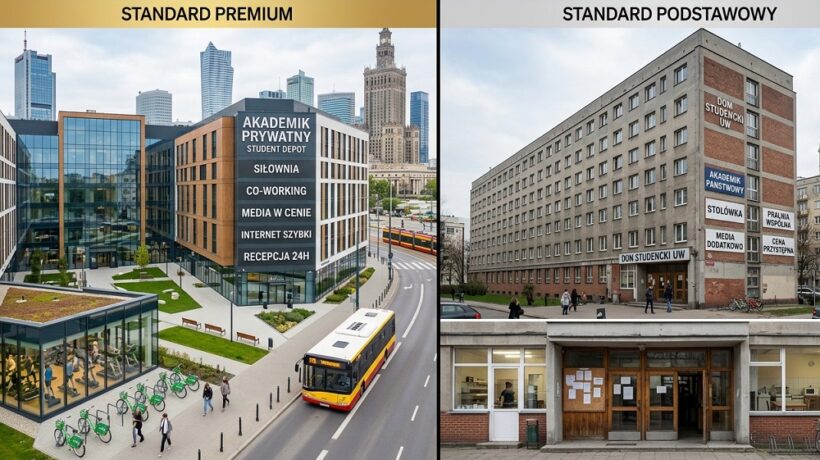
Study in Warsaw 2026/2027: State vs Private Dormitories
Planning your studies in Warsaw for the academic year 2026/2027 requires you to make one of the most important financial decisions: where you will live. The capital, with a student population of more than 200,000 people, offers two extremely different models of collective accommodation. On the one hand, you have state dormitories (student dormitories of individual universities), which are a scarce commodity and heavily subsidized. On the other hand, the private student housing (PDS) market, which in 2026 has become a professional but expensive alternative to traditional apartment rentals.
In this article, we will analyze the real costs, admission criteria and standards of both solutions, so that you can match the choice to your budget and logistical requirements in relation to the largest Warsaw campuses.
1. State Dormitories: The Cheapest Accommodation Base in the Capital
Student dormitories (DS) belonging to universities such as the University of Warsaw (UW), Warsaw University of Technology (WUT), the Warsaw School of Economics (SGH) or the Medical University of Warsaw (WUM) remain the most desirable option in 2026 due to their price.
Real costs and fees in 2026
Prices in state dormitories are regulated by rectors’ orders and in the academic year 2026/2027 they are as follows:
- Space in a 3-person room: 750 – 950 PLN.
- Space in a 2-person room: 900 – 1200 PLN.
- Single room (so-called single room): 1300 – 1700 PLN (available mainly for senior students or students with a disability certificate).
This price usually includes all utilities (electricity, water, heating) and access to the university internet. The deposit is usually the equivalent of a month’s rent.
Admission criteria – why is it difficult to get a place?
September 20, 2026
In 2026 in Warsaw, the allocation of a place is determined solely by an algorithm in the USOS system, based on two parameters:
- Income per person in the family: Priority is given to those with the lowest incomes. Exceeding the statutory threshold often automatically excludes you from the first round of recruitment.
- Distance from Warsaw: The further you live from the capital, the more points you get. Students from towns less than 50 km away (e.g. from Pruszków, Legionowo or Mińsk Mazowiecki) have minimal chances for a state dormitory.
2. Private Dorms (PDS): Hotel Standard for a High Price
Private student dormitories (e.g. chains such as Student Depot, Basecamp, LivinnX or Milestone) are a segment that is booming in Warsaw 2026. You will find them mainly in Wola, Mokotów (Służewiec) and near the Western Railway Station.
Costs and the “All-inclusive” model
In PDS, you don’t pay for a “seat”, but for a specific standard. In 2026, rates are significantly higher than in the state sector:
- 1-person studio with private bathroom and annex: 3800 – 5200 PLN per month.
- A place in a 2-person “twin” room: 2400 – 3100 PLN.
What do you gain at this price?
Unlike state dormitories, here you pay for additional infrastructure:
- Gym and cardio zones: Available 24/7 for the rent.
- Quiet learning and coworking rooms: Equipped with high-speed Wi-Fi and air conditioning.
- Entertainment zones: Cinema halls, consoles, billiard tables.
- Safety: 24-hour monitoring and reception, which in Warsaw is crucial for international students and people who value privacy.
3. Standards Comparison: What to Expect?
The choice between a state and private dormitory is a choice between community and independence.
State standard (UW/WUT/SGH)
Most of Warsaw’s state dormitories (e.g. DS “Riviera” at the University of Technology or DS “Smyczkowa” in Mokotów) have undergone thermal modernization and renovations.
- Bathrooms: Most often in the “segmented” system (one bathroom for two rooms) or, more rarely, shared in the hallway.
- Kitchens: Almost always shared upstairs. This generates the need to have your own dishes and cook in public spaces.
- Equipment: Standard furniture (bed, desk, wardrobe). You often need to have your own bedding and small equipment.
Private Standard (PDS)
Here, the standard is similar to modern micro-apartments.
- Privacy: A private bathroom and kitchenette are standard in most offers. You don’t have to share the fridge with five other people.
- Design: Modern finish, ergonomic furniture, air conditioning (which is a huge advantage in the Warsaw heat in June and September).
4. Location for your college
In Warsaw, travel time is a key element of the cost estimate.
For students of the University of Warsaw (Main Campus / Ochota):
- State: Dormitories at Żwirki i Wigury Street and Radomska Street. Excellent access to the faculties of Biology, Chemistry and Physics.
- Private: PDS in the vicinity of the Western Railway Station. It takes 10-15 minutes to get to Ochota by bus.
For WUT students (Centre):
- State: DS “Riviera”, “Mikrus” – door-to-door locations with the main buildings.
- Private: Facilities in nearby Wola (Siedmiogrodzka Street, Kasprzaka Street). It takes a few minutes to get to the Świętokrzyska station by the second metro line.
For students of the Warsaw School of Economics and the Medical University of Warsaw:
- State-owned: DS “Sabinki” (SGH) or dormitories of the Medical University of Warsaw at Banacha Street.
- Private: PDS Basin in Służewiec (Woronicza Street, Suwak Street). Thanks to trams and Metro M1, access to Mokotów and Ochota is very efficient.
5. Flexibility and formalities: Contracts 2026/2027
Contracts in state dormitories
These are strongly linked to your student status.
- If you are removed from the student list, you lose your right to live in usually 7-14 days.
- Fees are fixed and non-negotiable.
- The rental period covers the academic year (October – June). For the holidays, you must submit a separate application for a “summer dormitory”.
Contracts in private dormitories
These are classic commercial lease agreements.
- You can sign a contract for 10 or 12 months.
- It is necessary to have tenant liability insurance (often required in 2026).
- You can complete the formalities online in 15 minutes, without the need to provide certificates of income from your parents. This is an ideal option if your earnings or family income exceed the social thresholds at the university.
Specific tips: How to make a decision?
- Calculate Real Income: If you know that your net income per person exceeds PLN 2500-3000 (rates for 2026), give up trying to get a state dormitory in the first round. Your chances are close to zero.
- Check the recruitment deadlines: At the University of Warsaw and WUT, recruitment to dormitories usually starts in July (for new recruits) and May (for continuing students). In PDS, the best rooms (the cheapest studios) disappear as early as March and April.
- Transportation costs: If you choose a cheaper state dormitory in Jelonki (Osiedle Przyjaźń), add the cost of the metropolitan ticket (approx. 110 PLN/month) and travel time (40 min). A private dormitory close to the university can save you 20 hours per month.
- Verify “additional charges”: In private dormitories, ask if laundry is included. In 2026, paid washing machines are the standard (approx. PLN 15-20 per cycle), which gives an additional PLN 80 with 4 washes per month.
- Deposit: In state dormitories, the deposit is returned quickly. In private chains, the procedure can take up to 30 days – keep this in mind when planning your budget for moving after a year.
Frequently asked questions about student halls in Warsaw
1. Can a student of another university live in a state dormitory in 2026?
Yes, but only as part of the so-called “free sale”, which usually starts in October. The price is then higher by about 20-30% and you have no guarantee of space. Priority is always given to students of a given home university.
2. Which is cheaper: a room in an apartment in Wola or a private dormitory?
In 2026, prices are similar. A room in a new apartment in Wola costs approx. 2500-2800 PLN + bills. A private dorm for the same price offers an additional gym and security, making it a more cost-effective option in terms of price-benefit ratio.
3. Do private dormitories in Warsaw require student status?
Most do. PDSs are intended for learners (students, doctoral students, post-secondary school students). In 2026, some facilities allow young professionals (up to 26-30 years old), but they are subject to different VAT rates.
4. How much is the deposit in private dormitories in Warsaw?
The standard in 2026 is a deposit of one or one and a half months’ rent. With a study for 4000 PLN, you have to freeze a large amount at the start.
5. Are there 1-person rooms for everyone in state dormitories in Warsaw?
No. The number of “ones” at the University of Warsaw or WUT is negligible. These are mainly awarded to people with special educational needs, disabilities or students in their final year of master’s studies.
6. Is it possible to live with a dog/cat in private dormitories?
Most of the network private dormitories in Warsaw (e.g. Basecamp) allow pets for an additional fee (approx. PLN 100-200 per month). In state dormitories, this is strictly prohibited.
The choice between a state and private student residence in Warsaw for 2026/2027 is a balance between savings and comfort. If your family is in a difficult financial situation, fight for a place in the DS university – this is a saving of PLN 25,000 per year. However, if you don’t meet the income criteria and value your own bathroom and quick access to the gym, a private dorm will be a safer and more predictable option than renting a room from a private individual.
Infrastructure and Security – Porter Systems vs Modern Access Control
When choosing between a state and private model in Warsaw 2026, you need to understand the difference in managing your security and access to the building.
State Dormitories (Traditional “Porternia” model)
In the student dormitories of the University of Warsaw or WUT (e.g. DS “Babilon” or “Riviera“), security is based on the physical presence of a doorman.
- Verification: You must present your resident card or student ID card at the entrance. This system can be cumbersome when you’re inviting guests – anyone from the outside has to be entered in the guestbook and leave the building by 11:00 p.m.
- Advantage: Porters often know the residents, which builds a specific, family atmosphere and allows for a quick reaction in emergency situations (e.g. technical failure at night).
Private Dormitories (High-Tech & Digital Key)
PDS (e.g. networks in Wola or Praga-Północ) use access control systems similar to modern office buildings.
- Technology: Physical keys are rare. You use a contactless card or an app on your phone that opens the door to the building, the elevator, and your room.
- Monitoring: 4K cameras cover every common area. Guests can usually stay with you without any hour limits, as long as they do not disturb the peace, which gives you much more social freedom than in the state sector.
Social life and integration – kitchens in the corridor vs Shared Spaces
Warsaw is a city where it is easy to remain anonymous, so choosing a dormitory has a key impact on your network.
Kitchen as a networking center (State Dormitory)
Most of the state-owned DSs in Ochota or Mokotów force the use of shared kitchens on the first floor.
- Real experience: This is where you will meet senior students who will share notes from your faculty or give you tips on how to pass an exam with a particular professor. This model, although less comfortable, drastically speeds up integration, especially in the first year.
Professional “Social & Play” zones (Private Dormitory)
In PDS, integration is planned and moderated.
- Infrastructure: Instead of frying dinner together, you have cinema halls, gaming rooms with PS5 and even observation decks (e.g. in the dormitories on Suwak Street).
- Events: Private managers often hire “Community Managers” who organize pizza nights, esports tournaments, or yoga workshops. This is a “premium” integration, aimed at people who want to meet people, but then return to their sterile, private room.
Registration and formalities – The key to the “Varsovian Card”
Living in a dormitory in Warsaw involves the need to complete registration formalities, which has a real impact on your wallet.
- Registration obligation: Both state and private dormitories are required to register you for temporary residence. In the state sector, this is handled by the DS administration “immediately”. In the private one – you receive a certificate with which you have to go to the District Office (e.g. in Wola at Żelazna Street).
- Varsovian Card: If you have a temporary registration, you can get a Varsovian Card, which entitles you to cheaper long-term ZTM tickets (saving about PLN 20-30 per month) and discounts to municipal cultural institutions. On an academic year, this is an amount that will cover, for example, the cost of student insurance.
Operating costs and hidden fees (electricity, water)
In 2026, the devil is in the details of invoices. You need to know what exactly you are paying for besides rent.
Laundry – the cost you forget about
- State-owned: Washing machines are located in basements or dedicated rooms (e.g. in DS 1 UW). You usually use them for free (signing up for a notebook) or for a symbolic fee thrown into the machine (2-5 PLN).
- Private: Laundries are operated by third-party companies (e.g. AppWash). In 2026, the price for one wash and dry cycle in Warsaw is about PLN 20-25. If you do one laundry a week, you have to add about PLN 100 per month to your budget.
Air Conditioning and Heating – Standard 2026
- State: City heating (Veolia) is standard, but air conditioning is practically non-existent. In summer, in blocks of flats made of large slabs in Jelonki or Ursynów, the temperature in the rooms can be troublesome.
- Private: Modern PDS are centrally air-conditioned. In 2026, however, more and more facilities are introducing air conditioning energy meters. This means that you will pay extra for “freezing” a room in June according to consumption, which can increase the bill by PLN 150-200 if used carelessly.
Location: “Osiedle Przyjaźń” vs “Służewiec Przemysłowy”
Warsaw has two unique academic microsystems that you need to know.
- Przyjaźń Housing Estate (Jelonki/Bemowo): This is the only housing estate in Poland of wooden houses and dormitories in greenery, belonging mainly to the Academy of Special Education and the Military University of Technology. If you are looking for a “small town” atmosphere with low-rise buildings, this is the best state option. It takes about 25 minutes to get to the center by tram line 26 or 10.
- Służewiec Przemysłowy (Mokotów): This is the “basin” of private dormitories. You will find the highest density of buildings such as Student Depot or Basecamp. This location is ideal if your university (e.g. Lazarski University or the Faculty of Management of the University of Warsaw) is located in upper Mokotów. The downside is huge traffic jams and crowded trams during rush hours.
Practical advice
Is it possible to smoke IQOS/e-cigarettes in a private dormitory in Warsaw?
Most PDSs have highly sensitive smoke detectors connected directly to the fire protection system (DSO). Triggering a false alarm by smoking in a room is often associated with a contractual penalty of 500 to 1000 PLN and the cost of the arrival of the Fire Brigade.
What is the issue of parking a car?
- State-owned: Parking lots are usually open to the public under the block, but finding a place in Ochota borders on a miracle.
- Private: They offer underground garage halls, but a parking space in 2026 costs about PLN 300-500 per month.
What if I want to resign from my dormitory before the end of my contract?
- State: You usually have one month’s notice.
- Private: Contracts are often tenured (for 10-12 months). Resigning ahead of time requires you to find a “tenant to replace”, otherwise you will have to pay rent until the end of the contract.
Is there Wi-Fi in state dormitories?
Yes, but the standard at the University of Warsaw or the Warsaw University of Technology is the Eduroam network. It requires device configuration and works at all public universities in Warsaw. In private dormitories, you have classic Wi-Fi, usually with a much higher bandwidth (up to 1 Gbps), which is crucial for IT and graphic design majors.
Can you live in a 1-person room in PDS?
No. The contracts are personal. If you want to live with someone, you have to rent a “Studio Double” or “Twin” room, which comes with a higher fee and two separate contracts.
Warsaw 2026/2027 does not forgive being late in terms of accommodation. If your budget is tight, your priority is USOS and the May deadline for applying for a state DS. However, if you have a budget of PLN 4000 and value peace, a private dormitory in Wola or Mokotów will eliminate the stress associated with the Warsaw apartment rental market.
Choose 3 objects you are interested in, check their route on Google Maps on Monday at 8:00 a.m. and book a place before the June announcement of the final exam results – this is when prices in the private sector jump by another 10%.