


How does ZTM Warsaw work? A student guide to zones
Moving to Warsaw to study is the beginning of a new stage, which is associated with the need to quickly master the topography of the city and the rules governing local public transport. Daily journeys between the dormitory in Ochota (e.g. the popular “Babylon” at Narutowicz Square), the Main Campus of the University of Warsaw at Krakowskie Przedmieście, the Faculty of Physics of the Warsaw University of Technology at the University of Technology and the University Library (BUW) in Powiśle require efficient movement on the Warsaw Public Transport (WTP) network.
The Public Transport Authority (ZTM) manages one of the most extensive communication networks in Poland, including two metro lines (M1 and M2), hundreds of bus and tram lines, the Fast Urban Railway (SKM) and the Veturilo city bike system. In order to avoid high fines for driving without a valid ticket and optimize the cost of living in the capital, you should learn the rules of dividing into ticket zones and the offer dedicated to students.
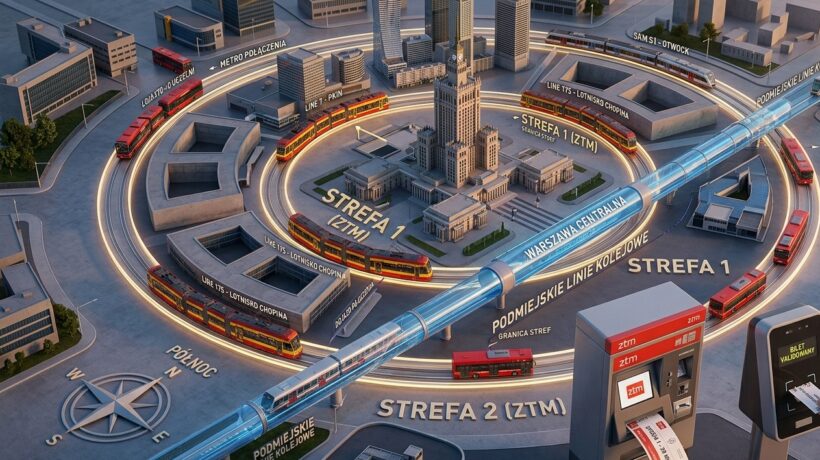
Zone 1 and Zone 2 – where does Warsaw end and the surcharge begin?
Transport organized by ZTM Warszawa is divided into two ticket zones. The key to stress-free travel lies in understanding where the boundary between them is and how to correctly interpret the markings at stops and in vehicles.
ZONE 1 (Warsaw)
- All districts (e.g. Śródmieście, Wola, Mokotów)
- Border stops (marked as zone boundary)
Zone boundary – ticket 1+2
September 20, 2026
- Neighbouring communes (e.g. Pruszków, Piaseczno, Legionowo)
Zone 1 (urban)
It covers the area within the administrative borders of Warsaw (all 18 districts – from Białołęka and Bemów, through Śródmieście and Wola, to Ursynów and Wilanów). If your daily student life revolves around the college, dormitory, and clubs in the center, you will only move within the boundaries of Zone 1.
Zone 2 (suburban)
It includes municipalities neighbouring Warsaw, which have signed a transport agreement with the capital. These are, m.in, Pruszków, Piaseczno, Otwock, Legionowo, Wołomin, Sulejówek and Łomianki. This zone is mainly served by suburban buses (zone lines numbered 7xx and 8xx) and trains of SKM and Koleje Mazowieckie.
How to recognize a border stop?
The place where Zone 1 ends and Zone 2 begins is called the border stop. Information about the status of the stop is located on timetables (on stop posts), is displayed on screens inside buses and trams and announced by voice via the passenger information system.
An example from everyday life: You take bus line 709 from the Wilanowska Metro station in the direction of Piaseczno. The last stop in Zone 1 is the Dąbrówka stop. The next stop is Zone 2. If you have a ticket only for Zone 1, you must validate the ticket valid for Zone 2 before passing the Dąbrówka stop.
Student discounts at ZTM Warszawa – criteria and entitlements
Students of universities (both public and non-public) are entitled to a 50% discount on travel on all public transport in Warsaw.
The most important conditions for using the student relief:
- Electronic Student Card (ELS): It is the only document that certifies the right to relief during ticket control. The card must have a current hologram (renewed every semester – until March 31 and October 31).
- No age limit: Unlike high school or doctoral students, first- and second-cycle students (bachelor’s, engineer’s, and master’s) benefit from a 50% discount regardless of age. Even if you are studying in your thirties, a valid ELS entitles you to cheaper tickets.
- PhD students: People in doctoral studies (doctoral schools) are also entitled to a 50% discount, but in their case there is an age limit of up to 35 years.
Best Student Tickets – Cost Comparison & Analysis
Buying single or transfer tickets for daily commuting to lectures is uneconomical. ZTM Warszawa has prepared a dedicated long-term offer, which allows to significantly reduce transport costs.
Semester Ticket – the most advantageous option for a student
This is a special ticket dedicated to learners, valid for 140 days (about 4.5 months). It perfectly coincides with the duration of the academic semester. It can be purchased in two zone variants.
Comparison of long-term tickets for students (50% discount)
| Ticket type | Zone | Price (reduced) | Cost per 1 day | Remarks |
| 30-day ticket | Zone 1 | zł55.00 | zł1.83 | A classic monthly ticket. |
| 90-day ticket | Zone 1 | zł140.00 | PLN1.55 | More advantageous than buying 30-day tickets. |
| Semester Ticket (140 days) | Zone 1 | zł110.00 | zł0.78 | The cheapest option for students moving around Warsaw. |
| 30-day ticket | Zone 1 & 2 | zł90.00 | zł3.00 | For commuters from neighboring municipalities. |
| 90-day ticket | Zone 1 & 2 | zł230.00 | PLN2.55 | Savings on commuting. |
| Semester Ticket (140 days) | Zone 1 & 2 | PLN169.00 | PLN 1.20 | The best option for students living near Warsaw. |
A Semester Ticket for Zone 1 costs only PLN 110 for 140 days of travel without limits. This is an expense of less than 80 groszy per day, which makes it an unbeatable solution for the student budget.
Where and how to encode the ticket?
You don’t have to make a traditional, plastic Warsaw City Card (WKM). Your student ID card (ELS) acts as a carrier for long-term tickets.
- Your smartphone / computer (buy your ticket online)
- Stationary ticket machine or Passenger Service Point (POP)
- Tap your ELS card ──> Your ticket is encoded
How to upload an ELS ticket step by step:
- Card activation: When you first code your ticket at a ticket machine or Passenger Service Point (POP ZTM), the system must integrate your ID card with the WTP database. It only takes a few seconds.
- Purchase at a stationary ticket machine: Most ticket machines (characteristic red or blue-yellow devices at metro stations, tram stops and main interchanges, e.g. at the Central Station or Dmowskiego Roundabout) have a contactless card reader. Slip the card into the reader’s pocket or place it on the indicated seat, select the type of ticket (e.g. Reduced Semester Ticket, Zone 1), pay for the transaction with a card or BLIK and wait for the message about the successful saving of the contract on the card.
- Online purchase: You can buy a ticket online on the WTP website. However, to activate (encode) it, you need to go to a stationary ticket machine or validator in a vehicle equipped with the function of encoding tickets purchased online and bring your ELS card closer.
Railways in Warsaw – SKM, Koleje Mazowieckie (KM) and WKD on one ticket
Warsaw’s railway junction is strongly integrated with public transport. As a student, you can move efficiently on trains, which allows you to bypass traffic jams on bridges during rush hour.
Rapid Urban Rail (SKM)
SKM trains (characteristic red and yellow trains marked with the letter “S”, e.g. S1, S2, S3, S10) are a fully integral part of the WTP. They have exactly the same tickets and zones as in buses, trams and metro. For example, on the route Warsaw Śródmieście – Warsaw Chopin Airport, you travel on a regular zone 1 ticket encoded on ELS.
Shared ZTM-KM-WKD Ticket
It is a special tariff agreement, thanks to which passengers with selected ZTM tickets can travel on suburban trains of Koleje Mazowieckie (KM) and Warsaw Commuter Railway (WKD) in Warsaw and surrounding municipalities.
Which ZTM tickets entitle you to travel on KM and WKD trains?
- 30-day tickets (for both Zone 1 and Zone 1 and 2).
- 90-day tickets.
- Semester tickets.
- Daily, 3-day and weekend tickets.
- Important: Regular single tickets (75- and 90-minute) and 20-minute tickets are not accepted on Koleje Mazowieckie and WKD trains as part of this offer.
Coverage of the shared ticket:
The boundaries of the Common Ticket on KM and WKD trains do not perfectly coincide with the administrative borders of Warsaw. For example, on the Siedlce line, the border station of the Common Ticket is Sulejówek Miłosna, on the Radom line – Piaseczno, and on the Skierniewice line – Pruszków. Detailed range maps are always available on the websites of carriers and ZTM.
Veturilo – a public bicycle as a complement to transport
In the warm months, a great alternative to trams or the metro is the Veturilo public bicycle system. Bicycle stations are located at most faculties of Warsaw universities, dormitories and metro stations.
- Student tariff: Standard registration in the system requires an active account and a minimum initial fee.
- The first 20 minutes for free: Each rental of a standard bike up to 20 minutes is completely free of charge. This is the perfect time for a quick ride, e.g. from the Metro Pole Mokotowskie station to the main building of the Warsaw University of Technology or from the Main Campus of the University of Warsaw down, to the BUW in Powiśle.
- Subsequent time slots are paid according to the price list (from PLN 1 for the first full stage), which still makes this means of transport extremely economical.
Ticket control and fines
Ticket inspectors in Warsaw (commonly referred to as “canaries”) work in all means of transport, including at night. They do not wear uniforms, and they start the inspection after the driver blocks the validators or automatically after the vehicle leaves the stop.
What are the risks for driving without a valid ticket?
The additional fee for the lack of a valid ticket is currently PLN 300 (it can be reduced by 30% if the fee is paid directly to the controller or within 7 days of issuing the summons).
Rescue scenario: I forgot my ELS card, but I have a valid ticket
If you’ve coded a semester ticket on your ID but forgot to take it out of your dorm room and you’ve been checked, don’t panic.
- The controller will issue a demand for payment (fine) for the full amount.
- You have 7 days to submit an appeal at any ZTM Passenger Service Point.
- You must show your ELS card, which was valid at the time of the check, and proof of identity.
- After verifying that the ticket on the card was active, the fine will be canceled, and you will only pay a symbolic handling fee (currently about PLN 20).
“Warsaw+” program for students registered near Warsaw (How to pay even less?)
Many students of Warsaw universities decide to rent a room or apartment in satellite towns in Warsaw due to lower rental prices (e.g. in Pruszków, Piaseczno, Legionowo or Wołomin). Others simply commute from there to their family homes for weekends. However, few people know about the existence of the “Warsaw+” (Metropolitan Ticket) program, which allows for an additional reduction in the cost of long-term tickets for people registered in municipalities near Warsaw.
This program consists in the fact that neighboring municipalities subsidize ZTM for the tickets of their residents. If you are a student and you live/are registered in a municipality that has signed an agreement with Warsaw, you are entitled to a Warsaw+ ticket.
What do the savings look like? (Sample prices for a student with a 50% discount):
- Classic 30-day ticket for Zones 1 and 2 (without municipal discount): PLN 90.00
- Warsaw+ ticket (level 1 – the municipality pays less): PLN 80.00
- Warsaw+ ticket (level 2 – the municipality pays more): PLN 60.00
For a student, this means savings of several dozen zlotys per month on commuting from Zone 2 to Zone 1 (e.g. from Józefosław to the SGGW campus in Ursynów).
How to get a Warsaw+ ticket as a student?
An EPP card alone is not enough. You must go to the office of your municipality (or a dedicated resident’s service point in a given town) and apply for a resident’s card (e.g. Pruszków Resident’s Card, Legionowian’s Card). After receiving it, with this card and an ELS card, you go to the ZTM Passenger Service Point (POP), where an employee will encode a special entitlement to purchase cheaper metropolitan tickets on your carrier.
Trap of PKP Intercity and Polregio trains within the borders of Warsaw
One of the most costly mistakes that students (especially those who are just starting their lives in Warsaw) make concerns traveling by train within the city limits.
The route between Warszawa Wschodnia, Warszawa Śródmieście/Centralna and Warszawa Zachodnia stations is a key communication artery of the capital (the diameter line). Trains run there every few minutes. Many students assume that since they have a ZTM Semester Ticket for Zone 1, they can board any train going in that direction. This is a mistake that costs over PLN 100-200 during the inspection.
TRAINS IN WARSAW – WHERE DOES YOUR ZTM TICKET WORK?
WORKS AT NO EXTRA COST
- Rapid Urban Rail (SKM)
- Koleje Mazowieckie (KM)
- Warsaw Commuter Railway (WKD)
DOES NOT WORK (FINE FOR NOT HAVING A TICKET)
- PKP Intercity (TLK, IC, EIP, EIC trains)
- Polregio (regional trains)
As part of the “Common Ticket ZTM-KM-WKD” offer for tickets from daily onwards.
What to watch out for?
- PKP Intercity (TLK, IC, EIC, EIP): These trains (usually silver and blue) do not honour the ZTM tariff. Even if you are going only one stop (e.g. from Gdański Railway Station to Western Railway Station), you must buy a separate single ticket from PKP Intercity.
- Polregio: Like Intercity, the trains of this carrier (often running in the direction of Łódź or Białystok via Warsaw) do not belong to the WTP system and do not have a Common Ticket.
If you want to quickly travel through the city by train, choose only SKM trains (red-yellow) or Koleje Mazowieckie trains (green-white-yellow – provided you have a validated ticket for at least a daily ticket or a coded long-term/semester ticket).
Night synchronization at the Central Station – how not to get stuck at 2:00 a.m.?
The Warsaw metro ends its operation on weekdays around 0:00 a.m., and on weekends (Friday/Saturday and Saturday/Sunday) it runs until about 2:30 a.m. After these hours, selected night trams remain the only means of rail transport, but the network of night buses (marked with the letter “N”) becomes the backbone of communication.
The heart of night transport is the bus terminus at the Central Station (located between the Central Station, the Złote Tarasy shopping center and the Marriott Hotel). It is here that the routes of almost all night lines in Warsaw intersect.
Rule xx:15 and xx:45 (This is not on the usual timetables):
Night buses in Warsaw operate in a synchronized transfer system. Departures from the Central Station terminus take place almost exclusively 15 and 45 minutes after each full hour (e.g. 1:15, 1:45, 2:15, 2:45, etc.).
- How does it work in practice? All night buses arrive at the loop a few minutes before the scheduled departure time. They stand next to each other in their assigned positions.
- Time for a transfer: You have exactly a few minutes to get off the bus you came from Prague (e.g. N24), cross the platforms and get on the bus going to Ursynów (e.g. N37) or Bemowo (e.g. N42).
- Departure blockade: Drivers are strictly prohibited from leaving before the designated minute (xx:15/xx:45). They move at the same time, forming a spectacular column of buses leaving the loop. If you are even a minute late and the column moves, the next synchronized departure will take place only in half an hour.
Lost laptop, backpack or ID? Warsaw has several different Lost and Found Offices
Absent-mindedness during an exam session is a classic problem for students. Leaving a bag with notes, a laptop or the ELS card itself in a public transport vehicle happens every day. It is crucial to quickly determine who physically operated the line you were travelling on, as Warsaw does not have a single, central point for all your lost belongings.
Most people make the mistake of calling the general Lost and Found Office m.st Warsaw at 15 Dzielna Street. Before any item gets there, it often takes several days. Where to look for the doom immediately?
Lost in the Metro (M1 or M2)
Warsaw Metro has its own, very efficient office. Anything found at stations or on metro trains goes to:
- Lost and Found Point of the Warsaw Metro: Located at the Stadion Narodowy Metro station (line M2), in a shopping arcade.
- Note: If you lose something in the metro late in the evening, it is worth asking the station attendant first (at the glass point at the end of the platform) – things found at the end of the day are often waiting at the end stations (Kabaty or Młociny) before being transported to the central point.
Lost on the bus
Buses in Warsaw are operated by various carriers commissioned by ZTM. Although they all look similar (red and yellow colors), they belong to different companies:
- MZA (Municipal Bus Works): The largest carrier. It has several depots (e.g. Woronicza, Ostrobramska, Stalowa, Kleszczowa). The losses are first sent to the dispatch room of a specific depot serving a given line, and after a few days to the MZA headquarters at Senatorska Street.
- Private carriers (Mobilis, Arriva, Relobus): They have their own bases.
- How to check it? Call the Warsaw 19115 city hotline. Based on the line number and time of travel, the consultant is able to determine which carrier operated a given route and provide a direct number to the dispatcher.
Lost in the tram
All trams in the capital belong to the Warsaw Trams company. The Central Point of Found Things is located at 22 Narutowicza Street (on the premises of the Tram Operation Plant in Ochota).
Technical “lifehack” for ELS cards
The Electronic Student Card (ELS) may be demagnetized or mechanically damaged (microcracks of the RFID antenna inside the plastic) when carried in a wallet next to other magnetic cards, keys or a phone. This is often manifested by the fact that the ticket machine reads the card without any problems, but the yellow entrance gates in the metro do not want to open, displaying the message “Reading error” or “Card unknown”.
What to do in such a situation so as not to be late for the colloquium?
- Damaged ELS card
- Gate does not work
- Take a free pass from the feeder
- Enter through a glass door or elevator
Free paper tickets (Metro tickets)
ZTM Warszawa has solved this problem systematically. At the entrances to metro stations (usually next to the station’s glazed cabins or by the elevators) there are small, red or grey dispensers with free paper magnetic cartons.
- These are the so-called “reusable tickets“.
- You can legally download such a pass, validate it at the gate (this will open the passage) and use it until you get a new duplicate of the ELS at the university.
- Important: The ticket itself is not a ticket. During the subway check, you must show the controller your damaged ELS card, on which a valid ticket is physically encoded (controllers have more sensitive handheld readers, which usually read damaged cards without any problems).
Entry through baggage gates (QR Code)
New metro stations (especially on the M2 line) and modernized entrances on the M1 line have wide baggage gates equipped with QR code readers. If you have a ticket purchased in a mobile application (e.g. Jakdojade, mObywatel, mPay), you do not have to approach traditional validating machines. Simply bring the phone screen with the generated QR code close to the reader at the gate to release the gateway lock.
Getting around Warsaw doesn’t have to be expensive or stressful if you know the operational realities of local transport. As a student, you should implement three basic habits:
- Always check the train carrier: Avoid boarding PKP Intercity trains on intracity routes if you only have a ZTM ticket.
- Use the Semester Ticket: This is statistically the cheapest form of legal travel in the capital (cost less than 80 groszy per day for Zone 1).
- Save the number 19115 on your phone: The city’s system of contact with residents is the fastest way to report a breakdown, lose things in the vehicle or get information about sudden changes in the operation of zone lines.
Frequently asked questions about ZTM Warszawa
Is the 20-minute ticket valid in both ticket zones?
Yes. A 20-minute ticket (costing a reduced price of PLN 1.70) is a zone ticket marked as Zone 1+2. This means that you can cross the border of ticket zones on its basis, as long as the travel time from the moment of validation does not exceed 20 minutes.
Does a student ID card from another Polish university entitle you to a tax relief in Warsaw?
Yes. Each valid Electronic Student Card issued by a Polish university entitles you to a 50% discount on ZTM Warszawa rides. You don’t have to be a student at a Warsaw university to take advantage of discounts.
How do night buses work in Warsaw?
Night buses (marked with the letter “N”, e.g. N43, N13) usually run from 11:30 p.m. to 4:30 a.m. The main interchange for all night lines are the stops around the Central Station. On night lines, the exact same ticket fare applies as on day lines (including semester and 30-day tickets).
Can I transport a bicycle or a dog on public transport for free?
Yes. The transport of dogs, bicycles and hand luggage in all ZTM Warszawa vehicles is completely free of charge. However, remember to transport the bicycle in designated places and not to obstruct the passage of other passengers.
The public transport system in Warsaw, despite its complicated structure, is one of the most passenger-friendly in Europe. For a student, the key to cheap and efficient travel is to encode the Semester Ticket on the ELS card as soon as possible and remember about the expiry dates of holograms (March 31 and October 31). Being aware of the course of the boundaries of zone 2 will protect you from an accidental fine during weekend trips out of town, and the integration of SKM and Koleje Mazowieckie trains as part of the Common Ticket will save you valuable time during your daily commute to the university.