


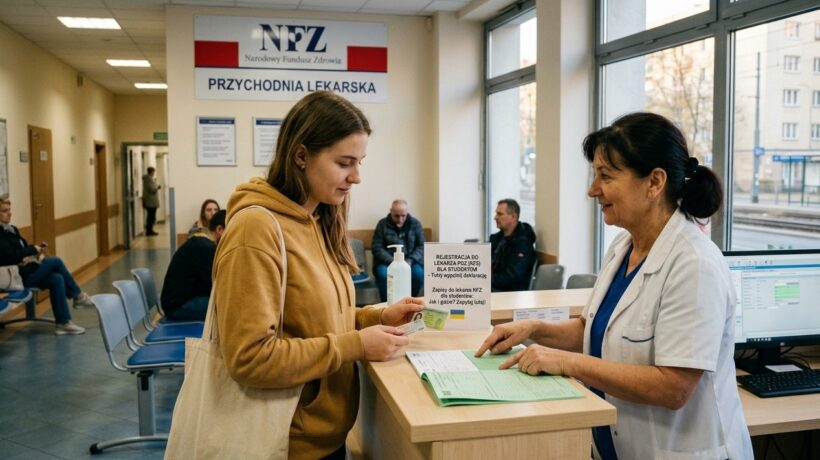
How to Access Public Healthcare (NFZ) as a Student in Warsaw
Moving to Warsaw to study in the academic year 2026/2027 does not require a change of permanent residence in order to benefit from free medical care. As a visiting student, you have the right to a free primary care (Primary Health Care) doctor in any Warsaw clinic that has a contract with the National Health Fund. You don’t have to go to your hometown for a prescription for an antibiotic or a referral for a blood count. The entire registration process takes place digitally via the Internet Patient Account (IKP) or stationary at the facility, and key medical points are located a stone’s throw from the Warsaw University of Technology Main Building, the Ochota Campus or the University of Warsaw.
Brutal analysis of the topic: NFZ for a student in the reality of Warsaw
In 2026, Warsaw’s healthcare system for students is a clash between modern digitization and huge occupancy of facilities in key districts: Śródmieście, Mokotów and Ochota. If you think that you will sign up for a doctor “on the day of illness”, you are mistaken, which costs PLN 250 for a private visit.
Facts you won’t hear at matriculation:
- Zoning does not exist: You can live in the “Riviera” nursing home at Waryńskiego Street, and have a doctor in Ursynów. However, ZTM’s logistics during peak hours makes choosing a clinic on the M1 route or close to the department the only rational move.
- CenterMed is not the only option: Although CenterMed (Waryńskiego Street, Mochnackiego Street) is a student “combine”, the queues to internists in October and March (the peak of infections) are legendary there. It is worth considering the smaller SPZOZ Warsaw-Wola or Warsaw-Mokotów facilities, which often have better availability of “for now” terms.
- Insurance in USOS: Your right to a doctor depends on your registration for insurance. If you work on a contract of mandate and are under 26 years old, the contributions are paid by your employer or you are connected to your parents’ Social Insurance Institution. If not – you must report it to the university (Social Section). The lack of a “green light” in the eWUŚ system when registering at a clinic is the most common reason for sending students back with a receipt.
- Sick leave (L4) for the dean’s office: In 2026, paper sick leaves are a relic. The doctor issues an e-ZLA, but for universities (e.g. to justify absence from an exam in a session) you often need a medical certificate of inability to study. Not every clinic issues them free of charge – the standard fee “for paper” is from PLN 30 to PLN 70.
September 20, 2026
Survival guide: How to get a handle on the doctor step by step?
Don’t wait until you get a fever in the dorm. Do this in the first week of October.
Step 1: Insurance verification (eWUŚ status)
Log in to the IKP (pacjent.gov.pl) using the Trusted Profile or the mObywatel application. Check if your insurance is active. If it’s red and you’re under 26, your parent must register you with their employer as a family member. If you don’t have parents with insurance, go to the dean’s office of the Warsaw University of Technology, the University of Warsaw or the Warsaw School of Economics with an application for insurance from the university.
Step 2: Choosing a “Strategic” Outpost
Choose a clinic close to your natural existence.
- For UW students: Clinic at Krakowskie Przedmieście Street or facilities on the route of line 116/503.
- For WUT students: CenterMed on Waryńskiego Street (right next to the Politechnika Metro) or Mochnackiego Street (near the Faculty of Architecture and Chemical Engineering).
- For the Ochota Campus (UW/WUM): Clinics in the area of Banacha and Pasteur Streets.
Step 3: Electronic Declaration of Choice
You don’t have to go to a clinic to sign up.
- Go to IKP -> My Patients -> Declarations.
- Choose a primary care physician, a nurse and (optionally) a midwife.
- Enter the city: Warsaw and find a specific institution (e.g. SPZOZ Warszawa-Wola).
- Sign with a trusted profile.
From that moment on, you are a patient of a given clinic. Your old clinic in Pcim or Suwałki is automatically notified of discharge.
Step 4: First visit and “Red Flags”
Have your student ID card with you on your first visit.
Beware of pitfalls: Some “student” clinics try to enforce “enrollment” or “patient card” fees. This is illegal under the National Health Fund. If a clinic claims that it “does not accept new students” and has a contract with the National Health Fund – they are lying. You have the right to change your doctor free of charge twice a calendar year. The third shift costs about PLN 80 (unless you are changing your place of residence).
Comparison of medical options for a student in Warsaw
| Feature | Student Clinic (e.g. CenterMed) | District Clinic of the National Health Fund (SPZOZ) | Private Package (LuxMed/Medicover) |
|---|---|---|---|
| Location | Very center, close to university campuses | In each district (e.g. Białołęka, Bemowo, Ursynów) | Modern office buildings, major transport hubs |
| Waiting time | Short: Usually 1-3 days (due to high patient turnover) | Medium: usually 2-5 days (often older patients have priority) | Instant: same day or up to 24 hours |
| Cost | PLN 0 – as part of the general insurance of the National Health Fund | PLN 0 – as part of the general insurance of the National Health Fund | Subscription: PLN 80–200 per month (or student package) |
| Exemptions / Prescriptions | Without any problems, doctors know the procedures and requirements of USOS | Standard procedures (L4 electronic or certificates) | Very fast, often issued remotely via chat/teleconsultation |
| Specialists | Often, basic specialists are available on site | They require a referral from the health care provider and a longer wait in line | Most specialists are available immediately, without referrals |
| Atmosphere | “Young” and dynamic, but there can be a lot of crowds during the session | “Osiedlowa”, dominated by seniors and parents with children | Corporate, high standard of service, no visible queues |
Why do most students rely on this topic? (Error Analysis)
The biggest mistake is the “I am immortal” mentality. Students remind themselves of the doctor when they need to be released for the “September campaign” or when an infection prevents them from climbing the stairs in the WUT Main Building.
- “Permanent residence” error: Many students think that since they are registered with their parents in another voivodeship, they cannot have a doctor in Warsaw. False. The NFZ system is nationwide. The lack of declarations in Warsaw means that in case of illness you have to use the Night and Christmas Health Care (NiŚOZ), where queues at Lindleya or Hoża streets on Sunday evening are 4-6 hours of waiting among people with more serious problems.
- “Teleconsultation” error: In 2026, teleconsultations are limited. The doctor is obliged to see you in person if this is your first visit or if the condition is serious. Don’t count on “conjuring” an L4 over the phone without first appearing in the institution’s file.
- Ignoring the IKP: If you do not have an active Online Patient Account, you will not be able to check the e-prescription code that the doctor sent you by SMS. In Warsaw pharmacies (e.g. those around the clock at the Central Railway Station) no one will discuss with you without a code and PESEL.
Mental health on the National Health Fund: Where to look for help when USOS and the session are pressing?
In the academic year 2026/2027, the Warsaw psychological support system for students is extremely burdened, but it offers real paths of help outside the private office for PLN 300 per session. If your problem is not angina, but anxiety, depression or total burnout, you do not need a referral to a psychiatrist, but to a psychologist at the National Health Fund – yes.
- Psychological Assistance Centre of the University of Warsaw (7 Pasteura Street): It is an absolute bastion for students of the University of Warsaw. They offer short-term therapy (up to a dozen or so meetings) completely free of charge. Registration is done in throws, usually at the beginning of the semester – you have to keep an eye on the deadlines on their website, because places disappear faster than free dates for microeconomics exams.
- Mental Health Clinics (PZP) on the National Health Fund: The largest and most “throughput” points are those at Nowowiejska Street (Nowowiejski Hospital) and at Dolna Street. As a student, you have the right to enroll in any UCoC in Warsaw.
- Crisis helpline: In extreme situations, when the system fails, WUT and UW students often use round-the-clock support at the Institute of Psychiatry and Neurology at Sobieskiego Street.
Fact: Since 2025, most universities have introduced the so-called “Mental Health Days” – two days a semester off from classes, which you can report through USOS without a medical certificate, but if you need a longer break (dean’s leave for health reasons), an opinion from a psychiatrist from the Warsaw branch of the National Health Fund is treated as a priority by the rectors’ committees.
Occupational Medicine: Mandatory Examinations for Students of “Dirty” and Medical Fields
If you study chemistry at the Ochota Campus, chemical technology at the Warsaw University of Technology, biology or medicine at the Medical University of Warsaw, you will not miss a referral to an occupational medicine doctor for examination. The university issues a referral that specifies harmful factors (e.g. chemical reagents, working at a monitor, contact with biological material).
Where to arrange it in Warsaw without paying?
Most universities have signed agreements with specific institutions, most often with the Mazovian Voivodeship Center for Occupational Medicine (MWOMP) at Kolejowa Street or Nowogrodzka Street.
- Strategic error: Waiting until the end of September to test. A queue of students from all over Warsaw (from the Military University of Technology to the Warsaw University of Life Sciences) will completely block these clinics. If you do not submit the certificate to the Dean’s Office by mid-October, your access to the laboratories at USOS will be blocked, which means that you will not be able to pass the course.
- Costs: If you have a referral from a university, the tests are free of charge. If you lose your referral and want to do it privately, be prepared to spend PLN 150-250.
SOR vs. NiŚOZ: Where to go when it hurts, and where to go when you die?
Warsaw students make a mistake en masse when they go to the Emergency Department (Hospital Emergency Department) with problems that should be solved by the Night Medical Help. The result? 8-12 hours of sitting on a plastic chair in the waiting room at Banacha Street.
- Emergency Department (Banacha Street, Lindleya Street, Wołoska Street): You go there ONLY if your life is in danger (suspected appendix, fracture, severe bleeding, loss of consciousness). In 2026, the triage system (segregation of patients) is merciless – if you come with a fever of 39 degrees, you will get a blue wristband and wait for doctors to take care of all the accidents on the Łazienkowska route.
- NiŚOZ (Night and Christmas Health Care): This is where you go with the flu, earache or sudden back pain after an all-night study at BUW.
For Śródmieście/Mokotów: 56 Hoża Street (ambulance station).
For Wola: 17 Kasprzaka Street (Wolski Hospital).
For Prague: 51/59 Grenadierów Street.
Protip: If you only need a prescription for medications that you constantly take and your clinic is closed, use the so-called telemedicine platforms integrated with the IKP, but remember that the NFZ is increasingly verifying the legitimacy of issuing e-prescriptions without a physical examination.
Dormitory hygiene: Vaccination and prevention of infectious diseases
Life in the “Riviera”, “Babilon” or “Żwirek” Children’s Hospital is not only an integration, but also an epidemiological risk. In dense environments (shared kitchens, bathrooms in the hallway), meningococci and whooping cough spread the fastest.
- Recommended vaccinations: Even if they are not mandatory, primary care physicians in Warsaw student clinics in 2026 strongly recommend vaccination against meningococcal type B and ACWY before moving into a dormitory. The cost of one dose is about PLN 170-250, but often Student Self-Governments (e.g. SSPW) negotiate discounts in institutions such as CenterMed.
- Head lice and scabies: These are not topics from the nineteenth century. There are regular bonfires in Warsaw dormitories. If you notice skin lesions, don’t be ashamed to go to the primary care doctor. An overview and a quick prescription for permethrin ointment do the trick in 24 hours.
The Varsovian Card and access to a doctor: Does it give anything?
In 2026, having an active Varsovian Card (uploaded to ELS or on your phone) is crucial not only for cheaper ZTM tickets. The City of Warsaw has launched prevention programs available only to residents (PIT settlers in Warsaw).
- Free test packages: The city regularly finances tests for vitamin D deficiency, sugar levels or cervical cancer prevention (cytology) for female students. Often, collection points are set up on the mobile side of the Theoretical Medicine Building of the Medical University of Warsaw or at the entrance to the Metro Politechnika.
- Dentist for young people: City programs often include free tooth sealing or scaling once a year for people under 26 years of age with a Warsaw Card, which goes beyond the standard basket of NFZ benefits.
Table: Medical infrastructure around the largest campuses
| Campus / University | Nearest Outpatient Clinic (NFZ) | Blood collection point | Night and Christmas Medical Assistance |
|---|---|---|---|
| WUT Main Building | CenterMed, 10a Waryńskiego Street (dedicated to students) | Alab Laboratoria, 3 Polna St. | Clinical Hospital, 56 Hoża St. |
| Ochota Campus (UW) | SPZOZ Warszawa-Ochota, 36 Szczęśliwicka Street | Synevo, 1a Banacha Street | Infant Jesus Clinical Hospital, 4 Lindleya St. |
| UW Main Campus | Bracka Clinic, 19 Bracka Street | Diagnostyka, 14 Chmielna St. | Clinical Hospital, 56 Hoża St. |
| SGH / Mokotów | SPZOZ Warszawa-Mokotów, 13 Madalińskiego Street | Alab Laboratoria, 43 Puławska St. | Holy Family Specialist Hospital, 25 Madalińskiego Street |
| Warsaw University of Life Sciences (Ursynów) | NZOZ Ursynów, 4 Romera St. | Picking Point, 15 Ciszewskiego Street | District and Specialist Clinic, 4 Romera Street |
PE “Tokens” and Injuries: The Path to Medical Documentation
If your adventure with PE at a Warsaw university ended with an ankle sprain (a classic in the halls at Banacha Street), you need to know how to manage documentation so as not to lose a year.
- Accident report: It must take place with the instructor. This is the basis for accident insurance.
- Medical certificate: A doctor of the National Health Fund in Warsaw must enter in the certificate not only the diagnosis, but also a specific period of exemption from physical activities.
- Making up for “chips”: If the leave is short, you will have to do your homework on another date. If it lasts a whole semester, you must submit an application to the Student Affairs Office for the reassignment of ECTS credits on the basis of a medical certificate.
Red flag: Do not buy sick leaves through suspicious “L4 in 5 minutes” websites for PLN 50. In 2026, Warsaw universities have automated systems for verifying doctors’ NPWZ numbers. If the system detects that the sick leave was issued by a doctor from the other end of Polish, who has 5000 issued forms per month, you will face disciplinary problems.
How not to become a “ghost patient”? (Verification of data in the IKP)
Many students forget to update their phone number in the IKP system after moving to Warsaw . The result? The code for the e-prescription or confirmation of the appointment to the specialist comes to your old number that you used in high school.
- Do it now: Go to the profile settings in the mObywatel application or on pacjent.gov.pl and update your contact details.
- Authorizations: If you live with someone in a dormitory room and you have full confidence in that person, you can authorize them to collect your e-prescriptions at the IKP. It saves your life when you are lying down with a 40-degree fever and you don’t have the strength to walk to the pharmacy at Zbawiciela Square.
Choosing an NFZ doctor in Warsaw is not an unpleasant duty, but your financial shield. In the reality of 2026, where the cost of living in the capital has increased by another 30%, spending money on private doctors just because you “didn’t want to click on the ICP” is the biggest financial mistake you can make at the start of your studies.
FAQ – What do students really ask in Warsaw?
How to get a sick leave for an exam if I don’t have a doctor in Warsaw?
If you have been affected by the disease and you do not have a submitted declaration, you have two options. The first is a visit to the Night and Christmas Health Care facility (NiŚOZ) – in Warsaw, these are, for m.in, points at 56 Hoża Street, 4 Lindleya Street and 25 Madalińskiego Street. They operate from 6:00 p.m. to 8:00 a.m. on weekdays and around the clock on weekends. The doctor receiving there is authorized to issue an e-ZLA (L4) and a certificate for the dean’s office. The second option is a private visit (cost 200-300 PLN), where the doctor will issue a certificate immediately. Remember that for most Warsaw universities (UW, WUT, SGH), the exemption must include the date of the exam. If your student clinic is overcrowded and you only need a certificate from USOS, look for smaller clinics on the outskirts (e.g. Bielany, Italy), where patient limits for a given day are less often exhausted before 10:00 a.m.
Is a student ID card enough to go to the doctor in Warsaw?
The student ID card (ELS) itself only confirms that you are a student and are entitled to ZTM discounts, but it is not proof of health insurance. In the NFZ system, the eWUŚ status linked to your PESEL number counts. However, the ID card is necessary to prove the student’s status in dedicated clinics (e.g. CenterMed), which have special contracts for servicing pupils. From 2026, most verification takes place automatically after providing PESEL, but it is worth having mObywatel with an active mLegitation. If you work under a contract for specific work, you are not automatically insured – you must be added to your parent’s insurance or reported by the university. Lack of insurance for visible activity in USOS is a procedural error that you must clarify with the student affairs office before your visit.
Where in Warsaw can I do blood tests at the National Health Fund as a student as the fastest?
A referral for blood tests is issued by a primary care physician. After receiving it, you do not have to do tests in the same clinic, as long as the facility has signed agreements with specific laboratories (e.g. Diagnostyka, Synevo). The fastest tests can be done at large collection points, e.g. at Emilii Plater Street, Chmielna Street or in the vicinity of Narutowicz Square. Remember that laboratories in student clinics are under siege between 7:00 a.m. and 9:00 a.m. If you care about time, choose a pick-up point in a less “student” district, e.g. in Wola near Kasprzaka Street. In 2026, the test results land automatically on your IKP, so you don’t have to return to the clinic to get them – the doctor will see them in the system during the follow-up visit.
What should I do if I need a dermatologist or gynaecologist at the National Health Fund in Warsaw?
You do not need a referral from a primary care physician to see a gynaecologist, oncologist, psychiatrist, dentist and venereologist. You can sign up directly for any facility in Warsaw that has a contract with the National Health Fund (e.g. St. Sophia Hospital on Żelazna Street for women or clinics at Koszykowa Street for dermatology). For other specialists (e.g. dermatologist, ophthalmologist, orthopaedist), you must first obtain an e-referral from your primary care physician. The queues to see specialists in Warsaw are long – for example, the wait for an endocrinologist is from 6 to 18 months. The trick of students is to look for dates in towns near Warsaw, such as Pruszków, Legionowo or Otwock, where you can get there in 30-40 minutes by SKM/KM train on the city card (Varsovian Card), and you will get an appointment three times faster.
How to change the NFZ doctor after moving to another dormitory or district?
The change is trivially simple and does not require a visit to the previous clinic. You enter the IKP, choose a new facility and doctor, send a declaration and that’s it. The system automatically transfers your electronic documentation. However, if your medical history is in paper form (old years or specific tests), you must submit an application to the new clinic to download the documentation from the previous facility or collect a photocopy in person (it may be paid). In Warsaw, students often change their doctor when moving, for example, from DS “Ustron” in Praga to an apartment in Mokotów – it is worth doing it right away, because in the event of sudden back pain or severe tonsillitis, 40 minutes on the tram is the last thing you want.