


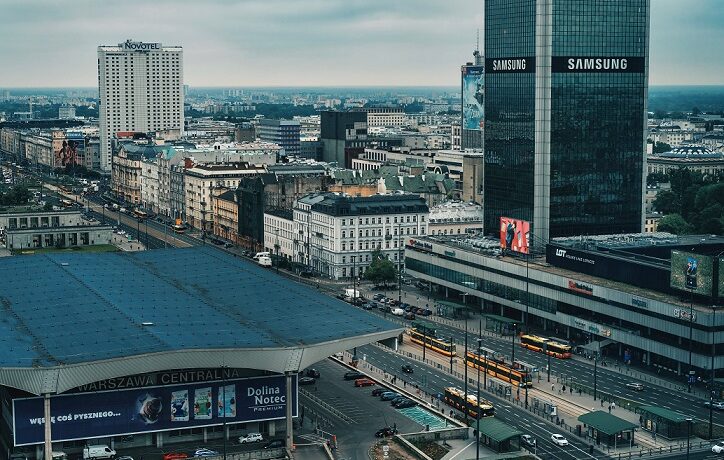
Student housing in Warsaw: Metro or Tram?
The choice of the location of an apartment for a student in Warsaw for the academic year 2026/2027 should be based on the distance from the metro station or the main tram junctions, not on the distance in kilometers from the university. Living on the M1 or M2 line provides a predictable commute time during peak hours, while trams offer a better alternative on routes between districts (e.g. Wola – Ochota) where the metro does not reach.
The most important information in a nutshell:
- Metro: Highest reliability, no traffic jams, but higher rental prices within a 10-minute walk from the station.
- Tram: Greater affordability, key in districts such as Praga-Północ or Ochota.
- WTP (Warsaw Public Transport): Regardless of your choice, check the coverage of the so-called “first ticket zone”, which covers almost the whole of Warsaw.
- Rush Hours: In Warsaw, between 7:30 and 9:00 and 16:00 and 18:00, a bus ride across the Łazienkowski Bridge or the Toruń Route can take twice as long as the metro.
Metro: The gold standard of Warsaw’s transport
September 20, 2026
Living next to a metro station is a guarantee of punctuality for a student, especially in the face of road repairs paralyzing the city. In the academic year 2026/2027, the M1 and M2 lines remain the backbone of the city, connecting the largest academic centers.
Why does the metro win on long-haul routes?
The metro is unbeatable if you live in Ursynów or Bielany, and you study at the University of Warsaw (Main Campus, Nowy Świat-Uniwersytet station) or at WUT (Politechnika station).
- Line M1 (Kabaty – Młociny): It crosses the center of the city. Ideal for students of the Warsaw School of Economics (Pole Mokotowskie station) and the University of Warsaw.
- Line M2 (Bemowo – Bródno): It is crucial for students of the Medical University of Warsaw (Rondo Daszyńskiego station) and people commuting from the left-bank Wola or the right-bank Praga.
Real cost of convenience: Prices for apartments within a radius of 800 meters from a metro station are on average 15-20% higher than in locations served exclusively by buses. When planning your budget for 2026/2027, take into account that you will pay from PLN 1800 upwards for a single room near the metro station in Śródmieście or Wola (not including utilities).
Tram: Flexibility and affordability
Trams in Warsaw, operated by Warsaw Trams, are the best solution for university students with a dispersed structure or those who are looking for cheaper accommodation in well-connected “non-meter” districts.
When is a tram better than a subway?
- Ochota and Mokotów: If you study at the faculties of the Warsaw University of Technology at Narutowicz Square or at the Ochota Campus of the University of Warsaw, the tram network on Grójecka and Banacha Streets is faster than the metro.
- Praga-Południe (Grochów): Despite the lack of a metro, a high-speed tram on the route along Washington Avenue takes students to the center in about 15-20 minutes.
- Białołęka/Tarchomin: The new tram line has significantly improved access to the Młociny metro station, which makes these districts attractively priced.
Attention to the condition of the infrastructure: In 2026, numerous track renovations (frequent in districts such as Wola or Mokotów) may force the use of substitute bus transport. Always check the [wtp.waw.pl]service (wtp.waw.pl) for planned conversions on your route.
Comparative analysis: Metro vs Tram (data 2026/2027)
| Feature | 🚇 Metro | 🚋 Tram |
| Time predictability | Very high • Completely collision-free (no traffic jams) | Average • Dependent on the separation of the track and intersections |
Accessibility for the student (prices of apartments nearby) | Limited • Very high rental prices and high demand | High • Much more cheaper deals within walking distance |
| Travel comfort | High • Trains run very often and quickly | Medium • Possible considerable congestion during rush hour |
| Coverage in Warsaw | Point • Fast transport, but only along the main lines (M1, M2) | Wide • Dense network connecting most districts |
How to check the real travel before signing the contract?
Don’t trust descriptions in ads like “10 minutes to the center”. In Warsaw, the distance in meters is less important than the travel time in the morning.
- Use the map asjade or Google Maps: Set “arrival to” to 8:00 a.m. on a weekday.
- Check out the walking distance: Check whether you are not going to the stop through dangerous passages or whether the road does not lead through a construction site (a common problem in Wilanów or Bemów).
- Test Veturilo: If you plan to commute by city bike, check the location of the nearest [Veturilo]station (https://veturilo.waw.pl). In Warsaw, the city bike system perfectly complements the shortcomings in tram transport.
Top Questions Students Asked
Is it worth paying more for an apartment near the metro?
Yes, if you study in the morning and don’t want to waste 1.5 hours a day in traffic jams on the Łazienkowska Route or Aleje Jerozolimskie.
Which districts are best for a student with a budget of up to PLN 1500?
In 2026/2027, search in Praga-Południe (Grochów) and in districts such as Targówek or Bielany (further from the metro station). Trams provide a solid connection to the city center.
Are there different ticket zones in Warsaw?
Yes, I and II zones. Most students need a ticket for Zone I (the whole city). If you are renting a room in Pruszków or Piaseczno, check the costs of a zone ticket.
Do trams in Warsaw run at night?
No, night transport is based solely on buses (lines “N”). The metro runs at night on weekends, which is a huge advantage of the M1 and M2 lines.
What is the cheapest way to travel around Warsaw as a student?
With a student ID, you are entitled to a 50% discount on WTP long-term tickets. The Varsovian Card (if you settle PIT in Warsaw) gives additional discounts.