


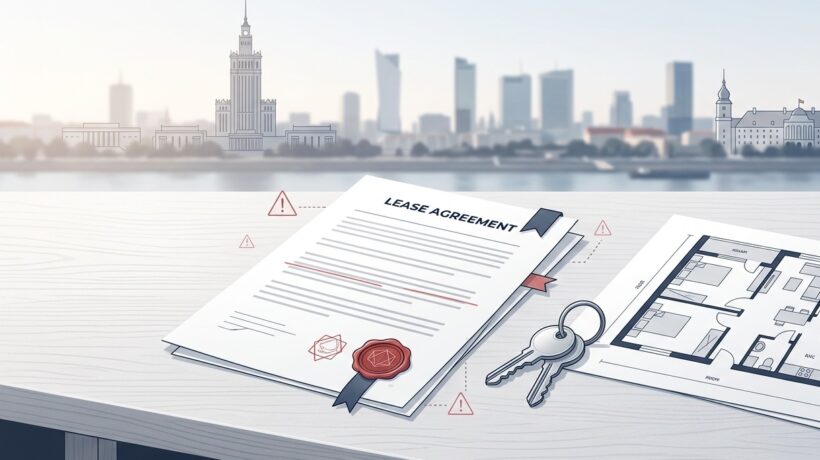
Student tenancy agreement in Warsaw – watch out for these clauses!
Signing a lease agreement in Warsaw is often the first serious contact with civil law for a student. In the reality of the capital’s real estate market, where demand at the turn of August and September drastically exceeds supply, it is easy to succumb to time pressure and sign an extremely unfavorable document. Haste, lack of experience and manipulation in advertisements may result in the loss of the deposit, unexpected fees of several hundred zlotys per month or the inability to terminate the contract early.
In order to safely rent a room or apartment in Mokotów, Ochota, Wola or Prague, you need to carefully analyze the provisions regarding the deposit, the division of administrative fees and the form of rent.
The most important information at a glance:
- Occasional lease requires indicating a replacement premises and visiting a notary, which may be a formal barrier for students from outside Warsaw.
- Rent and administrative rent are two different fees – make sure that the price in the advertisement includes fees to the cooperative.
- A fixed-term contract cannot be terminated prematurely, unless the conditions for such termination are precisely specified in its content.
- A handover protocol with detailed photographic documentation is the only effective tool for recovering a deposit.
Ordinary lease agreement or occasional lease? Key differences for a student from outside Warsaw
September 20, 2026
Occasional lease is a specific form of agreement that protects the property owner more strongly, making it easier for him to evict a burdensome tenant. For the student, this means the need to complete additional, often troublesome formalities with a notary.
Occasional lease agreement
- Tenant’s declaration of submission to enforcement (notarial deed – Article 777 of the Code of Civil Procedure)
- Indication of another premises in which the student can live in the event of eviction
- Statement of consent of the owner of that premises (with a notarized signature)
Most students coming to Warsaw universities (UW, WUT, SGH, SGGW, MUM) from other regions of Polish do not own real estate or family in the capital that could be subject to legal rigour. The solution is to indicate the family home (e.g. parents in their hometown). However, this involves the need for the parent to visit a notary public in order to sign a statement of consent to take the student under their roof in the event of eviction.
The cost of drawing up such a notarial deed (a declaration of submission to enforcement under the pain of Article 777 of the Code of Civil Procedure) is legally a maximum of 1/10 of the minimum remuneration for work plus a notarial fee. According to good practices, this cost should be covered by the owner of the apartment, but in Warsaw it has become a market standard to pass on this fee (or half of it) to the student.
Net rent vs. administrative rent – Warsaw’s advertising trap
The most common trick used by Warsaw landlords on classifieds portals (OLX, Otodom) is to artificially lower the offer price by hiding the real costs of operating the property.
Price in the ad: 2200 PLN (the so-called “pure” rent)
- + Administrative rent (to the cooperative/community): 650 PLN (heating, water, garbage)
- Advance payments for electricity and gas: 150 PLN
Real monthly cost: 3000 PLN
In accordance with Article 8a of the Act on the Protection of Tenants’ Rights, the landlord may only charge the tenant fees independent of the landlord (e.g. utilities, garbage collection) and rent. It is very important to precisely separate in the content of the contract which amount constitutes compensation/rent for the owner (fixed amount) and which is administrative rent paid to the housing cooperative or community (variable amount).
The lack of such a provision allows the owner to arbitrarily pass on to the student any increases in the renovation fund or the costs of managing the community property without the need to annex the agreement.
Term and conditions for termination of a fixed-term contract
Most lease agreements for students in Warsaw are concluded for a definite period of time – usually for 10 months (from 1 September to 30 June of the following year) or for a full 12 months. There is a common misconception that any contract can be terminated with a period of, for example, one or three months.
In accordance with Article 673 § 3 of the Civil Code, a lease agreement concluded for a definite period of time may be terminated by either party only in the cases specified in the agreement.
Fixed-term contract
- No provisions on the reasons for termination ──► No possibility of legal termination before the deadline
- Precisely defined reasons for termination ─► Possibility of early termination of the contract (e.g. resignation from studies, loss of source of income, conscription)
If a fixed-term contract contains a general provision: “Each of the parties may terminate the agreement with a one-month notice period“, without indicating specific, important reasons, this provision is invalid by law. As a result, if a student decides to drop out of college or move during the semester, the landlord has every right to demand payment of rent for all remaining months of the contract, even if the student physically leaves the premises.
Deposit – how much is it and when can the owner legally keep it?
A security deposit is a standard for every rental transaction in Warsaw. Its amount usually corresponds to the equivalent of one or two months’ rent. Article 6(1) of the Act on the Protection of Tenants’ Rights limits the maximum amount of the deposit to 12 times the monthly rent (in the case of occasional rentals to 6 times), but in student practice these values are much lower.
The most important rules regarding the deposit:
- Return Date: According to the law, the owner is obliged to return the deposit within 30 days from the date of emptying the premises and handing over the keys. The provisions in the contract extending this period to, for example, 60 or 90 days are inconsistent with the Act.
- Deductions from the deposit: The owner may deduct from the deposit only the equivalent of documented damages exceeding the standard wear and tear of the apartment (e.g. broken glass, damaged kitchen worktop) and arrears in payments.
- Standard wear (operation): Natural wear and tear of the premises (e.g. worn floor panels in the place of a desk chair, dusty walls, worn gaskets in the tap) is a burden on the owner and cannot be the basis for retaining the deposit.
Who pays for repairs in the apartment? Division of duties according to law
Conflicts between students and landlords most often concern failures of household appliances (washing machines, refrigerators) or sanitary installations. Many contracts contain abusive provisions that pass on all repair costs to the tenant. The Polish legislator precisely regulated this division in Articles 6a and 6b of the Act on the Protection of Tenants’ Rights.
Division of maintenance and repair duties:
| Obligations of the owner (Landlord) | Obligations of the student (tenant) |
| Ensuring the efficient operation of the installation (water, gas, heating, electricity). | Maintenance and repair of floors, carpets and ceramic wall coverings (e.g. tiles). |
| Repair and replacement of heating stoves, radiators and vertical pipes. | Repair and maintenance of windows, doors and built-in furniture. |
| Replacement of worn indoor installations . | Repair of sanitary equipment (siphons, faucets, cisterns) and household appliances put into use. |
| Main structural repairs of the building and the premises themselves. | Painting walls and ceilings (refreshing the premises at the end of the lease). |
Provisions in the contract transferring the obligation to repair, for example, a damaged sewage riser or the replacement of an old gas stove for a student are invalid as less beneficial for the tenant than the provisions of the Act.
A Guide to Warsaw’s Student Districts: Prices, Getting Directions and Topography
The choice of a district in Warsaw directly affects the cost of living and the time spent on public transport. Warsaw has an excellent transport network managed by Warsaw Public Transport (WTP), including two metro lines (M1 and M2).
Transport specifics of districts:
- Mokotów (mainly Górny Mokotów, Służew): Ideal for students of the Warsaw School of Economics (M1 Pole Mokotowskie metro station) and the Warsaw University of Technology. The district is expensive, but perfectly connected by the M1 metro line and trams along Niepodległości Avenue.
- Willingness: A traditional student district with proximity to the campus of the University of Warsaw in Ochota (physics, chemistry, biology) and the Medical University of Warsaw (Żwirki i Wigury Street). The main communication axis is trams on Grójecka Street.
- Praga-Południe (Kamionek, Gocław): A cheaper alternative to left-bank Warsaw. Excellent access to the Warsaw University of Technology and the Warsaw School of Economics by express buses running on the bus on the Łazienkowska Route (Łazienkowski Bridge). This avoids traffic jams.
- Bielany: A green district with direct access to the M1 metro station (Wawrzyszew, Młociny stations). A great base for UKSW and AWF students, and thanks to the M1 line, it takes only 15-20 minutes to get to the main campus of the University of Warsaw.
Comparison of rental costs in student districts
| District | Average cost of a single room | Average cost of a 2-room apartment | Major Colleges Nearby | Metro access (M1/M2) |
|---|---|---|---|---|
| Mokotów | 1400 – 1900 PLN | 3200 – 4500 PLN | SGH, WUT, UW | Yes (M1) |
| Willingness | 1300 – 1700 PLN | 3000 – 4000 PLN | MUW, UW | No (trams/buses only) |
| Will | 1400 – 1800 PLN | 3300 – 4600 PLN | PJATK, UW | Yes (M2) |
| Prague-South | 1100 – 1500 PLN | 2700 – 3500 PLN | SWPS, PW (Łazienkowska) | No (planned M3) |
| Bielany | 1200 – 1600 PLN | 2800 – 3700 PLN | UKSW, AWF, UW | Yes (M1) |
Handover protocol – your most important defence document (Checklist)
The handover protocol is a document drawn up at the time of handing over the keys to the premises. It is an integral part of the lease agreement. Failure to write this protocol reliably is the easiest way to lose the deposit when moving out, when the owner attributes to the student damages that already existed before.
Detailed protocol checklist (What do you need to check and write down?):
- Meter readings: Write down the exact values of electricity, gas, cold and hot water meters and heat dividers on radiators. Take photos of the meters.
- Condition of walls and paint coatings: Take note of any dirt, cracks, stud marks or stains (especially in the corners of bathrooms and kitchens).
- Condition of door and window joinery: Check that the windows close tightly, that the handles work smoothly and that the gaskets are not scorched.
- Efficiency of household appliances/electronics: Turn on the washing machine, refrigerator, hob, oven and dishwasher at the owner’s side. Note the missing plate in the microwave or the cracked drawer in the freezer.
- Condition of upholstered furniture: Check for stains, abrasions or structural damage to sofas, armchairs and bed mattresses (remove the sheet and inspect the mattress from both sides).
- Patency of sanitary drains: Turn off the water in the sink, sink and bathtub/shower tray. Check that the water drains quickly and that moisture does not seep from under the siphons.
- Number of sets of keys and remote controls: Enter the exact number of keys to the apartment, mailbox, intercom and remote controls for the garage door/barrier.
Enter all detected defects directly into the protocol. In addition, take detailed photos (or video) of the entire apartment on the day of receiving the keys and send them to the owner by e-mail as proof of the actual condition of the property.
Signing a lease agreement for an apartment or a room in Warsaw requires cool calculation and knowledge of the basic provisions of tenant law. Don’t succumb to market pressure – even the most attractive offer is not worth risking losing your deposit or incurring unreasonable costs throughout the academic year.
Before signing the contract, make sure that the document precisely defines the administrative fees, the rules for returning the deposit and the conditions for early termination of the agreement. Always demand that a reliable handover protocol be drawn up.
The trap of joint and several liability in group agreements (Article 366 of the Civil Code)
Most students who decide to rent a larger apartment together (e.g. a three-room apartment in Wola or Ursynów) make a fundamental legal mistake: they sign a single, joint lease agreement, in which everyone acts as a “Tenant”. In the light of civil law, this triggers the mechanism of joint and several liability (Article 366 of the Civil Code).
[Jedna umowa dla 3 osób] ──► Joint and several liability (Article 366 of the Civil Code)
- Your roommate stops paying (e.g. drops out of college and leaves)
- The owner demands 100% of the amount from the others (you are obliged to pay part of it)
In practice, this means that the landlord has the right to demand payment of the full amount of rent from any student of his choice or from all of them at once. If one of the roommates suddenly resigns from his studies, moves out of Warsaw and stops paying his part, the other students have a legal obligation to cover his debt. The explanation that “I paid my part” has no legal force.
How to solve this issue safely?
Instead of one contract for the entire apartment, you should insist on signing separate room lease agreements with the right to use the common areas (hallway, kitchen, bathroom). In this case, each student is solely responsible for their share of the rent and does not bear any financial risk associated with the insolvency or sudden resignation of the roommates.
Utility settlement and the settlement cycle of Warsaw housing cooperatives
Most disputes over the return of the deposit at the turn of June and July result from the mismatch of settlement dates in the contract with the actual work cycle of Warsaw housing cooperatives and communities (e.g. the Workers’ Housing Cooperative “Praga”, the Warsaw Housing Cooperative or the Construction and Housing Cooperative “Chomiczówka”).
Advances for water and central heating are paid monthly in administrative rent. However, their actual settlement (comparison of meter readings with actual consumption) usually takes place in semi-annual or annual cycles.
- End of contract: June 30
- Request for a refund of the deposit (30 days period)
- Annual settlement of the cooperative: September/October
- The owner withholds the deposit, fearing an underpayment for heating
Most large cooperatives in Ursynów, Gocław or Bemów settle heating costs for the winter season only in September or October of the following year. Apartment owners, fearing several hundred zlotys of underpayments for heating (especially in the case of leaky windows in a large slab), illegally keep student deposits for several months after the expiration of the contract.
Security clause in the contract:
To avoid this blockage, a precise algorithm for settling utilities on the day of moving out should be included in the contract:
- On the day of the end of the lease, the parties will write down the meter readings and settle the consumption of utilities on the basis of the current rates of operators (PGE, Veolia, cooperative). The value of consumption will be deducted from the deposit, and the remaining part of the deposit will be returned to the tenant within 14 days, without waiting for the annual settlement of the cooperative.”
Frequently Asked Questions (FAQ)
Does the landlord have the right to enter the rented room in my absence?
According to Polish law (Article 193 of the Criminal Code – disturbance of domestic peace), the landlord has no right to enter the rented apartment or room without the consent and knowledge of the tenant. Exceptions are situations of sudden danger (e.g. flooding of the apartment, fire, gas failure), when it is necessary for emergency services or the owner to immediately enter to secure the property. Any follow-up visits should be pre-arranged and recorded in the lease agreement.
Who bears the costs of repainting the apartment after the end of the lease agreement?
In accordance with Article 6e of the Act on the Protection of Tenants’ Rights, the tenant is obliged to return the premises in an undeteriorated condition, but is not responsible for wear and tear resulting from proper use (e.g. natural, light dusting of the walls). The provisions in the contracts requiring the student to absolutely paint the entire apartment at his expense when moving out are debatable, unless the walls have been grossly damaged, stained or repainted in bright colors without the consent of the owner.
What to do if the landlord refuses to return the deposit after moving out?
First, send the owner a written demand for payment (return of the deposit) by registered mail with confirmation of receipt, setting a deadline (according to the law, it is 30 days from the handover of the premises). If this does not work, the next step is to refer the case to the district court competent for the location of the property. In simplified proceedings, court costs are low, and the evidence in the case will be a contract, a handover protocol and photographic documentation.
Is an oral lease agreement valid in the light of Polish law?
Yes, a lease agreement concluded in oral form is valid, but under one key condition: according to Article 660 of the Civil Code, the lease of real estate for a period longer than one year should be concluded in writing. If this form is not observed, the agreement is considered to have been concluded for an indefinite period of time. From the point of view of evidence (e.g. in a dispute over a deposit or the amount of fees), an oral agreement is extremely disadvantageous for both parties, so you should always strive for a written form.
I rent a room in a multi-room apartment. Am I jointly and severally liable for damage in common areas?
It depends on the structure of the contract. If you rent a room under an individual room rental agreement (with the right to use the common areas such as the kitchen and bathroom), you are solely responsible for your room and for any damage to the common areas that you have directly caused. The landlord cannot jointly and severally charge you for the costs of damage to the kitchen caused by another tenant, unless you have signed one lease agreement for the entire apartment as a group of co-tenants.