


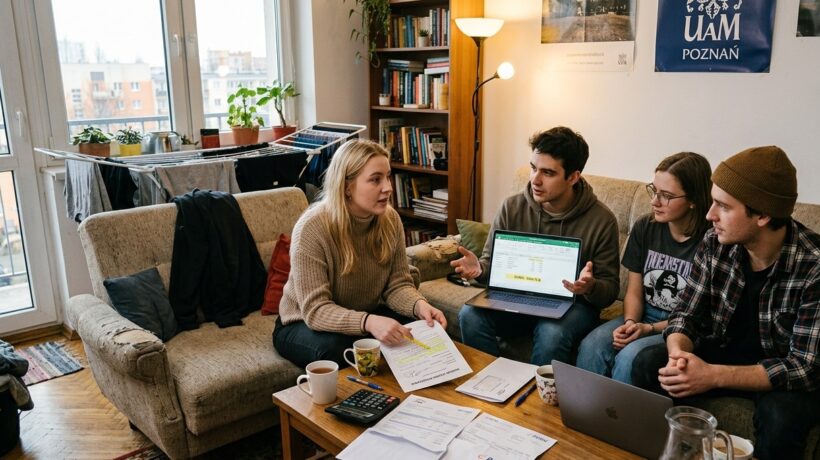
Flat-sharing with friends: How to draft a roommate agreement to avoid conflict
Renting an apartment together with friends in Warsaw allows you to significantly reduce the cost of living, but the lack of clear financial and organizational rules often leads to disputes. The solution to this problem is to write an internal partnership agreement (roommate contract), which legally and organizationally regulates the division of bills, deposit issues, guest visits and the rules for leaving the premises early. Such a document secures the interests of each tenant, regardless of the provisions in the main lease agreement signed with the owner of the property.
Highlights:
- Joint and several liability: The owner of the apartment has the right to demand the full amount of rent from any tenant – he is not interested in the internal division of costs between you.
- Partnership Agreement as a shield: An internal roommate contract provides a legal basis for seeking a refund from an unreliable friend (recourse claim).
- Precise division of media: Variable costs (electricity, water, heating) are best settled according to actual consumption or in proportion to the number of people, taking into account the heating season.
- Exit procedure: The contract must specify the conditions for finding a replacement to replace you in the event of an early move-out to avoid charging the rest of the group extra rent.
Why is a standard lease agreement with a landlord not enough?
September 20, 2026
A standard lease agreement primarily protects the interests of the property owner, leaving the relations between tenants in the zone of ambiguity. From the point of view of Polish law, more precisely Article 688[1] of the Civil Code, all adult tenants permanently residing in the apartment are jointly and severally liable for the payment of rent and other fees due.
In practice, this means the arrangement of relationships:
- Main lease agreement (with the owner): It regulates only the relationship between the Owner and the Tenant. It introduces joint and several liability of tenants. If you rent a four-room apartment in Warsaw’s Wola district for PLN 6000 and one of your friends suddenly stops paying his part (PLN 1500), the owner has every right to demand the missing amount from the other three. For the landlord, it doesn’t matter who made the transfer – what matters is the total impact on the account.
- Internal partnership agreement (between tenants): It completes the main lease agreement and regulates issues that the landlord does not see or that are not of interest to him. It defines the precise division of rent, utilities, the rules for returning the deposit in the case of tenant rotation and daily duties.
Without an additional, written agreement between you, it is extremely difficult to recover this money legally from a dishonest friend. A partnership agreement creates a clear obligation relationship between roommates, giving each of you a tool to assert your rights (recourse claims) before a civil court in the event that one of the tenants fails to meet his financial obligations.
What is a partnership agreement (cohabitation contract) and is it legal?
A partnership agreement (often referred to as a roommate contract) is a fully legal, unnamed civil law agreement, concluded on the basis of Article 353[1] of the Civil Code, which defines the principle of freedom of contract. The parties may establish a legal relationship at their discretion, provided that its content or purpose does not contradict the nature of the relationship, the law or the principles of social coexistence.
This document does not require a visit to a notary – for its validity for evidentiary purposes, a simple written or documentary form (e.g. signed with a qualified electronic signature or a trusted profile on dedicated platforms) is sufficient. This contract does not replace the lease agreement with the owner, but is an internal supplement to it, binding only on the persons who signed it. The owner of the apartment does not have to be a party to this agreement, although it is worth informing him about its existence as proof of your maturity and care for the regularity of payments.
How to fairly divide the cost of living in Warsaw? (Rent, utilities, deposit)
The Warsaw real estate market is characterized by high fixed costs. The administrative rent paid to cooperatives or housing communities in Mokotów, Śródmieście or Ursynów can increase drastically during the year, which is influenced by, for m.in example, the rates for garbage collection calculated on water consumption or the costs of network heating.
Division of accounts and unexpected increases
The most common mistake is to rigidly divide the total amount of the transfer into equal parts, without breaking it down into rent for the owner, administrative rent and meter fees. Your affiliate agreement should be precise about how you respond to rate changes.
| Fee component | Division method recommended in the partnership agreement | Billing frequency |
| Rent (amount for the owner) | In proportion to the area of the occupied rooms (e.g. a room with a balcony pays more). | Monthly (fixed amount) |
| Administrative rent (fixed) | Equally for the number of inhabitants (common areas serve everyone equally). | Monthly (as notified by the manager) |
| Alternating media (electricity, gas) | Equally per population OR according to actual consumption (e.g. equipment 24/7). | By invoice (usually every 2 months) |
| Water and heating | Equally per number of residents, taking into account subsidies after periodic settlement. | Every 6 or 12 months (after annual billing) |
| Internet & TV | Equally for all users (regardless of the intensity of use). | Monthly (fixed amount) |
A practical example from Warsaw’s Mokotów (near the Wilanowska Metro station):
You are renting a 3-room apartment. Room A (24 m²) is occupied by a couple, room B (12 m²) is occupied by one person, room C (15 m²) is occupied by one person. The total rent for the owner is PLN 4500. A fair distribution of this amount in the partnership agreement should take into account the occupied private space:
- A couple in room A pays 45% of the rent (i.e. about PLN 1012 per person).
- The tenant of room B pays 23% of the rent (PLN 1035).
- The tenant of room C pays 32% of the rent (PLN 1440).
On the other hand, electricity, Internet and water bills are rigidly divided into 4 equal parts, because the consumption of utilities is generated by each individual, not by square meters of a room.
Settlement of the deposit – a flashpoint in the rotation of tenants
The security deposit, usually in the amount of one or twice the monthly rent, is paid to the landlord in full before the keys are handed over. In the partnership agreement, it should be clearly stated how much exactly each of the roommates has paid.
The problem arises when, after 6 months, one person decides to move out (e.g. a UW student resigns from studiesduring the semester and returns to his family home), and a new tenant takes his place. The landlord will not return part of the deposit as long as the main lease is in force.
A provision in the partnership agreement should impose on the new tenant the obligation to pay the equivalent of the deposit directly to the account of the person moving out – provided that the condition of the room does not show damage beyond normal wear and tear. If there is damage, the partnership agreement should describe the procedure for deducting the appropriate amount from the deposit of the person leaving the premises for the benefit of the group’s recovery fund.
House rules, or how to regulate everyday life (guests, cleaning, silence at night)
Mismatch of characters and habits is the most common reason for the breakup of a housing community. A partnership agreement allows you to transfer verbal arrangements to the level of a formal commitment, which makes it much easier to enforce the rules.
Visits by guests and life partners
This is a classic conflict scenario in Warsaw housing estates: the partner of one of the tenants starts sleeping in the apartment 4-5 days a week. He consumes water, electricity, uses the kitchen and bathroom, de facto living there permanently, but not contributing to the bills.
Enter a provision in the contract specifying the limit of free guest nights (e.g. a maximum of 4 nights per month for one tenant). Each subsequent night should be associated with a lump sum fee (e.g. PLN 30-50 per night) added to the common fund for utilities or require the written consent of all other roommates and a proportional increase in the share of this person in water and garbage fees.
Common area cleaning schedule
General provisions rarely work in practice. The partnership agreement should include an attachment in the form of a cleaning schedule for the common areas (kitchen, bathroom, hallway).
It is worth determining the financial consequences for persistent avoidance of duties – e.g. if a tenant ignores his or her cleaning turn for two weeks in a row, the other roommates have the right to hire a professional cleaning company for the common areas, and the cost of the service (e.g. PLN 250 for a one-time cleaning in Warsaw) is covered in full from the deposit or the current payment of the insubordinate tenant.
Early departure of one of your friends – emergency procedure
Life in Warsaw can be dynamic – a sudden change of work from an office in Wola to a contract in Munich, a decision to live with a partner or personal problems may force one of the roommates to leave the apartment before the end of the lease agreement.
It is imperative to include a procedure in such a situation in the partnership agreement to avoid charging other people with the costs of an empty room. This procedure should be based on two scenarios:
- Scenario A (A new, acceptable tenant found): The new tenant pays the deposit directly to the person leaving, an annex to the main agreement with the owner is signed, and the existing tenant is exempt from further fees without financial losses.
- Scenario B (No new tenant): If the outgoing tenant does not find a replacement by the day of their move-out, they are obliged to pay their share of the rent and fixed fees until the end of the main lease agreement or until a new person moves in. The deposit is not returned to him ad hoc, but only after the owner has settled the entire agreement. This protects the rest of the group from a sudden increase in the cost of living by several hundred zlotys per month.
In addition, it is worth specifying the minimum internal time to report the desire to move out (e.g. at least 2 months in advance). The new tenant must be accepted by the other roommates, which prevents the introduction of random disturbers of the house.
Template of the structure of the partnership agreement – what must the document contain?
Below is the recommended structure of the partnership agreement. You can write it down yourself, supplementing it with your own arrangements tailored to the specifics of your apartment.
Details of the parties and purpose of the agreement
- Date and place of conclusion of the agreement (e.g. Warsaw, 15 March 2026).
- Precise data of all roommates (name, surname, PESEL, ID card series and number, contact phone).
- Indication of the address of the rented apartment and reference to the main lease agreement concluded with the owner of the property.
Financial Breakdown (Rent & Fees)
- Determining the exact amount that each tenant undertakes to transfer to the account of the designated “treasurer” of the group.
- Designation of the person responsible for direct contact with the owner and making collective transfers (the so-called Contact Leader).
- Deadline for internal settlements (e.g. by the 3rd day of each month, so that the treasurer manages to pay the rent to the landlord by the 10th day of the month).
- The method of documenting fees (e.g. a common online sheet with attached scans of electricity or gas invoices).
Deposit Management
- Indication of the amounts paid by individual persons towards the main deposit.
- Provision on the method of settling the deposit when changing tenants during the term of the agreement.
- The procedure of deductions from the deposit for damage caused in a private room (individual liability) and in the common areas (joint and several liability, unless it is possible to identify the direct perpetrator).
Rules for using the premises (House Rules)
- Quiet hours (e.g., Sunday to Thursday from 10:00 p.m. to 6:00 a.m., Fridays and Saturdays from 12:00 p.m. to 6:00 a.m.)
- Arrangements for the organization of events in the apartment (the requirement to give at least 3 days’ notice to other tenants and obtain their consent).
- Provisions on the division of cabinets in the kitchen, refrigerator and rules for using the laundry/bathroom in the morning (e.g. limiting bathing time during the morning rush hour before going to university or work).
Dispute resolution procedure and contractual penalties
- Provision on the amicable settlement of disputes through negotiation.
- Introduction of contractual penalties (e.g. for persistent violations of house rules, destruction of common property or payment delays exceeding 7 days). The penalty may take the form of the need to compensate for the inconvenience to the other tenants or be the basis for demanding that a nuisance person leave the apartment (in compliance with legal procedures).
- All roommates must sign the document legibly with their full name.
Sublease and taxes – a dangerous trap of “one main tenant”
In Warsaw, a model is very often used in which only one person (e.g. the most financially reliable for the owner) signs the main lease agreement for the apartment, and then “gets along” with friends who occupy the remaining rooms and transfer their share of the rent to her. From the point of view of law and taxes, this is an extremely risky situation.
Firstly, according to Article 688[2] of the Civil Code, a tenant may not sublet the premises or give it free of charge without the written consent of the owner. If the landlord does not know about it, he has the full right to terminate the lease agreement immediately, which results in the need for all residents to leave the premises.
Secondly, there is the tax aspect. The Tax Office in Warsaw (e.g. the Third Tax Office in Warsaw-Śródmieście, which specializes in such inspections) may consider transfers from roommates to the account of the main tenant as income from sublease. If the main tenant does not report this fact and does not pay a lump sum on recorded revenues (the rate is 8.5% up to PLN 120 thousand per year), he risks being accused of tax depletion.
How to safely solve this in a partnership agreement?
If the landlord has agreed to sublease, it should be precisely specified in the partnership agreement that transfers from roommates are only a reimbursement of operating costs and do not generate income on the part of the main tenant. However, the safest tax-safe solution is to ensure that the main lease agreement with the landlord contains the names of all people actually living in the premises.
Media and Internet contracts in the student’s name – how not to be left with someone else’s debt?
Landlords of apartments in Warsaw are increasingly requiring tenants to sign contracts with internet providers (e.g. Vectra, UPC/Play, Orange) and electricity providers (most often Stoen Operator and E.ON as a seller). In this way, they want to avoid a situation in which tenants leave them with unpaid bills.
For a student who decides to sign such an agreement in his own name, it carries a huge risk. If the group breaks up or someone suddenly leaves the apartment, the debt with the telecommunications operator is charged only to the person on the contract. Internet providers in Warsaw will not pursue receivables from other roommates – they are only interested in the contractual debtor.
In the partnership agreement, a dedicated provision should be introduced regarding the named media:
- The principle of recourse and co-responsibility: Other roommates signing a partnership agreement must explicitly declare that they undertake to cover their part of the bills for services provided in the name of one of them, and in the event of delay, this person has the right to demand immediate repayment with statutory interest.
- Service blocking as a sanction: A provision entitling the owner of the contract (e.g. for the Internet) to change the Wi-Fi password or restrict access to the network for a roommate who is more than 3 days late with the payment of his part.
- Assignment when moving out: The obligation to assign the contract (transfer the electricity meters in E.ON or the contract to the Internet) to another roommate staying in the apartment, if the person signing the agreement decides to move out early.
Holiday season (July-September) – who pays for an empty room?
This is the biggest nightmare of Warsaw students. The academic year at the University of Warsaw, Warsaw University of Technology or Warsaw School of Economics ends in June, and the next one begins in October. Many students return to their family homes (e.g. to the Tri-City, Lublin or Rzeszów) or go to work abroad for the period July-September. The apartment is then empty, but the owner of the property still demands the full amount of rent.
Most disputes arise when one of my friends states: “Since I’m not in Warsaw for 3 months, I don’t pay for my room.” Such an attitude hits the rest of the group, who suddenly have to cover the missing part of the main rent.
How does a partnership agreement solve this problem?
The document must include a holiday clause. There are two fair ways to regulate this issue:
- Fixed booking option: A tenant who goes on holiday but wants to keep his room from October is obliged to pay 100% of his part of the rent (the amount for the landlord) and fixed administration fees. It is exempt only from variable fees generated by physical presence (e.g. consumption of water, electricity, gas – as long as they are settled according to actual consumption, not a lump sum).
- Short-term sublease option: A partnership agreement may allow for the possibility of subletting a room for the holiday period to a third party (e.g. a student doing a summer internship in Warsaw), provided that the written consent of the owner of the apartment is obtained and the other roommates accept the profile of this person.
Failure of a washing machine, refrigerator or dishwasher – Article 681 of the Civil Code and reality
When a washing machine breaks down in a rented apartment in Warsaw’s Bielany district, the first reaction of students is to call the owner with a request for repair. The landlord often refuses, citing Article 681 of the Civil Code, which states that minor overlays combined with the usual use of things are charged to the tenant. These expenditures include, m.in example, minor repairs of installations and technical equipment.
At this point, a dispute arises within the group: who is to pay for the service technician? Is it the person who was washing his heavy shoes and overloading the drum, or everyone equally?
Regulation in the partnership agreement
Introduce the principle of distinguishing failures by cause and cost:
- Wear and tear (depreciation): If a household appliance breaks down due to old age (e.g. wear of brushes in the washing machine motor after 5 years of operation) and the cost of repair exceeds the amount stipulated in the contract (e.g. PLN 150), this cost should be borne by the owner of the premises (as an element of maintaining the item in a usable condition – Article 662 § 1 of the Civil Code). If the landlord refuses and the repair is necessary for living, the roommates split the cost equally between them and then jointly seek reimbursement from the landlord (e.g. by deducting the amount from the next rent, after prior call).
- Damage due to the user’s fault: If the failure is due to negligence (e.g. clogging the dishwasher filter with food residues, not cleaning the washing machine filter, mechanical damage to the drawer in the refrigerator), the cost of the repair is 100% covered by the person who caused the damage. If it is not possible to determine the perpetrator, and the failure has clear signs of improper use (e.g. throwing things into the bathroom drain that should not be there), the cost is divided equally among all tenants.
Pets in the apartment – liability for damage to the pet
More and more students in Warsaw decide to have pets – most often dogs or cats. Even if the owner of the apartment has given his consent to this in the main agreement, the presence of an animal in a shared space generates specific risks. A cat can scratch a leather sofa in the living room, and a young dog can gnaw on door frames or destroy parquet.
The partnership agreement should secure the interests of persons who are not the owners of the animal:
- Full material liability: The owner of the animal makes a written statement that he takes full and exclusive financial responsibility for any damage caused by his pet in private rooms and common areas.
- Guarantee of damage coverage upon acceptance of the apartment: If, when handing over the apartment, the owner of the property deducts the amount for the parquet scratched by the dog from the main deposit, this deduction is charged only to the deposit of the owner of the pet. Other roommates must receive their deposit refund in full, intact.
- Cleaning: Commitment to immediately clean the fur from the furniture in the living room and to take care of the hygiene of the litter box/bedding so that the smell does not make it difficult for other people to use the apartment.
Shared subscriptions and household appliances (Router, Netflix, coffee machine)
A modern student apartment in Warsaw is not only about the division of electricity or water fees, but also about managing a common digital and hardware infrastructure. Someone brings a coffee machine from the family home, someone else buys a Wi-Fi router, and yet another person creates a family account on a streaming platform that everyone in the living room uses.
When there is a move or conflict, the problem arises: “Who has the right to take the router?”, “How to account for the consumption of expensive capsules for the machine?”, “Who will pay for a Netflix account if two people have stopped using it?”.
Golden rules to write into a roommate contract
- Inventory of property: At the end of the partnership agreement, it is worth making a short list of equipment brought by individual tenants to the common areas. Clearly state that, for example, the TV in the living room is owned by tenant A and in the event of his moving out, it is taken away by him, and the others have no right to claim on this account.
- The “who breaks, buys” rule for private equipment: If you use a shared coffee machine belonging to tenant B and damage it due to improper use (e.g. using the wrong type of coffee or not descaling), you are responsible for the repair on the same terms as if the equipment belonged to the owner of the apartment.
- Digital billing: Subscription contracts (Netflix, Spotify, YouTube Premium) should be billed regardless of rent, preferably through automated micropayment systems or dedicated bill-splitting apps (e.g., Splitwise). In the partnership agreement, it is worth noting that unsubscribing requires 1 month in advance so that the group can adjust the tariff plan or find a new user for a free profile.
Frequently Asked Questions About Roommates in Warsaw
Can the owner of the apartment prohibit us from signing a partnership agreement?
The owner of the apartment has no influence on what civil law agreements the tenants conclude between themselves, as long as they do not violate the terms of the main lease agreement (e.g. by subletting the room to third parties without the landlord’s consent). The partnership agreement regulates your internal relations and does not affect the rights and obligations of the owner, so it does not require his consent or acceptance.
What to do if one of your friends is late with the payment of his part of the rent?
Thanks to the partnership agreement, you have a clear payment deadline (e.g. by the 3rd day of the month). If the tenant is late with the payment, the other roommates – in order to avoid arrears with the landlord – must jointly and severally cover the missing amount, but they immediately gain a formal financial claim against the debtor. A partnership agreement allows you to send a pre-court demand for payment, and in extreme cases – to deduct the debt from its part of the deposit and demand to vacate the premises.
One of the roommates destroyed the equipment in the living room. Who bears the repair costs?
If the perpetrator of the damage is known and undisputed, under the partnership agreement and the general provisions of the Civil Code on tort liability (Article 415 of the Civil Code), he bears 100% of the costs of repair or purchase of new equipment. If the perpetrator cannot be identified and the damage occurred in the common area, the repair costs are shared jointly and severally among all tenants using this space.
Does the partnership agreement protect me from eviction by the landlord?
No. The partnership agreement binds only the roommates. If the landlord decides to terminate the main lease agreement in compliance with statutory or contractual deadlines (e.g. due to non-payment of rent by the group), the partnership agreement will not block this process. It only protects your mutual financial settlements and makes it easier to claim damages from the person who led to problems with the owner.
What to do if a roommate’s partner starts living with us without our consent?
It is necessary to refer to the provisions of the partnership agreement specifying the limit of accommodation for guests. If the limit has been exceeded, you have the right to demand from your roommate a surcharge for utility bills (e.g. additional fees for water, electricity and garbage collection) or categorically comply with the limit of visits, otherwise you will violate the terms of the partnership agreement.
Where in Warsaw to look for legal assistance in drafting such an agreement?
The preparation of the agreement can be consulted with a lawyer specializing in real estate law. Students of Warsaw universities (e.g. UW, WUT, SGH) can also take advantage of free student legal clinics operating at law faculties, which often help verify lease agreements and roommate contracts in terms of their compliance with Polish law.
Sharing an apartment in Warsaw is an excellent way to save money and build social relationships, provided that financial and organizational issues are formalized. Writing a partnership agreement at the very beginning of our journey together – even before bringing the first cardboard boxes to an apartment in Mokotów or Ochota – is an expression of responsibility and maturity. Such a document avoids misunderstandings, protects your savings in the event of dishonesty of one of the group members, and gives clear guidelines on how to react in crisis situations.