


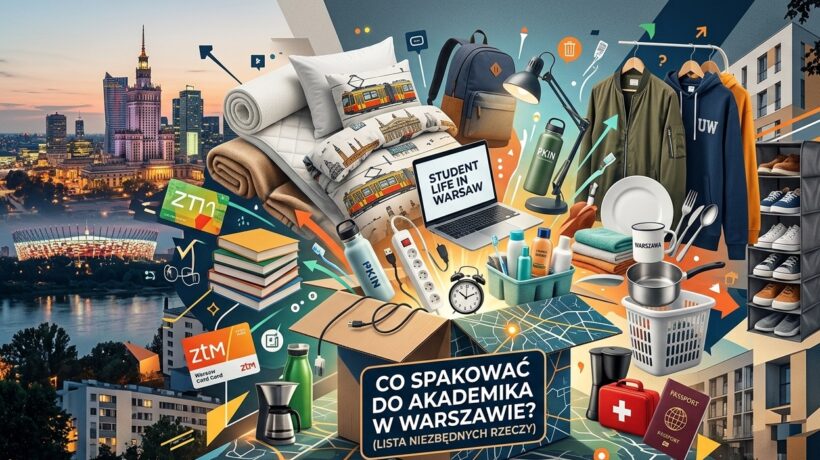
What to pack for a dorm in Warsaw? A checklist of essentials
To pack for a dormitory in Warsaw, you need to divide your luggage into necessary documents, room equipment, kitchen accessories and cleaning products. Warsaw student dormitories (e.g. belonging to the University of Warsaw, Warsaw University of Technology or Warsaw School of Economics) provide basic furniture, but the refrigerator, dishes, extension cord or bedding usually have to be organized on your own. Detailed preparation of the list facilitates logistics and avoids transporting unnecessary bulky items throughout Poland.
The most important information at the start
- The “buy on the spot” rule: Heavy and cheap items (clothes dryer, household chemicals, water filter) are best bought in Warsaw (e.g. in IKEA, Action or Pepco stores), saving space in your luggage.
- Differences in standard: Older buildings (e.g. DS “Jelonek” or “Babilon” in Bemów) have kitchens and shared bathrooms in the corridor. Newer or renovated ones (e.g. DS “Limba” SGGW in Ursynów) offer segmented layouts with kitchenettes divided into several rooms.
- The issue of the refrigerator: Not every dorm has a refrigerator in the room. Often, students buy or rent a small tourist/undercounter refrigerator together at the beginning of the academic year.
- Wired and wireless Internet: Wi-Fi in universities (e.g. the Eduroam network) works efficiently, but in the rooms of many older student dormitories, a stable connection requires an Ethernet cable (RJ-45).
Documents and formalities – what do you need to have for accommodation?
When accommodating to a Warsaw dormitory, you must present an identity card (or passport), a decision to grant a place, proof of payment of the deposit and a paper photo for the resident’s card. Without these documents, the porter’s office or administration (e.g. in the “Riviera” Children’s Hospital at Waryńskiego Street) will not issue the keys to the room.
Before leaving your family home, make sure you have a set of paper documents with you. Although the university administration uses USOSweb systems, registration procedures in Warsaw still require physical signatures and documents.
- ID card or passport: The identity document must be valid for the entire period of the planned accommodation.
- Deposit transfer confirmation: Print the transfer confirmation in PDF format. Accounting systems of universities (especially at the turn of September and October) work with a delay. A paper proof of payment prevents problems in the event of failure to credit the funds to the USOS sub-account.
- ID photos (2-3 pieces): Needed to make a physical student card. This card entitles you to enter the building after closing hours and to collect keys at the gatehouse.
- Certificate of student status: Useful if you are staying before the official start of the academic year (e.g. for a September internship) or if your data has not yet been fully synchronized in the system of the university in question.
Student room equipment – what to take and what does a dormitory provide?
September 20, 2026
Warsaw’s dormitories provide a bed, mattress, wardrobe, desk, chair and wall shelves. You need to organize your own bedding (duvet, pillow, pillowcases), an extension cord with a surge protector, a desk lamp and an organizer for documents and small items that will help you use the limited space of the room.
Dorm Room (Typical Layout)
The university provides:
- Bed with mattress (standard 90×200 cm)
- Wardrobe + desk + chair
- Bookcase or wall shelves
You need to bring/buy:
- Duvet, pillow, sheet with elastic band
- Extension cord (min. 3-5 m) with filter
- Headphones with ANC (noise cancellation)
- Desk lamp and organizers
Most rooms in Warsaw student dormitories (e.g. on the Ochota campus at Żwirki i Wigury Street) have a limited number of electrical outlets, often located in inconvenient places.
What to pack for sleeping and studying?
- AC extension cord (min. 3-5 meters): Choose a model with at least 5 outlets and a surge protector. You will need to connect your laptop, phone, desk lamp, refrigerator and possibly kettle at the same time.
- Own bedding and sheets: Universities offer deposit bedding, but its condition can vary greatly. Standard beds in dormitories are 90×200 cm. Buy a sheet with an elastic band – this prevents the material from slipping off mattresses covered with a slippery protective coating.
- Active Noise Cancelling (ANC) headphones: A key tool for learning and sleeping. In double or triple rooms (common in the “Kic” Children’s Hospital in Praga-Południe or the “Grosik” Children’s Hospital in Mokotów) it can be difficult to maintain silence, especially during the exam session.
- Earplugs and blindfold: Effective protection against the light of your roommate’s monitor and noise from the hallway.
- Hanging Closet Organizer: Helps you create vertical space. Wardrobes in dormitories can be narrow, and textile hanging shelves allow you to conveniently arrange clothes or cosmetics.
Dormitory kitchen: Shared hallway or own segment?
Kitchen equipment depends on the type of accommodation: in segments (e.g. DS “Kic” in Praga-Południe) the refrigerator and sink are divided into 2-4 rooms, while in classic student dormitories the kitchen is shared by the entire floor. The necessary minimum is one universal pot, pan, cutlery set, cup, plate and food containers.
Shared kitchens in older dormitories (e.g. on the WUT campus at Narbutta Street) tend to be crowded. Preparing meals requires mobile and durable equipment that can be easily moved back to your room once cooked.
Student Kitchen Essentials:
- Universal pot (diameter 18-20 cm) with lid: Allows you to cook pasta, rice, as well as prepare one-pot dishes.
- Non-stick pan: Preferably 24 cm in diameter, with a fitted lid.
- A set of dishes for one person: One deep plate (also used as a bowl), one flat plate, a cup and a set of cutlery (fork, knife, spoon, small spoon).
- Sharp chef’s knife and small cutting board: Cheap plastic boards are lighter and easier to disinfect than wooden ones.
- Plastic food containers (3-4 pieces): They allow you to store leftover food in the refrigerator and take lunch to the university (e.g. to the main campus of the University of Warsaw at Krakowskie Przedmieście).
- Water filter jug: Warsaw tap water is safe and drinkable (as confirmed by MPWiK Warszawa reports), but the filter improves its taste and eliminates the need to carry heavy packs of water to higher floors in buildings without an elevator.
Bathroom and laundry in a student house – hygiene essentials
For everyday use of the bathroom in the dormitory, you need shower flip-flops, a quick-drying microfiber towel, a toiletry basket and a foldable laundry basket. In laundries, you need your own laundry capsules and a supply of coins or a payment app (e.g. depending on the laundromat operator at the university).
The use of shared bathrooms (especially in a corridor floor layout) requires strict adherence to hygiene rules. Contact with damp surfaces in common areas carries the risk of dermatological infections.
Toiletry bag and bathroom accessories:
- Rubber shower flip-flops: Mandatory equipment to protect against foot fungus. Never use a shared shower barefoot.
- Plastic basket with holes for cosmetics: Allows you to conveniently carry shampoo, shower gel and toothpaste from the room to the bathroom. Holes in the bottom prevent water from accumulating in the basket.
- Microfiber towels (2 pieces): They dry much faster than classic cotton towels. In a small student room, where the humidity rises rapidly, a traditional towel may not dry out before the next use.
- Foldable laundry basket (mesh): Takes up minimal space in the room and allows you to conveniently carry dirty clothes to the laundromat.
- Capsule detergents: Capsules are easier to transport and dispense than heavy powder packs or laundry detergent bottles.
What to buy on the spot in Warsaw and what not to take from home?
To avoid overloading your luggage on a train or bus going to Warsaw, buy bulky items on the spot: a clothes dryer, a laundry bowl, a supply of household chemicals, a trash can and heavy pots. You can find all this at affordable prices in Warsaw discount stores and retail parks.
Transporting a clothes dryer or several liters of rinse aids by long-distance train to the Central Station is inefficient. Warsaw has a developed network of large-format stores with convenient access by public transport.
Where to shop after check-in?
- IKEA Targówek: The largest selection of cheap textiles, dishes and organizers. Access from Śródmieście: metro line M2 to Kondratowicza station, and then bus line 112, 190 or 120 directly to the CH Targówek shopping center.
- IKEA Blue City (Ochota): A smaller store format, convenient for students staying in dormitories at Żwirki i Wigury Street or on Narutowicza Square. Quick access by buses going along Aleje Jerozolimskie.
- Non-food discounters (Action, Pepco, Dealz): Located in many districts (e.g. at the Wierzbno metro station in Mokotów or near Plac Unii Lubelskiej). Ideal places to buy cheap hangers, cloths, trash cans and basic household chemicals.
How do you survive cleanliness checks?
The administrations of Warsaw dormitories regularly carry out cleanliness checks in rooms. To go through them without any problems, pack a basic set: microfiber cloths, all-purpose cleaning liquid (e.g. spray for the bathroom and kitchen), dish sponges, a small broom with a dustpan and garbage bags tailored to the dimensions of the room.
Maintaining order in a room with an area of several square meters, shared with another person, requires regularity. Dirty dishes or an unemptied trash can quickly become a source of unpleasant odors and tenant conflicts.
- All-purpose spray liquid (e.g. Multi-cleaner): Allows you to quickly wipe dust off your desk, wash cabinets and degrease your kitchen countertop.
- Microfiber cloths (set of 3-5): They are reusable, can be washed together with clothes and effectively remove dirt even without the use of strong chemicals.
- Sweeper and dustpan: Necessary for quick removal of sand brought on shoes from the streets of Warsaw (especially in autumn and winter). A vacuum cleaner can usually be rented free of charge at the gatehouse (e.g. upon presentation of a resident card), but a broom is useful for everyday, minor cleaning.
- Trash bags with cable tie: Choose a capacity of 35 liters – larger bags will sit in the room for too long before being full, which promotes bad odors.
Complete packing list
Use the list below for final verification of the contents of your luggage before leaving for Warsaw.
Documents and finances
- ID card / Passport
- Paper ID photos (min. 2 pieces)
- Confirmation of payment of the deposit for the dormitory (printout)
- Student ID Card (ELS) or Admission Decision
- Cash for the start (about 100-200 PLN for small fees in the laundry or refundable deposits for keys)
Room Amenities
- Mains extension cord (min. 3 m) with filter
- Pillow and duvet (standard size)
- Sheet with elastic band (90×200 cm) and 2 sets of pillowcases
- Desk lamp (neutral LED bulb)
- Wardrobe clothes hangers (about 10 pieces, preferably thin metal/velour)
- Noise-canceling headphones (ANC) and device chargers
Kitchen Supplies
- One pot (medium) and a frying pan (24 cm)
- Deep plate, flat plate, mug and cutlery set
- Sharp kitchen knife and small cutting board
- Water Filter Jug + Spare Filters
- Several clips to close open food packages
Hygiene and laundry
- Rubber shower flip-flops (non-slip)
- Plastic basket for bath cosmetics
- Two quick-drying microfiber towels
- Foldable, mesh laundry basket
- Laundry capsules and a bag for washing delicate items (e.g. socks)
Moving to a dormitory in Warsaw — logistics and transport
The most convenient way to transport things to the dormitory is to use passenger cars, carsharing (e.g. Traficar, Panek) or order a luggage taxi (e.g. Lajkonik Taxi, iTaxi Luggage). Avoid transporting bulky people by public transport during rush hour (7:30 a.m. to 9:30 a.m. and 4:00 p.m. to 6:30 p.m.), when buses and trams are extremely overcrowded.
Baggage Delivery Logistics:
- Train Station (Central/Western)
- Option A: Public Transit (WTP) -> Only 1 suitcase, off-peak hours
- Option B: Luggage taxi / Traficar Van -> Optimal for large dimensions
- Destination Dormitory (SPPN paid parking zone in Warsaw)
Warsaw has an extensive Unguarded Paid Parking Zone (SPPN). In front of buildings such as DS “Riviera” (Mokotów/Śródmieście) or DS “Babilon” (Wola/Bemowo), parking a passenger car without paying a fee at a parking meter is associated with a financial penalty (inspections are carried out, m.in, by special e-control cars of the ZDM). When unpacking your luggage, use the designated short-term drop-off parking spaces, if they are located at the student dormitory.
How not to cause a power failure on the first floor?
Most of Warsaw’s older student dormitories (especially those built in large slab technology or with installations from the 1970s and 1980s, such as some pavilions in Ochota or Jelonki) have strict restrictions on the load on the electricity network. Fuses in rooms (usually B10 overcurrent circuit breakers or older fuses) are adapted to a load of up to 1500-2000 W for the entire room, not for one person.
Maximum energy budget of a typical room: ~2000 W
- Gaming Desktop with Monitor: ~500W
- Small room refrigerator (compressor): ~100 W (more in the starting peak)
- Chargers (2x phone, 2x laptop): ~250 W
- REMAINING HEADROOM: ~1150 W
Using a classic kettle (2200 W) or dryer (2000 W) = immediate power cut.
How to approach the packaging of electrical appliances?
- Replace the kettle with a travel kettle: A standard household kettle draws between 2000 and 2400 watts.
- Power Adjustable Dryer: Choose a dryer with a DC motor up to 1200W or a model with a physical eco switch to limit power consumption.
- Uninterruptible Power Supply (UPS) with Filter: If you are bringing an expensive desktop computer for work or design (e.g. students of WUT architecture or graphics at PJATK), pack a small UPS. Voltage drops in academic networks during the evening rush hour can be the norm and can damage sensitive components.
Protection against insects (bed bugs and cockroaches)
Official informants are silent about this problem, but on student groups and forums (e.g. r/Warsaw) this topic returns regularly. The rotation of tenants, returns from holidays and the proximity of garbage chutes in high-rise buildings (e.g. DS “Babilon” or “Mikrus”) make the risk of contact with a house bug (Cimex lectularius) or cockroaches real.
- Full Barrier Mattress Cover (Anti-Allergic/Bug-Proof): This is the most important thing you should put on your academic mattress before placing your own sheet on it. The cover must be fastened with a zipper with a fine tooth and a special Velcro lock at the end of the zipper. This prevents insects from living inside the mattress structure and protects you from possible bites.
- Sealed plastic containers (with gasket and clips) instead of cardboard boxes: Cockroaches and Prusaks feed on glue from cardboard and love to nestle in the wavy structure of cardboard. Store all dry food supplies (pasta, rice, cereal) and underwear only in vacuum-sealed or clipped plastic containers.
- Diatomaceous earth (diatomite) in an atomizer: A natural, safe for humans agent in the form of a fine powder. It’s a good idea to pack a small package and gently dust the gaps behind the skirting boards and the back of the wardrobe with it while you are checking in. It has the properties of mechanical destruction of the carapace of running insects.
Warsaw’s water and urban microclimate
Water supplied to Warsaw’s apartments and dormitories is characterized by medium to high hardness (most often within the range of 200–350 mg $CaCO_$3/l, depending on the intake — m.in. from the Central or Northern Waterworks). This translates into rapid deposition of limescale on dishes and specific requirements for cosmetics.
What to pack, taking into account the parameters of water in Warsaw?
- Citric acid (several packs): The cheapest and most ecological way to descale your kettle and cups. In Warsaw conditions, this procedure must be repeated every 2-3 weeks.
- Cleansing shampoo and chelating conditioners: Hard water makes it difficult for delicate shampoos to foam and causes minerals to build up on the hair, making it rough and dull. Cosmetics containing EDTA (chelating ingredient) are essential to neutralize this effect.
- Fittings cleaner based on sulfamic or citric acid: Ordinary all-purpose liquids will not cope with the white coating on shower faucets and washbasins. Pack an acidic pH spray that will effortlessly keep the bathroom clean as required by the administration during room inspections.
Survival First Aid Kit
The heating season in Warsaw usually begins at the turn of September and October. In rooms with traditional cast iron or convector radiators (common in the “Jelonki” Dormitory or SGH dormitories), the air humidity can drop below 25% (the norm is 40-60%). Combined with daily travel in air-conditioned but crowded M1/M2 metro cars, this leads to the so-called “student cough” and respiratory infections.
- Humidifier (ultrasonic or evaporative): A compact model for your desk (powered by USB or a traditional outlet) is an element that will dramatically improve your sleep comfort and the condition of your mucous membranes during the heating season.
- Isotonic nasal spray (seawater): For daily use after returning from university. It helps to clear the respiratory tract of dust, smog and pathogens collected in public transport.
- Saline in ampoules (for inhalation or eye washing): The air in Warsaw, especially along the main arteries (such as Niepodległości Avenue at the Warsaw School of Economics or Waryńskiego Street at the Warsaw University of Technology), is sometimes polluted with particulate matter. Washing your eyes after a day out prevents conjunctivitis.
- OTC drugs with a reserve for the first 3 days of infection: When you get a fever and chills, going to the nearest pharmacy around the clock (of which there are not so many in Warsaw for one housing estate) will be a challenge. Pack: paracetamol/ibuprofen, sore throat medication, nasal decongestants and an electronic thermometer.
How not to lose your deposit when moving out
The deposit for a room in a Warsaw dormitory is usually the equivalent of a one- or two-month rent payment (in 2026 it is from PLN 500 to even PLN 1200). Administrations (e.g. at the University of Warsaw) rigorously account for the condition of walls, furniture and doors during check-out. Any trace of duct tape, a nail hole or a chip of veneer on the cabinet can result in the cost of repair being deducted from your deposit.
Rules for hanging and assembling in the room:
- Nails and wall plugs -> Total ban (risk of losing your deposit)
- Classic double-sided tape -> Leaves marks and tears off plaster
SAFE ALTERNATIVES:
- Fixing compound (Patafix type) -> For light posters and photos
- Hooks with Command system (stretchable straps) -> For clothes and towels
- Felt Pads -> Under the legs of a chair and laptop (desk protection)
What to pack for safe installation?
- Hooks and Velcro with a traceless removal system (e.g. tesa Powerstrips or Command 3M): A special elastic adhesive strip allows you to remove the hook by pulling it vertically downwards. It does not damage paint, plaster or furniture veneer. Perfect for hanging a calendar, organizer or an additional coat hanger.
- Fixing compound (plastic clay): An excellent alternative to pins and adhesive tape. It allows you to repeatedly stick notes, lesson plans or photos directly to the wall or door without leaving greasy stains or cavities in the paint.
- Spray label and sticker remover (or a small bottle of isopropyl alcohol – IPA): If you or your roommate accidentally leave traces of glue, isopropyl alcohol will dissolve it without damaging the surface of your laminate furniture.
- Melamine “magic sponges” (2-3 pieces): The best tool for removing dark streaks from walls, shoe marks or deposits on the door immediately before the day of the dorm committee examine.
Frequently Asked Questions
Can I have my own cordless kettle in my dorm room?
Most of the regulations of Warsaw dormitories (m.in. UW and WUT) prohibit the use of devices with high power consumption (over 1000W) directly in the rooms for fire safety reasons. Cordless kettles and microwave ovens should be located in shared kitchens. In practice, after agreement with roommates and administration, it is sometimes allowed to use small kettles with reduced power (e.g. 800W) equipped with an automatic switch.
How does the laundry work in the dormitories of the University of Warsaw and WUT?
Self-service laundries are usually located in basements or on the lowest floors of buildings. Registration for specific times is done through paper letters at the reception desk or dedicated online booking systems. The fee for the washing cycle is usually between PLN 5 and 10 (as of 2026) and is paid using coins, tokens purchased from the administration or dedicated payment applications integrated with industrial washing machines.
Is there Wi-Fi access in the student room or do I need to have a LAN cable?
Most student dormitories in Warsaw have full coverage of the university wireless network (e.g. Eduroam). However, during periods of heavy traffic (evening), the wireless network can be congested. A stable connection required for online learning or online games is provided by an Ethernet socket located in the wall of the room. It is worth packing an RJ-45 network cable with a length of at least 3 meters.
Can I bring my own furniture to the dormitory in Warsaw?
Bringing in your own bulky furniture (beds, wardrobes, desks) is prohibited by the regulations of student dormitories. This is due to fire regulations and the lack of space to store furniture that is standard room equipment. It is usually allowed to bring small ergonomic elements, such as your own desk chair (after prior notification to the administration and protecting the floor from scratches) or small plastic shelves on wheels.
Packing into a dorm in Warsaw requires a compromise between comfort and the limited space of a student room.
- Prepare your documents: Pack them in your carry-on luggage so they’re easily accessible at check-in.
- Share Luggage: Take personal belongings, souvenirs, and electronics from home. Buy bulky everyday items on the spot in Warsaw.
- Contact your roommates: If you already have contact with the people you will share the room with, determine the division of common equipment (who buys the kettle, who organizes the microfiber, whether you will share the refrigerator).