


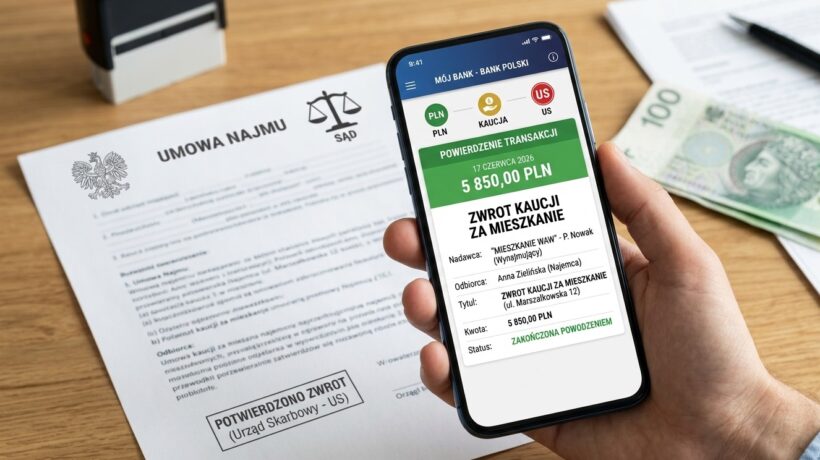
Rental deposit in Warsaw: How to legally reclaim your money from a dishonest landlord
The owner has 30 days to return the deposit from the day the apartment is emptied and the keys are handed over. If you do not have money in your account after this date, and the only argument of the landlord is “scratches on the floor” or “dirty grout”, you have the full right to pursue claims with statutory interest. Effective recovery of a deposit in Warsaw is based on three pillars: a handover protocol, a demand for payment and a possible lawsuit in the writ of payment procedure.
The most important information at a glance
- Statutory deadline: The refund must be made within 30 days (not a month, 30 days to be exact).
- Normal Consumption: The owner has no right to deduct money for worn parquet or faded walls (Article 675 § 1 of the Civil Code).
- Documentation: Photos taken on the day you move in and move out are your strongest proof.
- Court: A lawsuit in the e-court (EPU) costs a fraction of the amount in dispute and usually ends the case with an order for payment.
September 20, 2026
The Complete Guide: Tenant Rights and Deposit in Warsaw
The rental market in Warsaw in 2026 is merciless – with rents in Mokotów or Wola exceeding PLN 3000 per room, the deposit becomes an important capital. Dishonest landlords treat it as “additional rent”.
What can be deducted from the deposit?
The owner can only keep funds for:
- Overdue bills (utilities, administrative rent, electricity, gas).
- Excessive damage (hole in the wall, broken mirror, burnt hole in the carpet).
What CANNOT be deducted?
Any traces resulting from normal wear and tear. If the landlord demands PLN 500 for painting the walls after a year of your apartment – refuse. This is the cost of running a business.
Step-by-Step Guide: Deposit Recovery Procedure
- Final documentation: When handing over a room (e.g. at Waryńskiego Street or in Wola housing estates), draw up a handover protocol. If the owner refuses to sign, record a video with your smartphone, showing the condition of the room and the fact that you are leaving the keys.
- Pre-court demand for payment: This is a key document. It must be sent by registered mail with a return acknowledgement of receipt (the so-called yellow stanza). What to enter? The amount, account number, deadline (e.g. 7 days) and information about referring the case to court.
- Application to the e-Court (EPU): If the summons did not work, file a claim via the ‘e-sad.gov.pl’ portal. You don’t need a lawyer. The fee is low and payment orders are issued efficiently.
- Complaint to the Tax Office: This is the “nuclear option”. If you suspect that the landlord does not pay rental tax (which still happens in Warsaw), inform him of your intention to report this fact. Fear of tax control often speeds up the transfer of the deposit in 5 minutes.
The most common mistakes of tenants
No protocol when moving in
- Why it occurs: Haste, trust in the “nice old gentleman from Ochota”.
- Effects: The landlord attributes to you the damage left by the previous tenant.
- How to avoid: Always take photos before bringing your belongings and email them to the owner on the day you sign the contract.
Consent to the “lump sum deduction”
- Why it occurs: The desire to quickly close the topic and get at least part of the money back.
- Why it occurs: The desire to quickly close the topic and get at least part of the money back.
- How to avoid: Request invoices or receipts for alleged repairs. The owner must prove the cost incurred.
No current mailing address
- Why it occurs: You forget to give your new address after moving out.
- Effects: Demands for payment are ineffective in terms of litigation.
- How to avoid: Enter the address for correspondence in the key handover protocol.
Costs, pricing, and comparison of recovery methods
| Option | Cost (2026) | PROS | Cons | For whom? |
|---|---|---|---|---|
| Self-call | approx. 10 PLN (sheet) | The cheapest, no court stress | It works only on rational owners | Each case |
| E-Court (EPU) | 1.25% deposit | Legal effectiveness, bailiff | Waiting time (approx. 2-4 msc) | Amounts over 2000 PLN |
| Lawyer (Warsaw) | 500 – 1500 PLN | Full service, authority | High price compared to the deposit | Disputes over amounts > PLN 10,000 |
| Mediation / Ombudsman | 0 PLN | Free, amicable | Lack of coercive power | Students of the University of Warsaw/Warsaw University of Technology (Law Clinic) |
If you don’t want to go to court, consider:
- Compensation law firms: Some companies buy debts on the basis of a deposit (you get, for example, 60-70% of the amount immediately, they fight with the owner).
- Student Law Clinics: At the Faculty of Law and Administration of the University of Warsaw (4 Lipowa Street), senior students help write pleadings for free.
- Tenant insurance: In 2027, tenant’s liability policies with legal protection will become the standard. They cost about PLN 60-100 per year and cover the costs of a lawyer in bail disputes.
Deposit indexation: How to get back more than you paid?
Hardly any student in Warsaw knows that the deposit is subject to mandatory indexation. In accordance with Article 6(3) of the Act on the Protection of Tenants’ Rights, the deposit should be returned in the amount constituting the product of the rent in force on the date of the deposit return and the multiple of the rent accepted when paying the deposit.
Practical example (Warsaw 2026/2027):
If in 2025 you paid a deposit of one month’s rent (e.g. PLN 2500), and in the meantime the landlord has increased the rent to PLN 3000, then when you move out in 2027, you have the right to demand a refund of PLN 3000. The owners almost always omit this provision, giving back the nominal amount. Referring to this particular paragraph in the demand for payment shows the landlord that he is dealing with a person aware of his rights, which drastically increases the chance of a quick transfer.
Digital Evidence: Metadata and Cloud as a Foundation in Court
In 2027, Warsaw courts (e.g. the District Court for Warsaw-Wola or Śródmieście) are no longer based only on paper protocols. The metadata of your photos is the key proof.
- “Cloud-Check” procedure: Upload all photos and videos taken during the room release immediately to Google Drive or iCloud. Send the owner a link to the folder on the day you return the keys.
- Why does it work? The metadata of the file (date of execution, GPS coordinates, phone model) are irrefutable evidence for the forensic expert. If the landlord states after a week that he “found a stain on the mattress”, and you have a photo with the date of handing over the apartment where there is no stain – the case is won. The judge will decide that the damage occurred after you moved out.
Tax blackmail vs. hard negotiation: The role of the Tax Office
In Warsaw, a large part of the rental of rooms still takes place in the grey zone, especially in older blocks of flats in Bielany or Targówek. If the owner is illegally holding the deposit, your strongest argument is to verify his settlements with the tax authorities.
- Invoice inquiry: Request a confirmation of payment of the deposit and rents for the entire period.
- Notification to the Tax Office: You can inform the landlord that if the deposit is not returned, you will file a notice of suspicion of committing a prohibited act (failure to disclose sources of income).
- Risks: Remember that this is not a “denunciation”, but the right to report irregularities. For the owner, an inspection from the First Tax Office Warsaw-Śródmieście (Lindleya Street) is ten times more expensive and stressful than a case in court for PLN 3000. Often, the draft of such a notice attached to the email ends the dispute in 24 hours.
Free legal aid in Warsaw: Where to hit physically?
If you can’t afford a lawyer, Warsaw offers unique support points that specialize in tenant disputes:
- Law Clinic of the University of Warsaw (4 Lipowa Street): Students of recent years, under the supervision of professors, analyze contracts and write lawsuits free of charge. The effectiveness of their writings is legendary among Warsaw tenement houses.
- Citizens’ Advice Bureau (3 Gałczyńskiego Street): They offer support in writing pleadings and applications to the bailiff.
- Tenant’s Rights Ombudsman (14 Poznańska Street): Focused on drastic cases (e.g. when the owner replaced the locks without giving up the deposit and personal belongings).
Debtor registers: Enter a dishonest owner in KRD
Once you have obtained a valid order for payment from the e-court, you don’t have to wait only for a bailiff.
- BIG & KRD: As a natural person (tenant), you can enter the debtor (owner) in the Economic Information Bureau. The cost is about PLN 50-100, and the result for the owner is deplorable: he will not take a loan, buy a phone with a subscription, or lease a car.
- Negotiation trick: Inform the owner: “I have an order for payment. If the money does not arrive within 3 days, I enter your data into the KRD.” In Warsaw, where creditworthiness is crucial for housing investors, this is the final argument.
Exceptions that FB groups are silent about
There are situations in which the fight for the deposit is lost in advance:
- Sublease without consent: If you have rented a room to a third party without the written consent of the owner, you have breached an essential point of the contract. The owner can terminate the contract immediately and retain the deposit as a contractual penalty (if such a provision was in the contract).
- Arbitrary painting: If you painted the walls black without permission, the owner will deduct the cost of restoring them to their original (white) state. In 2026, the painting team in Warsaw takes about PLN 30-40 per m² – the deposit will disappear in no time.
- No notice period: If you run away from the room “overnight”, the landlord has the right to credit the deposit towards the rent for the notice period that you did not keep.
Order for payment: What to do when a bailiff claims that the owner is “poor”?
In Warsaw, it often happens that the apartment belongs to someone else, and it is rented by a “manager” or a family member.
- Seizure of rent receivables: If you win the case and the landlord doesn’t pay, the bailiff can seize the rent that the new tenants of that room pay. This is the most effective method of enforcement in the capital. The bailiff sends a letter to your successors: “From today you do not pay the owner, but to the bailiff’s account.” The owner, losing financial liquidity, usually immediately finds funds to repay your debt.
The trap of “Joint and Several Responsibility”: Do you pay for your roommate’s damage?
In Warsaw, especially in multi-room apartments in Mokotów (close to the Warsaw School of Economics) or Wola, owners often use one agreement for all tenants. This is the most dangerous provision for your deposit.
- Trap mechanism: If your contract says “joint and several liability” and your roommate has destroyed the washing machine or failed to pay for the last month, the landlord has the right to deduct the ENTIRE amount from your portion of the deposit.
- How to defend yourself? When signing a contract, request separate contracts for each room. If it’s too late and the landlord refuses to return your deposit due to someone else’s mistakes, the only way out is to file a recourse lawsuit against your roommate. However, in a relationship with the landlord, if your room’s handover protocol is clean, you can argue that the damage concerns property that third parties had access to and the landlord failed to identify the perpetrator.
Utility Billing: Actual Invoices vs. Owner’s “Estimates”
Dishonest owners in Warsaw (often in the areas of Chmielna or Nowy Świat Streets) use the trick “for an underpayment”. They claim that the deposit is lost because “heating bills have come higher”.
- Your right: You have a statutory right to inspect invoices from suppliers (E.ON, Stoen, Veolia, PGNiG). Never agree to a deduction from the deposit based on “respect” or an Excel screenshot of the owner.
- Procedure in 2027: Request billing based on meter readings written down in the protocol. If the owner claims that the settlement will come in 3 months and therefore keeps the deposit – this is an illegal action. The 30-day deadline for the return of the deposit is rigid. The owner should return the deposit, and settle any underpayment separately, presenting an invoice. Keeping a PLN 3000 deposit for a potential underpayment of PLN 200 for water is an abuse of law.
A faster alternative to the District Court
District courts in Warsaw (e.g. the Court at 82 Marszałkowska Street) are extremely busy in 2026. A bail case can last 12-18 months.
- Mediation Centre at ORA in Warsaw: You can offer the owner mediation. It costs a fraction of what a lawyer costs, and a settlement concluded before a mediator and approved by the court has the force of a court judgment.
- Psychology of negotiations: An invitation to mediation sent by a professional institution often “sobers up” the owner, who realizes that you will not let go and the case takes on an official course. This is an ideal solution when the amount of the dispute is PLN 4000-6000 (e.g. a deposit for a premium double room).
Rent guarantee: A solution for the future
If you have just lost your deposit and are looking for a new apartment in Warsaw, consider systems that are becoming standard in 2027 – the Replacement Warranty.
- How does it work? Instead of paying a 3000 PLN deposit, you buy a policy/warranty for about 200 PLN. The insurer guarantees the owner the payment of funds in the event of damage, and you maintain financial liquidity.
- For whom? For students who do not want to risk freezing cash with a private individual. In Warsaw, more and more rental agencies (especially in Białołęka and Wilanów) accept this solution, because it eliminates disputes over cash return between the owner and the tenant.
Final Key Collection Protocol: Your “stopwatch” for the 30-day period
Many students give up their keys “on the go”, without a document. This is a fatal error.
- Key Collection Protocol: This is not the same as the status of the premises. You must have a document with the date: “On Day X, the Landlord received a set of keys to the premises”.
- Why is it important? The 30-day deadline for returning the deposit is counted from the day of “emptying the premises”, i.e. the physical handover of power over the room. Without this document, the owner can claim in court that “the keys were in the mailbox a week later”, which postpones the return deadline and makes it difficult to calculate interest for late payment.
Pleadings
Don’t pay for templates of letters from the net. As a student in Warsaw, you have access to authorized resources:
- UW/WUT Students’ Self-Government: They have legal departments that provide templates of requests for payment adjusted to the current statutory interest rates for 2027.
- Ombudsman’s website: It includes a “Tenant’s Rights” section with ready-made claim forms for the return of the deposit.
- Faculty Law Libraries: Access to the LEX or Legalis systems – there you will find the latest case law of Warsaw courts in bail cases, which you can quote in your summons to “bend” the owner.
Recovering bail in Warsaw in 2027 requires a transition from a “pleading” to a “procedural” attitude. Every day of delay of the owner for more than 30 days is your additional interest money. Making the landlord at Lindleya or Rakowiecka Street aware of this usually ends the matter with an immediate transfer.
Frequently asked questions about the return of the deposit
Can an owner in Warsaw deduct from the deposit for cleaning?
Only if you have returned the room in a much worse condition than you found it and it has been documented in the protocol. Standard cleaning before the next tenant is at the landlord’s expense. In 2026, Warsaw courts are of the opinion that “refreshing” the premises after a year of living is normal operation.
How much time does the landlord have to return the deposit after moving out of the room in Warsaw?
According to Polish law, this deadline is 30 days from the moment the premises are emptied and the keys are returned. No provisions in the agreement such as “I will return when I find a new tenant” have legal force before the court – the 30-day deadline is superior.
What should I do if I don’t have a handover protocol?
You can still fight. Use witness testimony (e.g., roommates, parents helping with the move) and photos with metadata (GPS and date on file). In 2027, Polish courts will generally accept screenshots from WhatsApp as evidence of findings.
The owner does not receive a demand for payment – what now?
Twice notifying a registered letter to the address indicated in the contract is considered to have been served (the so-called fiction of service). You can confidently file a lawsuit in court, attaching an unclaimed envelope as proof of an attempt to settle the matter amicably.
Can the owner charge more for electricity and water than the meters show?
No. You have the right to request access to invoices from operators (E.ON, Stoen, Veolia). If the owner adds his own “margins”, it is unlawful enrichment.
How much does it cost to write a lawsuit for the return of a deposit by a lawyer in Warsaw?
In 2026/2027, prices in Warsaw law firms for a simple letter start at PLN 400. For most students, this is not profitable, so we recommend a free Tenant Ombudsman Office or e-court.
Is the deposit subject to indexation?
In accordance with Article 6(3) of the Act, the reimbursed amount should be equal to the product of the rent on the date of reimbursement and the multiple of the rent accepted when the deposit was paid. If the rent has increased during your lease, you should receive a proportionally higher deposit.
How to recover the deposit if the contract was “on the face”?
It’s more difficult, but possible. The proof is transfers entitled “Room deposit“, keys, witnesses and electronic correspondence. The lack of a written form does not mean that the lease agreement is not in the light of the law.
Can the owner deduct a deposit for scratches on the panels from an office chair?
It depends. If you have used a protective mat and the scratches are negligible – this is normal wear. However, if you have destroyed the parquet floor in the apartment in Wola, the owner can deduct the cost of the renovation, but must provide a valuation/invoice.
Where is the Court competent for bail cases in Warsaw?
This is usually the court with jurisdiction over the defendant’s place of residence (owner) or the place of performance of the contract (location of the apartment). For most cases, these will be: the District Court for Warsaw-Mokotów, Warsaw-Śródmieście or Warsaw-Wola.