


Rental handover protocol in Tricity: Your ultimate safety check
Gdańsk. Tri-City. The sea is humming outside the window, the tram is ringing at a nearby intersection, and you are holding the keys to your first, dream “M” in your hand. Or maybe to the next, but equally important stage on the student path. That feeling—a mixture of excitement, hope, and a slight trembling heart at the thought of a new chapter—I know it very well. Are you a student who has just docked in this vibrant port of knowledge and youth? Or maybe a high school graduate who, with a dream map in his hand, is looking for a horizon called independence? Or maybe you are a parent who cares and proudly helps your child take their first steps in the adult world of renting?
Whoever you are, this article is for you. It is like a lighthouse in a maze of formalities – it is supposed to light the way and show a safe course in one of the most important issues of rental: the handover protocol.
Think of this document not as a boring piece of paper, but as your personal insurance policy for peace of mind and… wallet. Yes, exactly! It is this often underestimated piece of paper (or digital file!) that can prove to be your strongest shield in potential disputes with the owner, especially when it comes time to settle the deposit. Do you remember that feeling I wrote about in the context of the bail – this anxiety, will the hard-earned money come back to you in full? The handover protocol is the key to ensuring that the answer is “YES!”.
Handover protocol
Imagine such a situation, unfortunately, not uncommon on the Tri-City rental market. You move into an apartment. You are so absorbed in unpacking cardboard boxes, planning your first housewarming party with a view of the Motława River (or maybe the sea?), that you wave your hand for a thorough inspection. “It looks OK,” you think. You sign the contract, the protocol superficially, because the owner is in a hurry. A year, maybe two, passes. Time to move out. And suddenly you hear: “But how come? That scratch on the dance floor? That burn on the countertop? And the stain on the wall in the bedroom?” Your heart is dying. You are sure that you have not done it, that it has already been! But how will you prove it? Word against word? In such a situation, your deposit is seriously jeopardized.
September 20, 2026
Now let’s reverse the script. You enter the apartment and turn into… detective. With a notebook (or a special form), a phone at the ready, and the peace of mind of a Zen master. You walk through EVERY room, methodically, unhurriedly. You insist on the presence of the owner – it’s your common cause, your joint start. And you start documenting.
Pick-up of the apartment – Gdańsk Gdynia Sopot
This is the moment when you create the foundations of your “policy”. Take your time. Spend an hour or two on it – as much as necessary.
Step-by-step inspection:
- Walls and ceilings: Look for cracks, scratches, stains, stains, nail holes (if relevant). Save: “West wall in the living room – a scratch of about 10 cm at a height of 1.5 m“, “Ceiling in the bathroom – a small leak in the corner above the shower“. Be precise! Not “dirty walls“, but “light dirt at the light switch in the hallway“.
- Flooring: Panels, parquet, tiles, carpet – every scratch, dent, stain, abrasion, loose skirting board matters. “Parquet in the bedroom – a deeper scratch of about 5 cm at the balcony door“, “The joint between the tiles at the entrance to the kitchen is crumbled“.
- Windows and doors: Check that they close, that the handles are working smoothly, that the windows are not cracked or scratched (beyond normal wash marks), that the gaskets are in good condition. “Handle in the kitchen window loose“, “Front door – scratch on the frame from the side of the apartment“.
- Furniture (if equipped): Upholstery condition (stains, abrasions, tears), stability (do chairs wobble?), condition of countertops (scratches, burns), operation of drawers and doors. “Sofa in the living room – a small, dried stain on the left armrest“, “Leg from the table in the kitchen slightly unstable“.
- Household appliances and electronics (if any): You have to be a tester here! Turn on the fridge (does it cool and freeze?), washing machine (a short rinse program is enough), stove (all burners/cooking zones!), oven, dishwasher, microwave, TV. Pay attention to the visual condition (housings, doors, gaskets). “The door from the washing machine creaks slightly when opened“, “One of the gas burners lights up with a slight delay“.
- Bathroom and kitchen – sanitary facilities and fittings: Check the taps (hot/cold water, pressure, whether it is dripping), toilet cistern, shower (handset, hose, drain). Pay attention to cracks in the washbasin, bathtub, shower tray, toilet bowl, condition of silicones and joints (mold?). “A slight limescale deposit on the shower head“, “The silicone around the bathtub slightly blackened in one place“.
- Installations: Check all electrical outlets (preferably with a simple tester for a few zlotys!), light switches, heating operation (if it’s the heating season). “The double socket at the desk in the room does not work (to be checked by the Owner)“.
Visual Evidence – Photos and Videos
- Don’t save memory on your phone! Take photos of EVERY room – the overall view. And then… CLOSE-UPS. Every scratch, stain, defect, scratch – even the smallest – deserves its own portrait. Think of it as creating a visual archive of the “zero” state.
- Good light is essential. Take photos during the day, in natural light if possible. Use a flash if necessary, but in a way that doesn’t distort the colors or texture.
- The videos are great too! You can record a short video by walking through the apartment and commenting on the condition of individual elements on an ongoing basis. Especially useful for showing how something works (or doesn’t work).
- Rip and secure! Immediately after drawing up the protocol , copy photos and videos to your computer’s disk, to the cloud, and send them to yourself by e-mail. Don’t let them get lost in the depths of your phone! Most smartphones store the date of taking (the so-called EXIF metadata) in the photo data, which is additional evidence.
Meters – water, electricity, gas
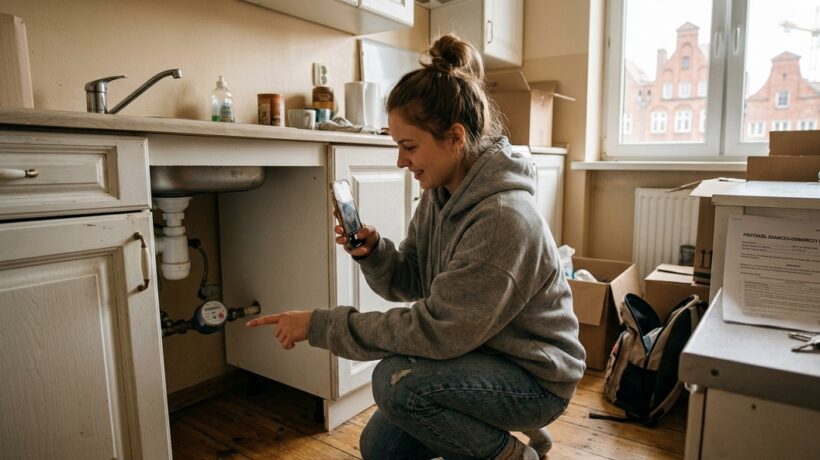
- Write down the EXACT readings of ALL meters: electricity (beware of tariffs! Sometimes there are two or three – T1, T2, T3 or A+, A-, A), cold water (ZW), hot water (CW), gas, as well as heat meters or heat dividers on radiators (if any).
- Photos, photos, photos! Take clear photos of EACH meter so that its SERIAL NUMBER and current CONDITION are visible. This is irrefutable proof of the moment when settlements begin.
Protocol form
- Use a ready-made protocol template (you can find many on the Internet) or create your own, clear document. Divide it into rooms and categories (walls, floors, etc.).
- Write all comments, descriptions of the status, meter readings legibly. Don’t leave empty spaces that someone could fill in later. Cross out the empty boxes.
- Captions on EVERY page! It’s super important. Prevents page replacement. All tenants and the owner (or their representative) sign. Prepare two identical copies – one for each side.
Red Flag – When the owner says “Uh, what is this for?”
If the owner disregards the protocol, dismisses you, says he “doesn’t have time” or doesn’t want to sign it – take this as a VERY serious warning sign. Someone who avoids documenting the facts at the beginning may have impure intentions when settling the accounts. What to do?
- Insist politely but firmly. Explain that it is in the interest of both parties to avoid misunderstandings.
- If the refusal is categorical: Think VERY HARD about whether you want to rent from this person. This is a really bad prognosis.
- If you’re already decided or have no choice: Draw up the protocol UNILATERALLY. Describe the condition of the premises in detail, take photos/videos. Ask a witness (roommate, parent, friend) to be present at the inspection and also sign the report as a witness. In the protocol, NOTE that the owner refused to participate in the preparation and signing of the protocol. Send a copy of such a one-sided protocol (preferably with photos) to the owner by registered mail with acknowledgment of receipt. It’s your mark that you tried to complete the formalities.
Handing over the apartment – Settlement and deposit
The lease period has passed. The moment comes to hand over the keys. Now your carefully prepared initial protocol and photos become a map for you to navigate.
- Prepare the premises: Before you meet with the owner, clean the apartment. It doesn’t have to shine like new (unless that’s what the contract says), but it has to be clean, without your belongings, rubbish, with an empty fridge. It’s simply a matter of culture and respect.
- Repeat the ritual: Again, preferably together with the owner, walk through the apartment, comparing the current state with the initial protocol and your photo documentation. Be honest – if you have actually damaged something beyond normal wear and tear, admit it and determine the method of repair or the cost of deduction. But if the owner points to something that has already been done before – reach for the protocol and photos. Your “material evidence” is priceless here!
- Final meter readings: Absolutely crucial for the final utility billing. Write down your states, take photos (yes, again!). Demand that the owner present the final settlement as soon as possible.
- Documentation of the “After” status: Take photos and videos showing what condition you leave the apartment in. This is your protection in case the owner tries to “find” something after you leave.
- Signing the final protocol: You enter notes, final meter readings. If there are discrepancies – the owner insists on the damage you do not agree with – BE SURE to add your position! E.g.: “The tenant does not agree with point X of the protocol concerning the scratch on the panels – damage noted in the initial protocol of [data] / documented in the photo of [data]“. Or: “In the Tenant’s opinion, a slight dirt on the wall at the balcony door results from normal use of the premises for a period of 2 years“. Don’t be afraid to defend your opinion by basing it on facts and evidence. If the owner prevents you from making such an entry or does not want to sign it himself – note this fact on the protocol and sign your annotation.
- Return of keys: Record in the handover protocol the fact that all sets of keys have been returned. This is the formal end of your “care” over the premises.
I know that this may sound like a lot of trouble. But believe me – this effort at the beginning and end of the lease is an investment that pays off with peace of mind throughout the apartment and financial security when moving out. This is not bureaucracy for bureaucracy’s sake. This is your right and your duty to yourself – to protect your interests and build relations with the owner on clear, transparent terms.
Treat the handover protocol as a map of your journey through the rented apartment. Mark the exact starting point on it, and at the end compare whether the course was in accordance with the plan. With this map in hand, with photos as a compass and with the knowledge of the rules as the wind in your sails – you can enjoy your student life in the beautiful Tri-City, knowing that your rights and your money are safe.
You are wise, you are capable. Equipped with this knowledge, you will cope perfectly. Good luck on your new journey! Let your time in Gdańsk be full of good memories, and the formalities related to living – just a simple stop on this wonderful route.