


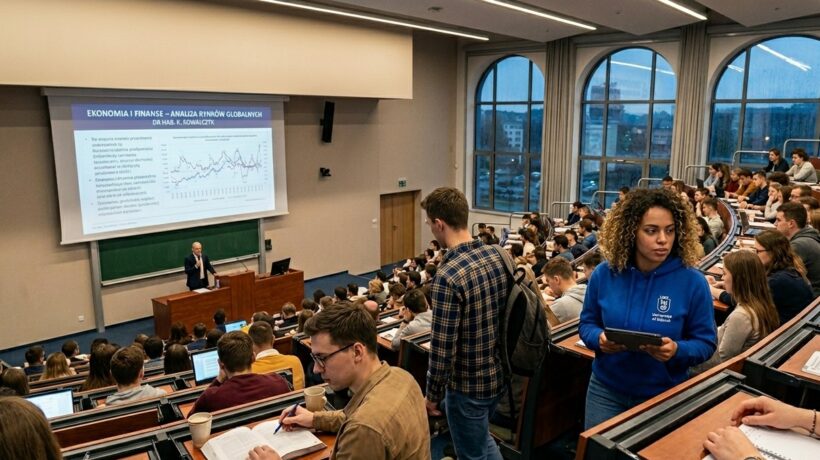
Economics and Finance at the University of Gdańsk: Hardest subjects and dropout rates
Studies in economics and finance at the University of Gdańsk are among the most demanding in northern Poland, and the greatest sifting occurs in the first year (about 25-30% of students) and after the fourth semester, when mathematical statistics come into play. The most difficult subjects that keep students in Sopot awake at night are invariably Mathematics (Analysis), Microeconomics, Statistics and Econometrics. However, the main reason for resignation is not a lack of willingness, but the clash of ideas about “light management” with the brutal, mathematical nature of modern economics and the high cost of living in the Tri-City, which forces many students to abandon full-time studies in favor of full-time jobs.
Specifics of Economics Studies at UG: Faculty of Economics vs Faculty of Management
Before we go into detail about the difficulty of the subjects, you need to understand the unique structure of the University of Gdansk. Although the university has “Gdańsk” in its name, the heart of finance and economics beats in Sopot. It is here, at Armii Krajowej Street, that there are two key departments: the Faculty of Economics (EC) and the Faculty of Management (WZ).
Students often confuse the two centers, and the difference is crucial for your survival:
- Faculty of Economics (EC): Economics, International Economic Relations and Logistics reign supreme here. It is more theoretical, model-like and… mathematically in the analytical sense.
- Management Department: Here you will find Finance and Accounting (FiR) and Management. It is more practical, accounting and procedural.
A resident of Sopot will tell you that both faculties are “on the hill” – literally. Climbing the steep hill to the faculty buildings every day from the SKM Sopot station is your first lesson in perseverance. Buildings A, B and C form a maze in which a first-year student gets lost on average three times during the first week.
The most difficult subjects: Where is the “condition” lurking?
September 20, 2026
At UG, economics is not only about stories about Adam Smith. It’s hard work with data, models, and patterns. Here is a subjective ranking of subjects that generate the most entries for a “condition” (paid entry for the next semester without a passed course).
1. Mathematics / Mathematical Analysis (Semester I)
This is the first “filter”. Many people choose economics because they “don’t like physics and chemistry”, forgetting that economics is mathematics dressed in words.
- What is difficult? Transition from high school math to the academic level. Boundaries, derivatives, integrals, matrices – everything that was optional or superficial in high school is the foundation here.
- Why do people drop out? Neglect of exercise. In a lecture, everything seems clear, but when you get a piece of paper in the exercises, it turns out that you can’t count the flexibility of the function.
2. Microeconomics (Semester I and II)
It is a subject that teaches you to think like an economist. It seems logical, as long as you don’t have to calculate the equilibrium point of an enterprise under conditions of perfect competition, drawing complex systems of cost curves in the process.
- What is difficult? Abstraction of models. You have to operate on charts that change with the slightest change in the parameter.
- Why do people drop out? Because they are trying to learn microeconomics by heart. This object cannot be “forged” – it must be understood. If you don’t catch the logic of optimization, you’ll rely on the first colloquium.
3. Descriptive and Mathematical Statistics (Semester III and IV)
For many students, this is the “ultimate boss”. Mathematical statistics at the University of Gdańsk has the reputation of a subject that simply needs to be “experienced”.
- What is difficult? Probability theory, hypothesis testing, confidence intervals. The formulas are half an array long, and one calculation error at the beginning of the task destroys all the rest.
- Why do people drop out? Statistics require meticulousness and time. There is no room for improvisation here. If you don’t do homework every week, you won’t know where to start in the session.
4. Econometrics (Semester IV or V)
A combination of mathematics, statistics, and economic theory.
- What is difficult? Building models that are supposed to predict the future. You need to be able to operate statistical programs (e.g. Gretl), but also understand what these numbers mean in the real world.
- Why do people drop out? It is an accumulation of everything that is most difficult in economic studies. If you had deficiencies in mathematics or statistics, econometrics will mercilessly expose them.
5. Financial Accounting (Faculty of Management)
A key subject for the Finance and Accounting course.
- What is difficult? Double Entry Rule, “Ows and Has”, balance sheets, profit and loss accounts. For unsystematic minds, it is torture.
- Why do people drop out? There is no place for “it seems to me” here. The balance must come to zero. If it doesn’t work out – the task is wrong.
When do UG students most often resign?
Statistics do not lie – studying economics in Sopot is a race with obstacles.
Semester I: “The Shock of a First-Year Student”
About 10-15% of students drop out after the first winter session. The reason is usually the aforementioned mathematics and a clash with academic freedom. No one checks the attendance at lectures in the Prof. Paweł Pawłowski Auditorium, so students stop coming and then they are not able to catch up on the material before the exam.
II Semester: The First Disappointment
The next wave of departures occurs after the first year. This is where people who have understood that economics is not their fairy tale resign. Instead of managing large corporations (as promised by university advertisements), they have to calculate integrals and analyze GDP.
IV Semester: Barrier of Statistics
This is a “to be or not to be” moment for second-year students. Mathematical statistics work like a sieve. If you do not pass this subject, you often lose motivation and change to one with a lower level of difficulty (e.g. private business schools in Gdańsk or Gdynia).
Why do students drop out? (Real reasons)
- Shortages in mathematics from high school: This is the most common cause. If you didn’t have extended math in high school, you’ll have to work three times harder than your classmates at UG.
- Paid work: Gdańsk and Sopot are expensive cities. The cost of renting a room in 2026/27 is often PLN 1800-2400. Many students go to work (e.g. in gastronomy in Monciak), which ends up with a lack of time for studying and, as a result, failing the sessions.
- Too much self-confidence: FiR students often think that since they “count money well”, then studying will be a formality. Accounting quickly verifies this approach.
- Problems with access: Students living, for example, in the Gdańsk South (Jasień, Ujeścisko) lose 2-3 hours a day on commuting by SKM and buses. This is the time that is missing for repeating the material.
Cost of Studying: How Much Do You Need to Have in Your Account?
- Condition (Retake exam/revision of the subject): In 2026/27, the cost of one ECTS credit with a condition is about PLN 100-150. An average subject is 4-6 ECTS, so one failed exam costs about 400-900 PLN.
- Apartment: Sopot is the most expensive. Rooms close to the faculty (Armii Krajowej Street, 23 Marca Street) cost PLN 2200+. UG students most often choose Gdańsk’s Żabianka or Zaspa to save a few hundred zlotys.
- Part-time (part-time) studies: Tuition fees for Economics or Faculty of Law at the University of Gdańsk cost about PLN 3500 – 5000 per semester, depending on the field of study and year.
How to survive the first year in Sopot?
- Don’t miss exercises: You can read lectures from notes, but you can’t replace math or microeconomics exercises with anything. This is where you learn how to solve the tasks that will be on the exam.
- Make friends with the library: The Economic Library in Sopot is a great place to study in silence. It also has access to paid databases that will be useful for writing papers.
- Take advantage of the consultations: Lecturers at the University of Gdańsk have mandatory consultation hours. If you don’t understand how to derive a regression formula – go and ask. Hardly anyone does this, and this is the best way to avoid the condition.
- Take advantage of the consultations: Lecturers at the University of Gdańsk have mandatory consultation hours. If you don’t understand how to derive a regression formula – go and ask. Hardly anyone does this, and this is the best way to avoid the condition.
Infrastructure of Fear and Success: Buildings A, B, and C
The Faculty of Economics and the Faculty of Management are de facto one big organism connected by a network of corridors in which it is easy to get stuck.
- Building A (old): Here you will feel the spirit of old school economics. The halls are high, sometimes cold, and the corridors smell of history. This is where most of the lectures take place in legendary auditoriums.
- Building B and C (New): This is where the heart of modern finance beats. Glazed rooms, air conditioning and computer labs. If you have a statistics or econometrics class, you’ll probably spend long hours here.
- Logistics “on the spot”: Changing a building between classes in 10 minutes is a challenge. If you have exercises in building C and a lecture in the Pavlowski Auditorium in building A, learn to run. Sopot teaches punctuality in a brutal way – many hosts close the door at the same time as the bell rings.
USOS System: Your Worst Enemy and Best Friend
In 2026, USOS (University Study Service System) is already modern, but enrollment in classes (the so-called “tokens” or “direct enrollment”) still resembles gladiator fighting.
- The battle for language courses and PE: Registration usually starts at night or early in the morning. If you don’t have fiber optics and the reflexes of an e-athlete, you’ll end up on “Nordic walking” at 7:30 a.m. on the beach or in a language class you didn’t want.
- Tip: Always have a list of alternative groups ready. If your dream microeconomics group fills up in 3 seconds, you need to have a plan B, C, and D.
IT in economics: What to learn “on the side”?
The study program at the University of Gdańsk is rich, but the labor market in the Tri-City (State Street, Bayer, ThyssenKrupp) expects something more. If you want to be among the 30% of people who not only finish their studies, but have a job already in their third year:
- Excel is a religion: It is not enough that you know how to enter the formula of the sum. You need to master PivotTables, Power Query, and the basics of VBA. On FiR (Finance and Accounting) without Excel, you are like a soldier without a rifle.
- Gretl, R and Python: At econometrics you will encounter the Gretl program. It’s simple, but it’s worth licking R or Python on your own. In Sopot, more and more scientific circles (e.g. KN Inwestor or KN Strateg) organize free workshops on data analysis. It is these certificates, not the PE grade, that open the door to Olivia Star.
Scientific Circles: The Only Way to a “Real” Career
There are over 30 scientific circles in Economics and Management at the University of Gdańsk. These are not interest groups from high school – they are semi-professional organizations.
- Networking: Members of the circles have direct access to bank presidents and managers from the “Big Four”, who regularly visit the department.
- Conferences: Trips to conferences in Warsaw, Krakow or abroad (Erasmus+) are financed from the university’s budget. It’s the best way to travel and build your resume for free.
The culture of “Kindergarten” and “September Campaign”
In Sopot, exams are divided into those that can be passed in zero time and those that require “miracles on the Oder”.
- Kindergartens: Many lecturers (especially in subjects such as History of Economic Thought or Law) offer the exam in December or May, even before the session. Always approach them. Even if you don’t pass, you’ll learn what the questions look like.
- Retake Session (September): This is the time of the greatest dramas. If you fail Statistics in June, your vacation will turn into a course in calculating probability on the beach. Statistics show that people who leave difficult subjects for September are 50% less likely to pass them due to increasing stress.
Student life
Living and studying in Sopot means living in a permanent “vacation” mode.
- Thursdays in Sopot: It’s a traditional party day. Clubs such as Atelier or Sfinks700 are bursting at the seams. As a fuks (first-year student), you will quickly understand that the colloquium on Friday at 8:00 after “Thursday in Sopot” is a mistake that is not made twice.
- Where to eat cheaply? Forget about restaurants on Monciak itself. UG students dine in the Bursztyn Bar (a classic milk bar on Grunwaldzka Street) or in the neighborhood “delicacies” on 23 Marca Street. There is also a buffet at the faculty itself, but during rush hour the queue resembles the one for an iPhone.
The trap of the “first job”
Olivia Business Centre and Alchemia are so close that the temptation to go to full-time work as early as the second year is gigantic.
Warning: Companies in Gdańsk are happy to take UG students to “slap invoices” at night or in the afternoon. You will earn 5000-6000 PLN, but you will lose contact with science. In 2026, we see a trend where FiR students work so much that they are “hanging” on 3-4 conditions, which ultimately leads to being crossed off the list for the semester before the bachelor’s degree. First studies, then a career – or a job for a maximum of 1/2 of a full-time job.
Economics and Finance at the University of Gdańsk is a course for people with a “head for numbers” and a “”. If you survive your first year of math and second year of statistics, the world of finance will open up to you. Sopot is a beautiful but merciless place for those who lose concentration.
The key to success: Find a group of 3-4 friends with whom you will count tasks together. At the University of Gdańsk, loners drop out the fastest. Photocopying notes together, cursing USOS together and learning to “mares” (the most difficult subjects) together is the only proven method to reach the defense without gray hair.
Everything that students of Economics and Faculty of Law at UG ask about
Is it possible to graduate from economics at the University of Gdańsk without knowing mathematics?
Short answer: No. Economics at the University of Gdańsk is based on mathematical modeling. While in some humanities faculties mathematics is only an addition, here it is a tool for work. You need to master at least the basics of mathematical analysis (derivatives, functions of many variables) and statistics. If you have trauma after high school, sign up for tutoring as early as October. Waiting until the winter session is a verdict on your index.
Which is more difficult: the Faculty of Economics or the Faculty of Management?
This is an eternal dispute between students in Sopot.
- The Faculty of Economics (EC) is considered to be more difficult in terms of theory and model. Subjects such as International Economic Relations require a broad knowledge of the world and the ability to connect facts.
- The Faculty of Management (WZ), and especially the Finance and Accounting major, is considered to be more difficult in terms of precision and the amount of memorization/procedural learning (e.g. tax regulations, accounting standards).
Finally, it is the FiR at the General Meeting that has the highest rate of “conditions” due to the complexity of accounting subjects.
How to survive statistics with the most demanding lecturers?
The key is to be systematic and make to-do lists. Statistics at the University of Gdańsk is not a subject that can be “understood” without counting. You have to go through hundreds of tasks from previous years. It is also very important to master Excel and possibly programs such as R or Gretl (depending on the teacher). Mathematical statistics (semester IV) requires an understanding of probability theory – if you neglect this, hypothesis testing will be black magic for you. Don’t be afraid to ask the instructors for help during the consultation – most of them appreciate the interest, as long as you don’t come a week before the exam.
Is full-time work and full-time studies at the University of Gdańsk Economics possible?
In practice: Very difficult. In the first and second year, the schedule is usually “jagged” – you have windows, classes from 8:00 to 18:00 with breaks. On top of that, there is a huge amount of self-learning. Most people who try to work 40 hours a week in full-time studies drop out after the first semester or move to part-time (part-time) studies. If you have to work, look for weekend or evening jobs (e.g. in the catering industry), but be aware that your social life and mental health will suffer.
What is a “condition” and how much does it cost at UG?
A “condition”, i.e. conditional enrolment for the next semester, is a situation in which you have not passed a course (despite corrections), but the university allows you to continue your studies on the condition that you pass this subject next year.
- A “condition”, i.e. conditional enrolment for the next semester, is a situation in which you have not passed a course (despite corrections), but the university allows you to continue your studies on the condition that you pass this subject next year.
- Limit: You can’t have an infinite number of conditions. Usually, exceeding a certain number of ECTS credits (e.g. 12) results in deletion from the list of students.
Economics at the University of Gdańsk vs Economics at the Gdańsk University of Technology (WZiE) – what to choose?
It depends on your goals.
- UG (University): A more classic approach, a strong theoretical foundation, better recognition in the banking and advisory sector.
- Gdańsk University of Technology (University of Technology): A more engineering approach to economics, a strong focus on IT tools, industrial logistics and production management.
If you dream of working in a bank, audit or the big four (EY, KPMG, PwC) – UG will be a better choice. If you prefer to work in manufacturing or IT companies – consider the University of Technology.
Are English-taught programs easier?
There is often a myth that in English-language courses (e.g. International Business) lecturers look with a gentler eye. This is not entirely true. The material is the same, and an additional difficulty is the professional terminology in a foreign language. Pros? Smaller groups and better contact with the staff. Downsides? Higher tuition fees for foreigners and often higher requirements for group projects. If you know English well, these studies may be more prestigious, but you won’t learn mathematics in English any easier than in Polish.
What is the real cost of living in Sopot in 2026/27?
Assuming that you are renting a single room (not a studio apartment):
- Rent: 1900 – 2400 PLN (with fees).
- Food: 1000 – 1500 PLN (using milk bars such as “Bar Bursztyn” in Sopot).
- Transport: PLN 60 (semester ticket for one city) or PLN 120 (metropolitan).
- Other (entertainment, materials): 500 PLN.
Realistically, you have to reckon with an expense of PLN 3500 – 4500 per month. Studying in Sopot without a scholarship or parental help is very difficult for the average student without a casual job.