


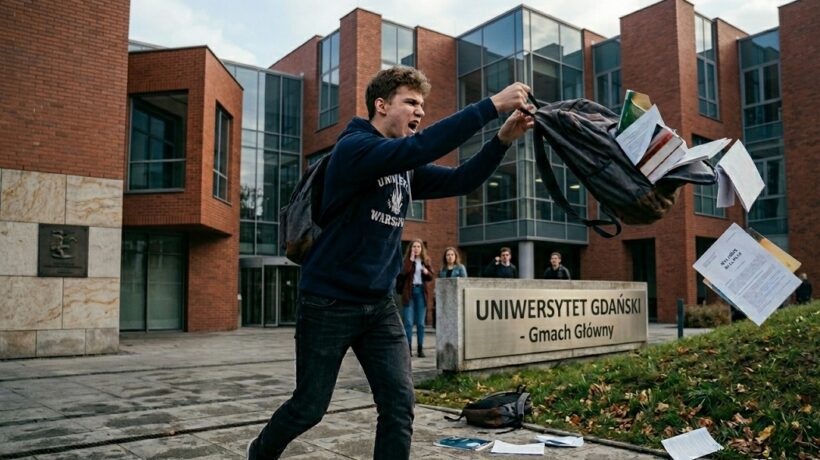
Dropping out or changing studies in Tricity: A comprehensive student’s guide
Are you standing on the SKM platform, looking at the runaway train towards Gdańsk Główny and feeling that your field of study is a mistake? Or maybe every visit to the building of the Gdańsk University of Technology or the Faculty of Social Sciences of the University of Gdańsk is associated with growing frustration? You are not alone in this. The decision to give up or change educational paths is one of the most difficult moments in the life of a young adult – especially in such a dynamic region as the Tri-City, where the possibilities seem limitless and the pressure to succeed can be overwhelming.
This article is a comprehensive analysis of your situation. Without unnecessary evaluation, but with a large dose of specifics regarding the change of field of study in the Tri-City, academic procedures and conversations with loved ones, which are often more difficult than the most difficult session at MUG.
Understanding the cause is key to taking the next step. In the specific conditions of the Gdańsk agglomeration, the most common reasons are:
September 20, 2026
- Wrong choice under time pressure: Recruitment right after graduation is often done in a hurry. You choose a prestigious field of study in Sopot because “that’s the way it should be“, and after a year you discover that finance and accounting are your biggest nuisance.
- Cost of living in the Tri-City: Prices of renting apartments in Przymorze or Oliwa have increased drastically. Many students have to combine full-time study with work in gastronomy or corporations at Olivia Business Centre, which leads to rapid burnout.
- Discrepancy between theory and practice: The Tri-City labor market (especially IT, logistics and the maritime sector) is developing faster than the programs of some universities. Students see that their friends without a diploma, but with courses, earn more in the Port of Gdynia or Gdańsk software houses.
- Mental health problems: Isolation, the pressure of results, and living away from home can overwhelm even the strongest individuals.
How to talk to parents about dropping out of college?
Parents’ perspective is often different from yours. For them, studying in the Tri-City is an investment – financial and emotional. The title of the article “My child wants to drop out of college” is a phrase that they type into a search engine with fear. Your job is to turn that fear into understanding.
Prepare a plan, not just emotions
Before you sit down to talk, don’t just say, “I hate this college.” This is a message that arouses resistance. Instead, prepare arguments:
- Loss and Profit Analysis: Show that continuing your current course is a waste of time and money (tuition, cost of living in Gdańsk).
- Alternative: “I want to quit law at the University of Gdańsk, but from October I am going to study logistics at the University of Administration and Business in Gdynia, because the program there is more practical.”
- Bridging plan: What will you do for the new recruitment? A job at Alchemia, a language course, or maybe an internship in one of the Tri-City forwarding companies?
Choose the right moment
Don’t start this conversation on the run, between one train and another to Gdynia. Choose a time when everyone is calm. Remember that for your parents, your education is often a guarantee of safety. You have to prove to them that changing studies is not an escape from duties, but a conscious professional reorientation.
Change of field of study in the Tri-City – technical and formal aspects
If you have made the decision to stay in academia, but change colors (e.g. from Gdańsk University of Technology to the Gdynia Maritime University), you need to know the procedures.
Transfer between universities (ECTS transfer)
This is the least painful option. If your current studies are at least a little related to the new ones, you can apply for a transcription of grades in general subjects (language courses, PE, humanities).
- Important: Check the terms and regulations of studies at the University of Gdańsk, Gdańsk University of Technology or private universities. Typically, transfer applications are submitted before the start of a new semester.
- Program differences: Be prepared for the dean to assign you subjects to complete.
Dean’s leave (the so-called “dean’s”)
Before you definitely throw away your ID card, consider dean’s leave. In the Tri-City, many people use this time to improve their budget or go abroad (e.g. as part of Work & Travel).
- Advantage: You retain your student status, discounts on SKM and ZTM, and health insurance.
- Disadvantage: You delay the moment of obtaining a diploma.
Resignation and re-recruitment
If you change your profile completely (e.g. from MUG to the Academy of Fine Arts in Gdańsk), you will have a new recruitment. Remember about the IRK (Online Candidate Registration) system. Make sure that your results from the matura exams are sufficient for a new field of study – sometimes it is worth spending a year to improve your matura exam in one of the Tri-City language schools or tutoring centers.
The labour market in Gdańsk, Gdynia and Sopot as an alternative to a diploma
The Tri-City is one of the best regions in Poland to start a career without (or during) a university degree. If you decide to take a break, the local market offers:
- BPO/SSC (Shared Service Centres) sector: Companies located in Olivia Business Centre or Alchemia in Gdańsk Oliwa are constantly looking for people with knowledge of foreign languages. Often, a bachelor’s or master’s degree is not required for junior positions, and soft skills and willingness to learn are what count.
- IT industry: Gdańsk and Gdynia are technology hubs. If you feel that studying computer science at university bores you, check out intensive programming bootcamps organized locally. Many people, after 6 months of intensive study, find work in Tri-City software houses.
- Maritime industry and logistics: The Port of Gdansk and the Port of Gdynia are the economic hearts of the region. Work in freight forwarding, logistics or port service is often available after short specialist courses.
- Gastronomy and tourism: Sopot and Gdańsk’s Old Town are places where working “for a while” allows you to earn real money, especially in the summer season, which can be a great way to finance a new field of study.
Practical tips: What do you need to keep in mind when dropping out of college?
Decision made? Here’s your checklist so you don’t wake up with legal or financial problems:
- Health Insurance: As a student, you are insured by the university or your parents. As soon as you are removed from the list of students, you lose this right (after 4 months from the expiry of the status). The solution is to register with the Labour Office (e.g. in Gdańsk at 3 Maja Street) or to take up a job under an employment contract.
- Student ID: You must return it to the dean’s office. This means the end of cheap SKM rides. It is worth getting a Resident’s Card (Gdańsk, Gdynia Rodzinna, etc.), which offers other local benefits.
- Student Loan: If you charge it, you are obliged to inform the bank about the interruption of studies. The disbursement of tranches will be withheld, and repayment may begin earlier.
- Apartment/Dormitory: If you live in a student dormitory (e.g. in the Polanki housing estate in Oliwa), resigning from your studies means you have to move out. Start looking for a room for rent in advance – the market in the Tri-City is difficult, especially in September and February.
The most common fears of students about change – The psychology of choice
Many people are stuck in hopeless studies because of the so-called sunk cost error. You think: “I’ve already completed two years at UG, it’s a shame to quit now.” The truth is, it’s better to “lose” two years than forty working in a profession you hate.
The Tri-City offers a unique atmosphere of freedom. Here, between the sea and the moraine hills, it is easier to get perspective. Take advantage of a walk along the shores of the Bay of Gdańsk to honestly answer the question: Where do I see myself in 5 years? If the answer has nothing to do with the current index – it’s time for changes.
FAQ – Frequently Asked Questions
How to quit your studies in the Tri-City and not lose your insurance?
To keep your insurance after dropping out of university, the easiest way is to register as an unemployed person at the District Employment Office (Gdańsk, Gdynia or Sopot) or take up work under an employment contract. If you are under 26 years of age and work on a contract of mandate, and you do not have the status of a student, the principal must pay social security contributions for you.
Is it possible to move from Gdańsk University of Technology to the University of Gdańsk during the year?
Transfer is usually possible after completing at least one semester or year. The consent of the deans of both faculties is required. The key is to match the learning outcomes and the number of ECTS credits.
What are the consequences of dropping out of full-time studies at a public university?
The main consequence is the loss of student privileges (transport discounts, insurance, the right to a place in a dormitory). If you studied in a medical or specialist field, it is worth checking whether there are no specific settlements for unused materials, although in most public fields of study the resignation itself is not associated with financial penalties.
Where to look for career counseling in Gdańsk?
It is worth going to the Career Offices of your universities (e.g. the Career Office of the University of Gdańsk in Oliwa or the Career Office of Gdańsk Tech). Even if you don’t want to study there, the advisors working there can help you diagnose your strengths. You can also use the services of the Voivodeship Labour Office in Gdańsk.
Is it a shame to drop out of college after the first semester?
Absolutely not. Statistics show that up to 30% of students change their major after the first year. In the Tri-City, where the labor market is very flexible, what matters most is your initiative and ability to adapt, not whether you graduated the first time.
How to tell parents about changing studies if they pay for it?
The key is honesty and a concrete recovery plan. Present the calculations, show that the change of major will be more profitable in the long run (e.g. better earnings after technical studies in Gdynia than after humanities studies in another city). Offer to take on a casual job to relieve their budget.
Your future in the Tri-City begins with a bold decision
Changing or dropping out of college is not a failure – it’s managing your own life. Gdańsk, Gdynia and Sopot are places that are conducive to new beginnings. Regardless of whether you decide to pursue a different course at the University of Gdańsk, choose practical studies at the WSB University, or quit your studies in favor of a career at Olivia Business Centre – the most important thing is that your path is in line with you.
Do you need support in making a decision?
- Make a list of the pros and cons of your current university.
- Make an appointment at the Career Office.
- Check out the current internship offers in Tri-City companies to see what the market really requires.
Don’t wait for burnout to take away your desire to act. The Tri-City gives you hundreds of options – choose the one that will allow you to set sail!
The trap of ECTS credits – financial and legal consequences of changing studies
Most students in Gdańsk or Sopot are not aware that studies “for free” at public universities (UG, PG, MUG) have their limits resulting from the Higher Education Act. This is a key argument in a conversation with parents and an important element of budget planning.
How do ECTS credits work when changing courses?
Each year of study is a standard of 60 ECTS credits. The state finances your education only within a certain limit. If you change your field of study after two years of studying at the Gdańsk University of Technology and start a new study from scratch, you have to take into account that your point “credit” is depleted.
- Fee risk: If you use free credits in one field of study and you have to repeat subjects in a new one or you extend your studies, the university may charge fees for additional ECTS credits.
- Rector’s Scholarship and Social Security: Remember that changing majors affects your ability to receive benefits. According to the regulations, scholarships are only eligible for 12 semesters (6 years). If you drop out of college in your 3rd year and start a new one, you may be deprived of financial support for the last years of your studies.
Strategic moment of resignation – don’t do it in the middle of the semester!
In the academic environment of the Tri-City, time is literally money. The moment you submit the paper to the dean’s office is of colossal importance for your future recruitment and portfolio.
- Resignation before the winter session: If you already know in November that law at the University of Gdańsk is not your thing, don’t wait until February. Official resignation before the end of the semester allows you to avoid entering “failed” in the USOS system, which may look better when you return to the same university in the future.
- Tuition reimbursement issue (non-public universities): If you study at WSB Merito in Gdańsk or SSW in Sopot, read the contract carefully. There is often a notice period. Being one day late with a decision may cost you tuition fees for the next month, which in the Tri-City reality means a loss of PLN 500-900.
Alternative educational paths in the Tri-City – what instead of a university?
The Tri-City is not only about large universities. The local education market offers options that allow you to acquire a specific profession in 12-24 months, which is ideal for people who feel aversion to academic theory.
Post-secondary schools in Gdańsk and Gdynia
Many people, after dropping out of university, choose post-secondary schools (e.g. TEB Education, Cosinus or medical schools). It’s a great way to:
- Maintaining the status of a student/pupil: You still have discounts on SKM and your ID.
- Quick re-branching: Courses such as dental technician, dental assistant (highly sought after in Tri-City clinics) or programmer give real professional qualifications much faster than engineering studies.
Certified courses and maritime certificates
Living in Gdynia or Gdańsk, you have access to a unique path – maritime training (STCW). Instead of bothering with transport theory, you can take basic safety courses and take up a job on passenger ships or in port logistics. This is the industry that pays the best at the start in the Pomeranian region, often without the requirement to have a master’s degree.
Mental health: Where to look for support in the Tri-City?
The decision to interrupt your studies is a huge stress. Google promotes content that cares about the user’s well-being (Helpfulness). If the reason for your resignation is a mental crisis, you will find free help in the Tri-City:
- Academic Centre for Psychological Support of the University of Gdańsk: It offers free consultations not only for students of this university, but often conducts open workshops.
- Crisis Intervention Centres: They operate in Gdańsk (Ks. Gustkowicza Street) and Gdynia (Biskupa Dominika Street). They are available 24/7.
- SWPS Youth Zone in Sopot: They often organize webinars and meetings on dealing with the pressure of success.
Building a “CV” – how to fill the gap after dropping out of studies?
For your future employer at Olivia Business Centre, continuity of development is important. If you drop out of college in March and start a new one in October, you have a 7-month gap. How to use them in the Tri-City?
- Competency volunteering: The Tri-City is a basin of non-governmental organizations. Working on projects such as Gdynia Design Days or Gdańsk Professional Week builds a portfolio better than a completed lecture.
- Coworking and networking: Instead of sitting at home, go to the Entrepreneurship Incubator in Sopot or Starter in Gdańsk. Getting to know the people who build startups will show you that not having a degree at the age of 21 is not the end of the world, but often the beginning of an interesting business path.
Do I have to return the social scholarship after resigning from my studies?
In most cases, no. The social scholarship is paid for the time you have held student status. If you officially cancel on November 15th, you keep the funds withdrawn until that moment, but you lose the right to further transfers.
What about health insurance (NFZ) during the Gap Year in the Tri-City?
If you are under 26, your parents can still insure you, provided that you register with the Employment Office as a job seeker or take up post-secondary school. Otherwise, you lose the right to free medical care in facilities such as the UCK in Gdańsk.
Is it paid to take the Matura exam in the Tri-City?
The matura exam itself in the retake term (August) or retaking after a year (May) is free of charge for the first 5 years after graduation. Only specialized preparatory courses offered by Tri-City educational centers can be paid.
Can I change my major within Gdańsk University of Technology without recruitment?
There is a procedure for changing faculty or majors (the so-called internal transfer), but this usually requires passing the first year and a high grade point average. If your results are poor, the only way is to re-recruit through the eRecruitment PG system.
Dropping out of studies in Gdańsk, Gdynia or Sopot is not an “escape from the battlefield“, but often a strategic retreat. This region offers too many opportunities to waste time learning something that doesn’t give you satisfaction or financial prospects.
Your checklist for the next 48 hours
- Check your ECTS score in the USOS/MojaPG system.
- Verify the dates of winter recruitment at non-public universities in the Tri-City – some logistics or IT courses start in March!
- Visit the career office and ask about paid intership internships in Tri-City corporations – this is the best way to check if the new industry really suits you.
Remember, the Baltic Sea teaches one thing – the wave always comes back, but you need to know which one is worth jumping on with a board. Good luck!