


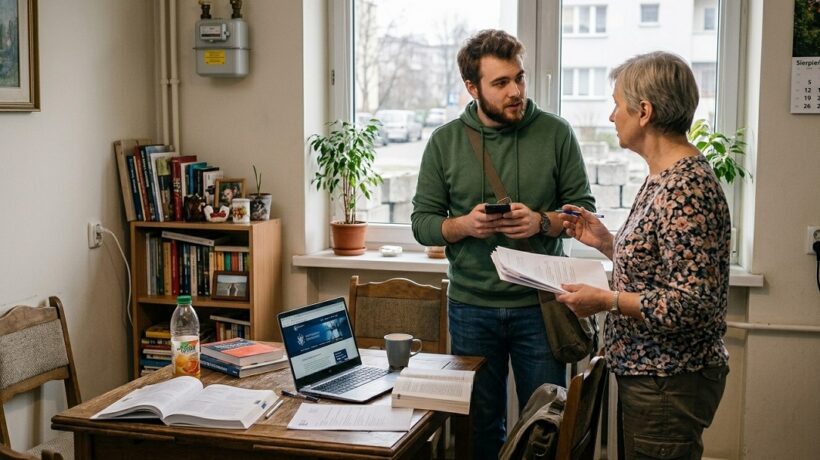
The most common disputes with the landlord: How to assert your rights as a tenant in Poland
Tenant Rights Guide
You rent a room in Wrzeszcz, a studio apartment in Żabianka or an apartment with a friend in the center of Gdynia – and suddenly the landlord says that he won’t give the deposit because “you have to paint the whole apartment“. Or from the next month the rent increases by PLN 400, because he decided to do so. Or the heating has not been working for three weeks and you hear: “you will manage somehow“.
Sound familiar? If so, you’re not alone. The Tri-City rental market is one of the most expensive and most tense in Poland. Every year, Gdańsk, Gdynia and Sopot receive tens of thousands of students from the Gdańsk University of Technology, the University of Gdańsk, the Medical University of Gdańsk, the Academy of Fine Arts and the Naval Academy. The demand for apartments is huge, the supply is severely limited, and some landlords are well aware that students often do not know what rights they are entitled to.
This article changes that. Here you will find specific answers to the most common problems, regulations you can refer to, and practical steps to take – without legal jargon and without generalities.
September 20, 2026
Why are students in the Tri-City particularly exposed to disputes with landlords?
Before we get into specific disputes, it is useful to understand the mechanism that drives them.
In the vicinity of the campuses – at Narutowicza Street in Gdańsk-Wrzeszcz, along Victory Avenue, near the SKM Politechnika or Gdańsk Główny stops – good rental ads disappear within a few hours. In such a situation, some students sign the contract without reading carefully, in order to be in time before other applicants. It is this moment – rush and stress – that is the most common source of later problems.
There is also a characteristic balance of power: the owner has an apartment and experience, you have an urgent need and often a limited budget. On top of that, there is a turnover – the student moves out after a year or two years, so the owner can “reset” the conditions with a new tenant every now and then.
The good news is that Polish law protects the tenant effectively – provided you know how to use this protection.
Legal Bases You Need to Know
Two legal acts form the foundation of your rights:
- The Act on the Protection of Tenants’ Rights, the Housing Stock of the Commune and on the Amendment of the Civil Code of 21 June 2001 – this is the main shield of the tenant. It regulates the deposit, the rules for terminating the contract, remedial obligations and much more.
- Civil Code, Articles 659–692 – supplements the provisions on lease and defines the mutual rights and obligations of the parties.
Key principle: these provisions cannot be excluded by contractual provisions. If there is a clause in your contract that is contrary to the law – it is invalid by law, even if you have signed it. The owner cannot “take away” your rights by contract, which are given by law.
Unlawful retention of bail
This is by far the most common and financially painful type of conflict between a student and a landlord. The mechanism is always similar: you pay a deposit equivalent to 1-3 months’ rent, after a year or two you move out, and the landlord informs you that he will not give the money back – because “the whole apartment needs to be painted“, “the carpet can be thrown away” or “the parquet needs to be scraped“.
What does the law say about bail?
According to Article 6 of the Act on the Protection of Tenants’ Rights:
- The deposit may not exceed twelve times the monthly rent (in practice, the agreements provide for 1-3 months).
- The landlord has 30 days from the date of vacating the premises to return it – after any deductions justified by actual damages.
- Normal wear and tear of the apartment – paint abrasion, minor scratches on the floor, natural aging of the equipment – is the owner’s cost, not yours. You may only be charged for actual damages beyond normal use.
How to protect yourself – concrete steps
When moving in:
- Prepare a detailed handover protocol with a description of the condition of each room, equipment and any defects that existed before your introduction.
- Take photos and video of the entire apartment – every angle, every scratch, every stain. Email them to the landlord on the same day (you then have the date in the header of the message).
- Sign the protocol together with the owner – without his signature, it is only a one-sided document.
When moving out:
- Repeat the same ritual: protocol + photos + recording.
- Do not accept a list of “damages” presented only verbally – ask for a written version with a quote.
- If the deposit is not returned within 30 days – send a written request for payment with a 7-day deadline. Keep your pick-up receipt or return receipt.
- If this does not work – a lawsuit to the district court (civil division). Cases up to PLN 20,000 are considered in a simplified procedure, relatively quickly and without the obligation to use a lawyer. The court fee is 5% of the value of the claim, minimum PLN 30.
Illegal rent increases and imposed fees
The Tri-City real estate market is growing, rental prices are breaking records – and some owners treat this as a green light for unilateral decisions during the term of the agreement. You get an SMS: “from the 1st of the next month, the rent will increase by PLN 350“. Or suddenly there is an invoice for “building administration“, which is not mentioned in the contract.
When is a raise legal?
Changing the amount of rent requires:
- A written notice of the current rate with the deadline indicated in the contract (usually 3 months).
- If you have a fixed-term contract, an increase during its term is generally unacceptable – unless the contract explicitly provides for an indexation mechanism (e.g. by the GUS inflation index or another objective indicator).
- Fees that are not in the contract do not automatically apply to you – you would have to agree to change the terms of the contract.
How to react?
- Respond in writing (e-mail is sufficient), referring to the content of the contract. Don’t be silent – the lack of reaction can be interpreted as an implicit acceptance of the new terms.
- If the owner insists on an illegal increase, you can refer the case to the Permanent Consumer Arbitration Court at the Trade Inspection Authority – the procedure is free of charge and faster than a common court.
- You can also contact the Municipal Consumer Ombudsman in Gdańsk (8/12 Nowe Ogrody Street) or its counterparts in Gdynia and Sopot – free legal assistance for tenants.
Glitches and repairs that no one does
A broken washing machine for two weeks, non-working heating in the middle of the Tri-City winter, a leaking roof, fungus on the bathroom wall – and the owner who replies to messages after a week (if he answers at all) with the words: “I’ll buy a new washing machine when I have time”.
Who is responsible for what?
The division is clear in the Civil Code:
The landlord is responsible for:
- repairs of installations (electrical, water and sewage, gas, heating),
- repair or replacement of household appliances that are furnishing the apartment,
- repair of roof, windows, external doors,
- removal of moisture and fungus resulting from building defects.
The tenant is responsible for:
- minor repairs resulting from current use (replacement of light bulbs, batteries for the remote control),
- repairs of equipment damaged due to one’s own fault,
- maintaining cleanliness and order.
What to do if the owner procrastinates?
- Report the defect in writing – by e-mail or a message with a receipt confirmation. Set a specific repair date (e.g., 14 days).
- If the deadline passes without success, you have the right to order a repair at your own expense and deduct the expense from the rent – but only in the scope of urgent repairs necessary for the normal use of the premises. Keep invoices.
- In extreme cases (e.g. lack of heating in winter, failure of the installation that threatens health), you can reduce the rent in proportion to the limitation of the usability of the premises – this is a right resulting directly from Article 664 of the Civil Code.
- If the technical condition of the apartment endangers health, you can report the matter to the District Inspector of Construction Supervision or the Sanepid – which triggers official proceedings.
Unlawful entry into non-reproach and invasion of privacy
The landlord comes to “check the condition of the apartment” without notice, enters with a key during your absence or arranges visits from potential buyers or new tenants when it suits him. It’s not just a matter of comfort – it’s a violation of the law.
Your right to privacy as a tenant
The lease transfers to you the right to use the premises peacefully. This means that the landlord – although he remains the owner of the property – cannot enter the apartment without your consent and without notice. The only exceptions are situations of direct danger (e.g. fire, failure of the installation causing flooding of neighbors).
Any illegal entry can be reported as a violation of domestic peace (Article 193 of the Criminal Code) – which is punishable by a fine, restriction of liberty or even imprisonment for up to a year.
How to solve it?
- Agree with the owner on the written rules of visits – the date and form of notification (e.g. 48 hours in advance, by e-mail).
- If the violations are repeated, send a formal written warning invoking Article 193 of the Penal Code.
- In extreme cases – notification to the police or prosecutor’s office.
Unlawful termination of the contract or pressure to leave the premises
The landlord wants to sell the apartment, rent it out more expensively to someone else, or simply doesn’t like you as a tenant. And suddenly you hear: “you have a month to move out“. Or – what is worse – actions that are supposed to make your life more difficult begin: disconnecting utilities, changing locks, sudden “check-ups“.
When is termination effective?
The landlord may terminate the lease agreement only for the reasons indicated in the Act, m.in. when:
- the tenant is in arrears with rent for at least two full payment periods – but must first call on him in writing to pay and set an additional monthly deadline,
- the tenant uses the premises in a manner contrary to the contract or destroys the apartment,
- the tenant grossly or persistently violates the house rules.
Notice periods depend on the content of the agreement and the lease period – they are usually 1-3 months.
What can’t the owner do?
- Cutting off utilities (electricity, water, heating) in order to force you to move out – this is an illegal action and can be classified as coercion.
- Replace the locks while you are away – this is a violation of the law, you can call the police and return to the apartment.
- Throw your belongings in the stairwell or outside.
You can report all such actions to the police and the prosecutor’s office. These are not civil law issues – they are potential crimes.
Where to look for help in the Tri-City – Specific addresses
You don’t have to go to a lawyer right away. There are several institutions in the Tri-City that can help you free of charge or for a nominal fee.
Free legal assistance
- Free Legal Aid Points – operate in every municipality, including Gdańsk, Gdynia and Sopot. You can make an appointment through the np-p.ms.gov.pl website or directly at the municipal office. The assistance covers housing matters.
- Municipal Consumer Ombudsman in Gdańsk – 8/12 Nowe Ogrody Street, Gdańsk. Free advice for tenants in disputes with landlords.
- Consumer Federation – Tri-City branch – free legal advice, telephone and e-mail contact.
- Permanent Consumer Arbitration Court at the Trade Inspection Authority in Gdańsk – free mediation and proceedings in consumer disputes.
Student Legal Offices and University Aid
It is worth checking if your university offers legal support for students:
- Legal Clinic at the Faculty of Law and Administration of the University of Gdańsk – law students provide free legal advice under academic supervision.
- Student affairs offices at individual universities – can refer to appropriate aid institutions.
- Student government – it is worth asking about access to an academic lawyer or support programs.
10 Golden Rules of a Student-Tenant in the Tri-City
Before signing the contract, during the lease and when moving out – stick to these rules and you will minimize the risk of costly disputes:
- Never sign a contract without reading it – even if other people are waiting for an apartment. Take a copy home and read it calmly.
- Draw up a handover protocol with photos at each entry and exit – this is your main evidence.
- All communication with the landlord should be in writing – SMS, e-mail, messenger with a confirmation of reading. Telephone conversations do not exist in court.
- Keep all rent transfer receipts for the entire term of the lease and for at least 3 years after it ends.
- Do not sign annexes under pressure – you have the right to ask for time to think.
- Check if the landlord is the owner – ask for the land and mortgage register number and verify it in the ekw.ms.gov.pl system. This takes 5 minutes and protects against renting from a person who does not have the right to do so.
- Take care of the tenant’s liability insurance – it costs several dozen zlotys a year, and protects against claims in the event of accidental damage (e.g. flooding of a neighbor).
- Know the deadlines – the deposit is returned in 30 days, the notice requires a written form and statutory deadlines.
- Don’t be intimidated – threats from the owner without a legal basis have no power. Calmly referring to a provision often ends a dispute.
- If you have any doubts – ask – free legal aid is available and does not require you to hire a lawyer.
FAQ – Frequently asked questions by Students about Tenant Rights
Can the landlord kick me out overnight?
No. Even if you are in arrears on your rent, the landlord must first call you in writing to pay and set at least one month of additional time. Only after its ineffective expiry can the contract be terminated – subject to statutory deadlines. Immediate “ejection” is illegal, regardless of what is in the contract.
The landlord says that I have to pay for painting the whole apartment. Is it true?
Not when it comes to normal wear. Walls painted every year or two, minor scratches and scratches – this is normal use, the cost of which you cannot bear. However, if you have turned your living room into a mural for a year without the owner’s consent, this is a different situation. The key question: does the damage go beyond normal use?
I do not have a handover protocol. Is there anything I can do?
Yes, although the situation is more difficult. You can use photos from social media, photos from a rental advertisement (which often show the condition of the apartment before you moved in), witness testimonies (e.g. a colleague who helped you move in). The law does not require a protocol – it requires proof of condition, and the evidence can be various materials.
The landlord threatens me with a court for leaving the apartment early. Can he win?
It depends on the contract. If you have a fixed-term contract and want to terminate it early, you may be required to pay compensation – but only if the contract so provides, and only within the limits of the owner’s actual damage. Courts rarely impose contractual penalties exceeding the actual loss incurred.
The owner entered the apartment without my consent and in my absence. What can I do?
This is a potential violation of domestic peace (Article 193 of the Penal Code). Take photos, document the situation, send a written warning to the owner. If the situation repeats itself – file a report with the police. You can also terminate the contract due to the landlord’s fault.
The owner has not paid the deposit for 6 weeks and does not respond to messages. What to do?
Send a written request for payment by registered mail with acknowledgment of receipt. Set a 7-day deadline. If it does not work – file a lawsuit with the district court (civil division, simplified procedure). The lawsuit should be accompanied by: the contract, protocols, photographs, transfer confirmations, correspondence and a demand for payment. If the amount does not exceed PLN 20,000, the case is simplified and you can handle it yourself.
Can I rent an apartment and sublet a room to a friend at the same time?
Only if the contract allows it or the owner has given his consent in writing. Subletting without the owner’s consent may be grounds for terminating the agreement. If you plan to live with someone – determine this before signing or ask for an appropriate provision in the contract.
A fungus appeared in the apartment. Who is to fix it?
It depends on the cause. If the fungus results from defects in the building, poor insulation, leaking roof or installation – the landlord is responsible. If it results from your improper ventilation (which the landlord would have to prove) – your problem. In practice, the burden of proof lies with the landlord who wants to charge you for the costs.
Summary – Don’t be surprised
Gdańsk, Gdynia and Sopot are great cities to study – lively, developing, with better and better infrastructure and a labor market that does not make Gdańsk University of Gdańsk Tech or UG graduates wait long for their first offer. But the rental market can be unforgiving, and your financial situation as a student doesn’t give you much margin for unexpected losses.
Knowing your own rights is not a matter of being a “difficult” tenant. It is an elementary protection of your money and the comfort of life. Most disputes can be resolved with a calm, written conversation referring to a specific provision – no court, no stress, no escalation.
Remember three things:
- Document everything from the start.
- Communicate in writing.
- Do not sign anything under pressure and without understanding.
And if there is a dispute – you already know what tools you have and where to look for help in the Tri-City. Free legal aid is real, available and often sufficient to effectively end the conflict in your favor.
The article is informative and educational. In complicated legal matters, it is worth consulting a legal advisor or attorney.