


AI training for staff CPD: ready-made plan and resources
Bringing artificial intelligence into a school is like providing a symphony orchestra with state-of-the-art instruments. We can buy shiny violins and powerful drums, but without a conductor, a score and, most importantly, without the willingness and skill of the musicians to play together, we will only hear a chaotic collection of sounds, not a harmonious symphony. The same is true of AI in education. Many principals and leaders believe that all they have to do is pay for licenses, send teachers a few links, and the innovation will happen on its own. It’s an illusion.
Real, lasting change starts with people. It starts with understanding their concerns, equipping them with competencies, and igniting a spark of enthusiasm in them. That’s why professionally designed and masterfully delivered AI pedagogical council training is an absolutely crucial, indispensable element of a strategic digital transformation plan. This is not another point to be “ticked off” in the pedagogical supervision plan. This is the foundation on which we build the entire future of our facility. In this comprehensive guide, which is a practical development of the “Change Management” chapter from my original guide “Artificial Intelligence for Schools and Teachers”, I will present you with a comprehensive, proven training plan for AI teachers, which is more than just an instruction – it is a process of building a new work culture.
Artificial Intelligence in Education: The Psychology of Resistance in the Teachers’ Room
- AI training for staff CPD: ready-made plan and resources
- Artificial Intelligence in Education: The Psychology of Resistance in the Teachers' Room
- Designing a Learning Experience
- Module I (Introductory): "A New Horizon, Not Another Storm" (Time: 30-40 minutes)
- Module II "Practice makes perfect" (Duration: 60-75 minutes)
- Module III (Strategy): "From Today to Tomorrow" (Time: 20-30 minutes)
- Training as an investment, a guide as a lever
- How to tailor your message to different audiences
- Measuring the effectiveness of training and building feedback
- The Director's role as the "Main User"
September 20, 2026
Before we enter with a training plan, we need to conduct strategic reconnaissance. Resistance in the teachers’ room to new technologies is a natural and complex phenomenon. An effective leader does not fight this resistance, but tries to understand it and manage it. In the case of AI, this resistance manifests itself on several levels that we must consciously address in our plan.
- Fear of Incompetence (Technostress): This is the most superficial, but also the most common barrier. Teachers, especially those with longer experience, are afraid that they will not master a new tool, that they will be left behind behind their younger colleagues and, what is worse, behind their students. They are afraid of public failure and loss of authority when it turns out that the student can write a better prompt.
- “Full Plate” Syndrome: Teachers’ professional burnout is a fact. Everyday life is piles of quizzes, bureaucracy, difficult conversations and constant pressure. In this reality, every “innovation” sounds like “another duty”. The message “you have to learn AI” is perceived as “you have to find extra hours in a non-existent era”.
- Professional identity crisis: This is the deepest and most difficult barrier to overcome. The teacher sees himself as a master, an expert in his field. Artificial intelligence, which can generate an essay or solve a math problem in a second, strikes at the very heart of this identity. A fundamental question arises: “If the machine knows more than me, then who am I in this class? What is my value?”
Every element of our training must be a precise response to these fears. We need to show that AI is simple (the answer to technostress), that it saves rather than takes time (the answer to the full plate syndrome), and that it reinforces rather than depreciates the role of the teacher (the answer to the identity crisis).
Designing a Learning Experience
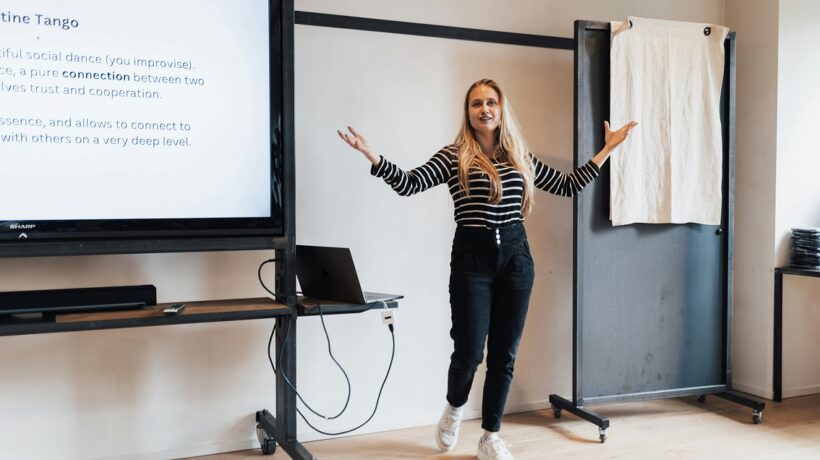
Let’s forget about the traditional model of “training”, where the expert speaks and the rest listens. To break through resistance and build engagement, we need to design a dynamic, workshop experience. The following detailed training plan for AI teachers, divided into modules, is a structure that guides participants through a logical and emotional journey.
Module I (Introductory): “A New Horizon, Not Another Storm” (Time: 30-40 minutes)
Goal: To change the perspective from “duty” to “opportunity”. Building a sense of psychological security.
- Opening (10 minutes): Emotion Validation and Vision. The leader (director or leader) starts with full empathy. “Good morning. I know that when we hear about artificial intelligence, a lot of questions and concerns arise in our heads. And this is completely normal. We are not here to add to your work. On the contrary. We’re here to discover together a tool that can make a meaningful difference to it and allow us to focus on what we love most about our work.” Next, we present a vision: not technological, but pedagogical. “Our goal is not to ‘implement AI.’ Our goal is to increase student engagement, better individualize work and regain time to build relationships.”
- “Wow-Effect” presentation (20 minutes): A demonstration of strength and utility. It must be a carefully crafted, dynamic presentation about ai for teachers, with a live demonstration at its core. The key is to show solutions to the most pressing problems.
Problem 1: Lack of time. Live Show: Generate a quiz with an answer key. “Let’s imagine a Tuesday evening, we are tired, and tomorrow we need a photosynthesis test. Let’s see…” Prompt: “Create a test for grade 7 in photosynthesis, containing 5 closed-ended questions, 3 open-ended and one problem task. Include an answer key with example, correct answers to open-ended questions.” The reaction “Oh my God, how much time does this save!” is priceless.
Problem 2: Difficulties in Communication with Parents. Live Show: “We need to write a descriptive behavioural assessment for a student who has trouble concentrating but is very empathetic. It’s difficult and time-consuming. Let’s see…” Prompt: “Write a short, professional and kind journal comment for the parents of a student who has difficulty maintaining attention in class but is very helpful to colleagues. Highlight their strengths and suggest an area to work with using positive language.”
Summary of Module I (5-10 minutes): Redefining the role. We end this section with a new definition of teacher. “As you can see, AI is a brilliant assistant in repetitive tasks. But he can’t inspire, he can’t look a student in the eye and say ‘I believe in you’, he can’t lead a difficult conversation. And that’s what we want to regain time for. Our role becomes even more human and irreplaceable.”
Module II “Practice makes perfect” (Duration: 60-75 minutes)
Goal: To build a sense of competence and agency. Everyone has to come out with the conviction “I can use it!”.
- Briefing (10 minutes): “One tool, one task” principle. Let’s not overwhelm with a multitude of applications. Let’s focus on one, simplest tool (e.g. the free version of ChatGPT or Gemini) and one, universal type of task – generating teaching materials. Let’s explain the absolute basics: how to log in, where the dialog box is.
- Work in Subject Teams (40-50 minutes): The Power of Context. This is the key to the success of these workshops with ai for education. We divide participants into small subject or block groups (humanists, scientists, professionals). Each group receives a worksheet with tasks tailored perfectly to their needs. They need to feel that this tool solves THEIR problems.
Humanist Group: “Create a plan for a debate in a WOS lesson on ‘Do social media connect or divide more?’. AI is supposed to prepare arguments for both sides.”
A group of scientists: “Generate a physics task on the principle of conservation of energy, in which the hero will be a character from a popular computer game. Include a detailed step-by-step solution.”
A group of professionals (e.g. catering): “Create a checklist for the cook’s workplace control before starting a shift, in accordance with HACCP rules.” - Presentation and Sharing of Discoveries (10-15 minutes): Each group presents in 2 minutes what they have managed to create. This builds energy, shows a variety of applications and strengthens the sense of shared success.
Module III (Strategy): “From Today to Tomorrow” (Time: 20-30 minutes)
Objective: To transform a one-time impulse into a permanent process of change and establish a common framework for action.
- Joint elaboration of the “School Decalogue of AI” (15 minutes): On the basis of a previously prepared project, the moderator leads a short discussion: “What principles should guide us? What do we expect from ourselves and from students?” Jointly establishing a few key principles (e.g. “We are transparent”, “We verify information”, “We cite sources”) builds a sense of responsibility and co-ownership for the process of implementing AI in school.
- Creating a Roadmap (10 minutes): This cannot be the end. The director or leader presents a specific, realistic plan for the coming months: “Our training is the beginning. Next month, we invite you to a voluntary ’15-minute coffee with AI’, where we will share prompts. Next semester, we will appoint a team of innovation leaders. And in six months we will meet again to summarize our experience.” This shows that the teacher’s professional development in this area is a priority, not a one-off “firework”.
Training as an investment, a guide as a lever
Conducting such a training is more than just passing on knowledge. It is conscious change management that builds teachers’ digital competences, reduces anxiety and creates a foundation for an authentic culture of innovation. It’s a process that transforms skeptics into enthusiasts and individual enthusiasts into a close-knit team. The enormous advantages in work and teaching that AI offers only become real when the entire staff feels equipped, motivated, and supported.
Preparing and carrying out such a process from scratch is a monumental task. It requires not only deep knowledge of AI, but also coaching, psychological and leadership competencies. It requires the preparation of dozens of materials – from presentations, through worksheets, to strategic documents.
That’s why my guide was created. “Artificial Intelligence for Schools and Teachers” is not simply a book to read. It’s a complete, ready-to-use AI guide for education that acts as a professional toolkit for the principal and leader.
You don’t have to reinvent the wheel. Take advantage of ready-made, proven solutions and focus your energy on what matters most – inspiring and leading your team towards the education of the future. Invest in tools that will make the transformation process not only effective, but also exciting for the entire school community.
How to tailor your message to different audiences
Effective training of the pedagogical council with AI cannot treat all teachers equally. In the teachers’ room, we are dealing with a whole spectrum of attitudes and competencies: from digital enthusiasts who have been experimenting with new technologies for a long time, to avowed skeptics who struggle to operate basic software. Therefore, the key to success is the intelligent differentiation of the message and workshop tasks. Instead of a single, monolithic block, it is worth creating several paths during the practical part. For the beginner group, the main goal will be to break the psychological barrier – to follow the first, simple command and see the result, which builds a sense of agency. The intermediate group can work on more complex, multi-step prompts that automate the preparation of entire lesson units. On the other hand, for digital leaders, a strategic task can be challenging, e.g. developing a proposal for an interdisciplinary project using AI or testing a more niche, specialized tool. This approach not only increases the effectiveness of the training, but also sends an important message: we respect your individual development path and provide support adequate to your needs. It is the methodology of designing differentiated development paths for staff that is one of the key elements of advanced innovation management in school, and ready-made scenarios for different levels of advancement are a valuable resource that makes this task much easier.
Measuring the effectiveness of training and building feedback
Every developmental activity at school should be subject to evaluation. Just “conducting” the training is only half the battle. It is crucial to check whether it has brought about a real change in teachers’ attitudes and practices. Implementing a simple but regular feedback loop is essential to ensure that the transformation process is not a one-time event, but a continuous process of improvement. Immediately after the training, it is worth conducting a short, anonymous online survey, asking not only about the evaluation of the meeting itself, but above all about what are the biggest concerns after the workshop and what further support teachers need. More importantly, after a month or two, a second survey or short meetings in subject teams should be carried out to gather the first experiences. Questions such as: “In what one task did AI really save you time in the last month?” or “What challenge in using AI did you encounter in your lessons?” provide invaluable information. This data allows management and innovation leaders to precisely plan further actions – organize short thematic workshops, create a database of answers to the most common problems or identify teachers who need additional, individual support. This data-driven approach to managing teacher professional development shows that the school takes the implementation process seriously and responds dynamically to the needs of its team.
The Director’s role as the “Main User”
In the process of implementing AI in schools, the role of the principal goes far beyond just organizing training. The leader of the institution must become its most visible and authentic advocate, modeling the desired attitudes and behaviors. If the headteacher shows on a daily basis how he uses AI to improve his work – for example, by generating an outline of the agenda of the pedagogical council, creating professional messages for parents, or analyzing data from exams – his message will become many times more credible. During the weekly email to the teaching staff, he can regularly share his “prompt of the week”, showing simple but effective applications that he has discovered himself. Such an attitude of a leader-practitioner who is not afraid to admit his own trials and mistakes is extremely inspiring. It builds an organizational culture in which experimentation is the norm and sharing knowledge is a natural reflex. A principal who actively uses the tools he teaches sends the strongest possible signal: “This is important, it works, and we are in this together.” It is practical tips on how an educational leader can use AI to strengthen their leadership and management that is devoted to a separate, strategic segment in the guide, because real change always starts at the top.