


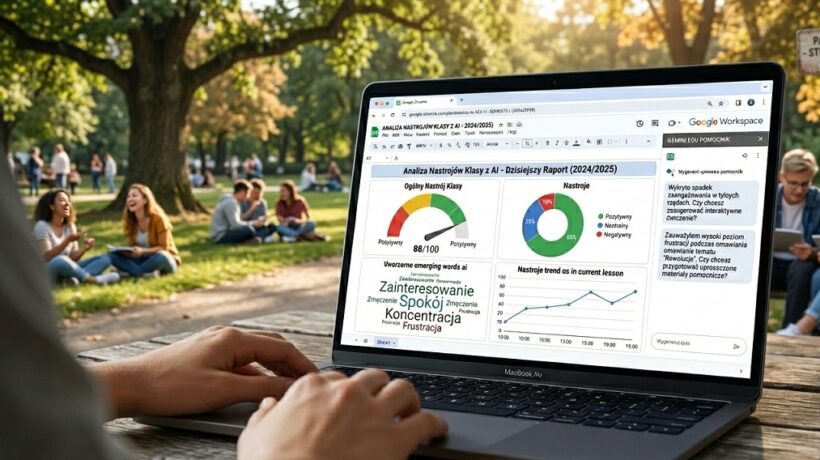
Classroom mood analysis with AI: how to support student wellbeing
There is a pedagogical council. Analysis of results, discussions, fatigue on everyone’s faces. Suddenly, the headmaster brings up the topic of your educational class. And then a sentence from the mouth of a pedagogue comes out that freezes your blood: “Ali’s mother is very worried. She says that something bad has been happening in the classroom for months, there is some silent violence, exclusion. Ala is afraid to go to school. You didn’t notice anything?”
Silence. Everyone is looking at you. And you feel a hot wave of shame and helplessness flooding your cheeks. After all, I talked to them. I asked if everything was okay. No one said anything. You looked at them every day, but you didn’t see what was most important. This moment, this feeling of failure, is one of the hardest in our profession.
How much more of your energy do you have to devote to fighting this wall of silence to no avail? How many more times do you have to feel that sting of helplessness when you find out about the problem when it’s already a giant, festering ulcer?
I was there too. I conducted countless educational hours, made questionnaires that were filled out for a detachment, organized integration. And then a bomb exploded anyway, which I had no idea existed. In an act of desperation, after one of these failures, I thought: What if they want to speak but are afraid to do it directly? What if their true thoughts and feelings are hidden in their everyday words, in anonymous comments, in what they do NOT say? And then it dawned on me. I don’t need another survey. I need a tool that can listen to silence.
In this article, I will not give you another theory about communication. I’ll give you a proven, 5-step game plan. After reading it, you’ll know exactly how to become an educator who sees beneath the surface, nips problems in the bud, and builds authentic relationships, turning the classroom into a safe, supportive community.
Why You Can’t Afford to Ignore It
- Classroom mood analysis with AI: how to support student wellbeing
- Why You Can't Afford to Ignore It
- Your "Classroom Sentiment Barometer" step by step
- Where 90% of teachers make a mistake
- A Story of Transformation No. 2: Mr. Tomasz and the Rebellious High School Graduates
- AI Tools for the Teacher
- Your Transformation Map
- The Art of Reading "Negative Space" – What Do Students NOT Say?
- Long-Term Trend Analysis – From Response to Forecasting
- The Limits of the Tool and Your Irreplaceable Role – When AI Says "Stop"
- The Effect of Group Therapy – How the Process Itself Affects the Classroom
September 20, 2026
You might think it’s just another whim. That your intuition is enough. Let me tell you straight: in today’s world, full of hidden tensions and digital dramas, intuition alone is not enough. Ignoring this topic is not a time-saver. It’s a ticking bomb.
- Regaining Joy: Every crisis, every “bomb” in the classroom, drains you of energy for weeks. Putting out fires is not teaching. When you start preventing rather than just reacting, you will suddenly regain space for what you love: for real interaction, for jokes, for authentic conversations, for smiling.
- Domino effect: A class in which there is an unresolved, hidden fear is a class that cannot learn. This is a class that generates discipline problems in every subject. By disarming tensions at the source, you don’t just save your parenting hour. You improve the atmosphere throughout the school. Your work becomes a gift to other teachers.
- Your calmness: You know that feeling when you are lying in bed and analyzing the strange behavior of some student? That anxiety that you take home with you? This method gives you a tool to turn that anxiety into data and then into action. It gives you a sense of control based on knowledge, not guesswork. And this is the foundation of a restful sleep.
The real cost of omission? Sunday Night Syndrome. This growing fear of going to work because you don’t know what will explode this time. It’s a slow drip of acid on your passion, which makes it less and less every year. This is not dramatizing. This is a scenario I’ve seen too many times. You can change it.
Your “Classroom Sentiment Barometer” step by step
This is your recipe for building a teacher’s sixth sense. A simple, repetitive system that will take you 15 minutes a week.
Psychological safety is key. Students must be 100% sure that they can write honestly, without consequences.
Create a simple Google Form. Two or three open questions, nothing more.
The questions must be simple and open-ended, e.g.:
- “How would you describe the atmosphere in our classroom this week?”
- “What was the coolest thing that happened at school this week?”
- “What was the hardest thing or what worried you?”
Introduce this as a weekly 5-minute ritual. Friday, the last 5 minutes of the lesson. Make it as normal as checking attendance. Put the link to the form permanently in your Teams group or in your diary. The more regular they are, the more natural and honest the answers become.
You already have the data – dozens of anonymous answers. Manual analysis would take ages. You can do it in 2 minutes.
- Open the answer sheet in Google Forms.
- Copy the entire column of answers to one question (e.g., all answers to “What worried you?”).
- Go to the Microsoft Copilot or ChatGPT website.
Don’t paste data with the question “What do you think?”. You have to be precise. Use the template below.
Copy-paste template:
You are an experienced school psychologist and data analyst. Below is a collection of anonymous statements from students [wpisz z jakiej klasy, np. liceum] to the question: “[wklej pytanie z ankiety]“.
[Wklej tutaj skopiowane odpowiedzi uczniów]
Your task is to analyze this data and answer 3 questions:
- Main topics: What are the 3-4 most recurring themes or problems in these statements? List them in points.
- Emotion analysis: What is the dominant mood in these answers? Identify key emotions (e.g., anxiety, frustration, joy, indifference).
- Red flags: Is there anything in this data that should be of particular concern to the educator? Identify specific (anonymized) phrases that may indicate a hidden conflict, a problem of exclusion or silent violence.
The AI has given you a map. It showed flashes. Now it’s your role. Don’t panic. Act subtly.
- AI pointed to the fear of the upcoming chemistry test? In the next educational lesson, do a 15-minute mini-workshop on how to learn instead of doing a talk.
- Have there been any signals about excluding someone in social media? Don’t do a public investigation. Start the lesson with a general discussion about online hate, using an example from the life of a celebrity.
- Fatigue is the dominant emotion? Let go in one lesson and do something looser.
Your intervention is meant to be a response to a group pattern, not a hunt for individual “guilty parties.” In a week, you repeat the process. You look to see if the new data differs from the old one. Did your intervention have an effect? Has the fear of chemotherapy decreased? Have new topics appeared? Think of it as your classroom’s control panel.
Where 90% of teachers make a mistake
History of Transformation No. 1: Mrs. Ania and “Silent” 5b
- Before: Ms. Anna’s class seemed perfect. Calm, polite, no problems. But there was tension in the air. Mrs. Ania felt that something was wrong, but she could not name it.
- Po: The first “Barometer” showed that the dominant emotion was the fear of being judged and making mistakes. The children were afraid to report. Ania’s intervention was the introduction of the “Thursdays with a Precious Mistake” rule, where they celebrated the most interesting mistake of the week and learned from it. The result? After a month, the number of students applying for answers had tripled. And the class started laughing.
A Story of Transformation No. 2: Mr. Tomasz and the Rebellious High School Graduates
- Before: Mr. Tomasz’s class was cynical and blasphemy. Every attempt to talk ended with a shrug of the shoulders.
- After: Mr. Tomasz introduced an anonymous Barometer. AI identified that the main problem was not the high school diploma at all, but the feeling of lack of meaning and the question “Why do I need this school?”. Instead of another lesson about exam stress, he invited a graduate to the lesson, who told what “life after school” looks like. The result? Average class attendance in the last semester increased by 12%. More importantly, several students stayed after class for the first time to ask about his own career path.
“Witch Hunt” trap: You try at all costs to find out “who wrote it”.
Antidote: From the beginning, you have been clear about trends, not individuals. We analyze the health of the entire class, not look for the guilty.” Anonymity is sacred. Breaking it is the end of trust.
The trap “Public Dirt Laundry”: During the educational lesson you say: “My survey shows that you have a problem with Kasia…”.
Antidote: Never refer directly to survey results! Act on the conclusions, but present them as your own observations or universal themes. Your knowledge is your secret weapon.
The “Irregularity” trap: You do a survey once every two months.
Antidote: The strength of this method lies in regularity. A short, weekly pulse is much better than a long test once a quarter. Write it into your calendar like holiness.
AI Tools for the Teacher
- Google Forms (https://forms.google.com) Best for: Collect 100% anonymous, open-ended responses. Your foundation.
- Microsoft Copilot (https://copilot.microsoft.com) Best for: Log-free data analytics, with access to the latest language models. Your analyst.
- Mentimeter (https://www.mentimeter.com) Best for: Quick, anonymous live “pulse-checks” during lessons (e.g. word cloud). Your handheld probe.
Your Transformation Map
This is not a chapter about technology. This is a chapter about a change of perspective. For this method to work, you need three fundamental changes in your thinking:
- From being a firefighter to being a gardener: You stop putting out fires. You start to regularly nurture the soil in your classroom so that nothing toxic has a chance to grow.
- From speaking to listening: You accept that the most valuable information will not be given in a loud discussion, but in quiet, anonymous honesty. Your job is to create a channel for this whisper.
- From guesswork to knowledge: Instead of basing your actions on intuition, you base them on real, albeit anonymous, data. You become an evidence-based educator.
Day 1: I’m going to create a simple Google Form with three open-ended questions.
Day 2-4: I will inform the class about the new weekly ritual, guaranteeing 100% anonymity.
Day 5 (Friday): I will take the first 5-minute “measurement” at the end of the lesson.
Day 6-7 (weekend): I’ll take 10 minutes to analyze the results with AI and save one conclusion for the coming week.
Let’s talk honestly. This method is not just a clever educational trick. It’s something much bigger. In a world that rarely asks young people, “How do you really feel?”, you create a space where this question is asked every week.
By teaching them how to articulate their concerns and needs in a safe way, you’re not just solving problems in the classroom. You give them a tool for life. You model a culture of dialogue and empathy. You show them that their inner world matters.
Twenty years from now, your students won’t remember the topics of the lessons. But they may remember the feeling of being seen in your class. That there was an adult who could listen even when they themselves were afraid to speak. And this is the true legacy of the teacher-mentor. This is your big “WHY”.
You have already mastered the technique. You know how to collect data, how to analyze it, and how to intervene. Congratulations. Now it’s time to put the tools aside and talk about what’s going on around them. Because your Class Barometer is not a thermometer stuck in a sick body. It is a seismograph that records the tremors of the entire school ecosystem.
The Art of Reading “Negative Space” – What Do Students NOT Say?
One of the most advanced skills is analyzing what doesn’t appear in the data. Sometimes the biggest problems are hidden in the deafening silence on a given topic.
- Silence scenario: You enter the Barometer. Week after week, standard things appear in the answers to the question “What worries you?”: tests, getting up early, arguing with a colleague. But there is not a word about one problem you know – for example, about the fact that there is a student with a very difficult home situation in the class. No one mentions him.
- What does this mean? Such a “negative space” is a powerful signal. It can mean one of two things. Or the problem is such a big taboo that students are afraid to even touch it in an anonymous survey. Or, more likely, they built a protective umbrella around that student and made an unwritten, collective decision to protect his privacy. Silence is not ignorance. It can be a form of mature empathy.
How to act? Don’t try to break through that wall. Your job is to see it and respect it. You can bring up the general topic of discretion and support in the lesson, saying: “Sometimes the greatest help for someone is not asking questions and being next to them.” Students will understand that you see and appreciate their attitude.
Long-Term Trend Analysis – From Response to Forecasting
After a few months of collecting data regularly, your answer sheet becomes something extraordinary – an ECG line of your class’s emotional health. Now you can move from weekly analysis to observing trends.
- What to observe? Open your AI analytics notes from the last 2-3 months. Look for patterns. Do the moods in the classroom drop cyclically before the end of the semester? Is there the same problem with reintegration after every holiday? Does a particular month (e.g. gloomy November) always correlate with an increase in statements about fatigue and lack of motivation?
- How to act? You start forecasting. If you know that November is difficult, you plan in your semester worksheet (remember it?) that this is when you will organize a looser project week or an integration outing. If you see that stress always increases in the third week of September, you are planning a workshop on dealing with pressure for that time.
You stop being just a diagnostician. You become a strategist who not only sees what is now, but also predicts what will happen in a month and builds support mechanisms in advance. This is an absolutely masterful level of educational work.
The Limits of the Tool and Your Irreplaceable Role – When AI Says “Stop”
This is a thread about humility. AI is a brilliant analyst, but it has its fundamental limitations. Your job is to know where they lie.
- AI does not understand subtle sarcasm and irony. He may interpret a joking remark about “wanting to commit suicide before the math exam” as a real red flag, triggering an unnecessary alarm. Conversely, he may overlook a very subtly camouflaged, but deadly serious plea for help.
- AI does not know the individual context. She doesn’t know that Ania writes about sadness because her hamster has just died, and Kasia writes about sadness because she is experiencing deep depression. For the machine, it’s the same “emotional signal.”
- AI analyzes words, not body language. He does not see tears in the eyes of the student when he writes a casual “everything is ok” into the form.
Your irreplaceable role: The AI barometer and analysis are your early warning system. They give you a map, show you where it can burn in the forest. But it is you, with your human intuition, your ability to talk one-on-one, and the knowledge of your students, that you have to go to that place and see if it’s a small fire or a fire. The technology indicates “CO”. Only you can discover the “WHY” and help “HOW”. The tool will never relieve you of the obligation to be an attentive, empathetic person. It is supposed to give you a signal where to direct this mindfulness in the first place.
The Effect of Group Therapy – How the Process Itself Affects the Classroom
The greatest magic of this method is often not the conclusions you draw, but the very fact of its existence. Regular, anonymous “pouring” of thoughts out of oneself has a powerful, therapeutic potential for the whole group.
- Normalization of feelings: When a student writes that he is afraid of a test, he feels alone with his fear. But when you, based on analysis, bring up the general topic of stress on the forum, he suddenly discovers that half of the class feels the same way. His problem becomes a shared experience, not a personal failure. This greatly reduces the feeling of isolation.
- Shaping metacompetence: The very process of regularly asking yourself “What am I feeling and why?” is an invaluable training in emotional intelligence. You teach your students, without saying it directly, the most important skill in life: self-reflection.
After a while, you will notice that their answers become more and more mature and precise. They begin to understand themselves better. And this is a gift that will stay with them forever, long after they forget the delta pattern. This is the hidden, deeper “WHY” of your work.